Reading a contract isn't about just giving it a quick once-over. It's about having a game plan. You need to know how to pinpoint your key responsibilities, spot the potential landmines, and fully grasp your rights before you even think about signing. The best way to tackle it is by breaking it down and zooming in on the big-ticket items like payment terms, scope of work, and termination clauses.
Why Reading Contracts Is Your Best Defense
Let's be real: legal documents can be a total headache. Staring at pages of dense fine print, the urge to just skim and sign is powerful. It’s a habit that's more common than you'd think—a recent study found that a staggering 68% of people either don't read or don't really get the contracts they sign for everyday services. You can dig into these findings on contract literacy over at The University of Law.

This tendency to gloss over the details can blow up in your face. One little overlooked clause can spiral a simple agreement into a messy, expensive dispute.
The Real Cost of a Quick Glance
Think about a freelance graphic designer who just landed a project with an exciting new startup. She's eager to get started, so she signs the contract quickly, barely noticing a small line about "unlimited revisions." The project scope they discussed was clear: three rounds of feedback.
Fast forward a few weeks. The client is now demanding their tenth round of major changes, pointing right back to that unlimited revisions clause. The designer is trapped in a loop of unpaid work, all because she missed a single line in the agreement. This kind of story plays out all the time and highlights a crucial truth: a contract isn't just a formality; it’s the official rulebook for your entire professional relationship.
Viewing a contract as your first line of defense, rather than a final hurdle, fundamentally changes how you approach it. It becomes a tool for clarity and protection, not a chore to be rushed.
Making that mental shift is the very first step toward reviewing contracts effectively. Instead of feeling overwhelmed, you start to see it as your chance to get everyone on the same page and lock in your own interests from day one. This proactive mindset is a huge part of smart contract risk management.
Your Contract Review Prep Checklist
Before you even lay eyes on the first paragraph, a little prep work can make the whole process go a lot smoother. Getting organized helps you approach the document with a clear head and a solid purpose.
Get organized before you dive in. Following these steps will make your review process smoother and more effective.
Action Step Why It Matters Set Aside Dedicated Time Rushing leads to mistakes. Block out distraction-free time on your calendar to focus solely on the document. Gather All Related Documents Collect any emails, proposals, or notes that outline what was verbally agreed upon. Have a Pen and Highlighter Ready Mark up the document. Highlight confusing language, underline key dates, and write questions in the margins. Know Your Non-Negotiables Before reading, list your absolute must-haves and deal-breakers (e.g., payment schedule, ownership of work).
This simple checklist sets the stage for a focused review, ensuring you don't miss the details that matter most.
Understanding the Anatomy of a Contract
Every contract, from a simple freelance agreement to a monster corporate deal, follows a similar blueprint. Getting a handle on these core components is the first step to reading any contract without that feeling of dread. Think of it as a roadmap; once you know the landmarks, navigating the document becomes much less intimidating.

Let's use a real-world example most people can relate to: hiring a wedding photographer. This simple agreement has the same fundamental building blocks you'll find in much bigger, more complex documents. We'll walk through these sections one by one.
The Parties and the Preamble
Right at the top, you'll see the Parties section. This just identifies everyone involved in the agreement. It might seem obvious, but I've seen huge problems crop up from mistakes right here.
Make sure the legal names are spelled correctly and that the right business entity is listed. For example, is it "Jane Doe Photography" or "Jane Doe Photography, LLC"? That little detail matters immensely if a dispute ever pops up.
After the parties, you’ll often find a preamble or "recitals" section. It usually starts with "WHEREAS..." and basically sets the stage. It’s the background story of the agreement—why you're all here. For our example, it would simply state that the client wants to hire the photographer for their wedding.
Scope of Services and Deliverables
This is arguably the most critical part of the whole contract. The Scope of Services defines exactly what one party will do for the other. Vagueness here is a massive red flag that just invites misunderstandings and that dreaded "scope creep."
For our wedding photographer, this section needs to be incredibly specific.
- Hours of Coverage: Are they on the clock for 8 hours or 10? Does this include travel time?
- Number of Photographers: Are you getting one photographer or a team with a second shooter?
- Specific Events Covered: Does the fee cover the rehearsal dinner, or just the main ceremony and reception?
- Final Deliverables: How many edited photos will you receive? Will they be high-resolution digital files, a physical album, or both?
A well-defined scope of services protects both sides. The client knows exactly what they're paying for, and the provider is shielded from endless requests for work that was never part of the deal.
If the scope isn't crystal clear, now is the time to push for more detail. Don’t ever assume anything that isn’t written down in black and white.
Payment Terms and Schedule
This section maps out the money: how much, when, and how it will be paid. I can't tell you how many relationships sour because these terms weren't understood. It can easily lead to friction and even legal action.
Look for a clear breakdown:
- Total Cost: The full, all-in amount for the services described.
- Payment Schedule: Is there a deposit or retainer? When is the final balance due—before the wedding, on the day itself, or 30 days after the photos are delivered?
- Accepted Payment Methods: Do they take credit cards, bank transfers, or good old-fashioned checks?
- Late Fees: What happens if a payment is late? The contract should spell out any penalties.
A very common structure is a 50% non-refundable retainer to book the date and the remaining 50% due 30 days before the event. Make sure you're comfortable with these terms before you put your signature on that line.
Term and Termination
Finally, every contract needs a beginning and an end. The Term defines the lifespan of the agreement. For our photographer, the term might start on the day the contract is signed and officially end once the final photos are delivered and accepted.
The Termination clause is just as important. Think of it as your escape hatch. It explains how either party can legally end the relationship. What happens if the wedding is canceled? Can the photographer back out for some reason? This section should clearly state the conditions for cancellation, any notice periods required, and what happens to any money already paid. Make sure you understand exactly how it works.
How to Spot Critical Clauses and Red Flags
Alright, now that you’ve got the basic layout of a contract down, it’s time to zoom in on the parts that carry the most weight—and the most risk. These clauses are often buried in dense legal language, but this is where the real action is. Think of it as learning to spot the warning signs before you get stuck in a bad deal.
Let's say you're hiring a web developer. The main agreement looks pretty straightforward, but a few key clauses tucked away inside could completely change the entire project.
Decoding the High-Stakes Clauses
Some clauses aren't just boilerplate; they are the contract's teeth. They have the power to create huge financial or legal headaches down the road. Missing the nuance here is a classic, costly mistake.
Here are three of the most common ones you absolutely need to watch for:
- Indemnification: This is a big one. In plain English, it means one person agrees to cover the other's losses if something goes wrong. In our web developer example, an indemnification clause might force you to pay their legal fees if they get sued for using an image you provided for the website. You have to be crystal clear about who is protecting whom, and for what.
- Limitation of Liability: This clause puts a ceiling on how much money a party has to pay if they mess up and breach the contract. If your developer slips this in, they might limit their liability to the total amount you’ve paid them—even if their mistake ends up costing your business way more in lost sales or damages.
- Confidentiality: This part of the contract dictates how sensitive information gets handled. It’s vital to make sure it protects your trade secrets and clearly states how long the other party is obligated to keep things under wraps. For a deeper dive, check out these helpful contract clause examples.
This photo-realistic image illustrates how a focused risk assessment, complete with a checklist, is central to a thorough contract review.
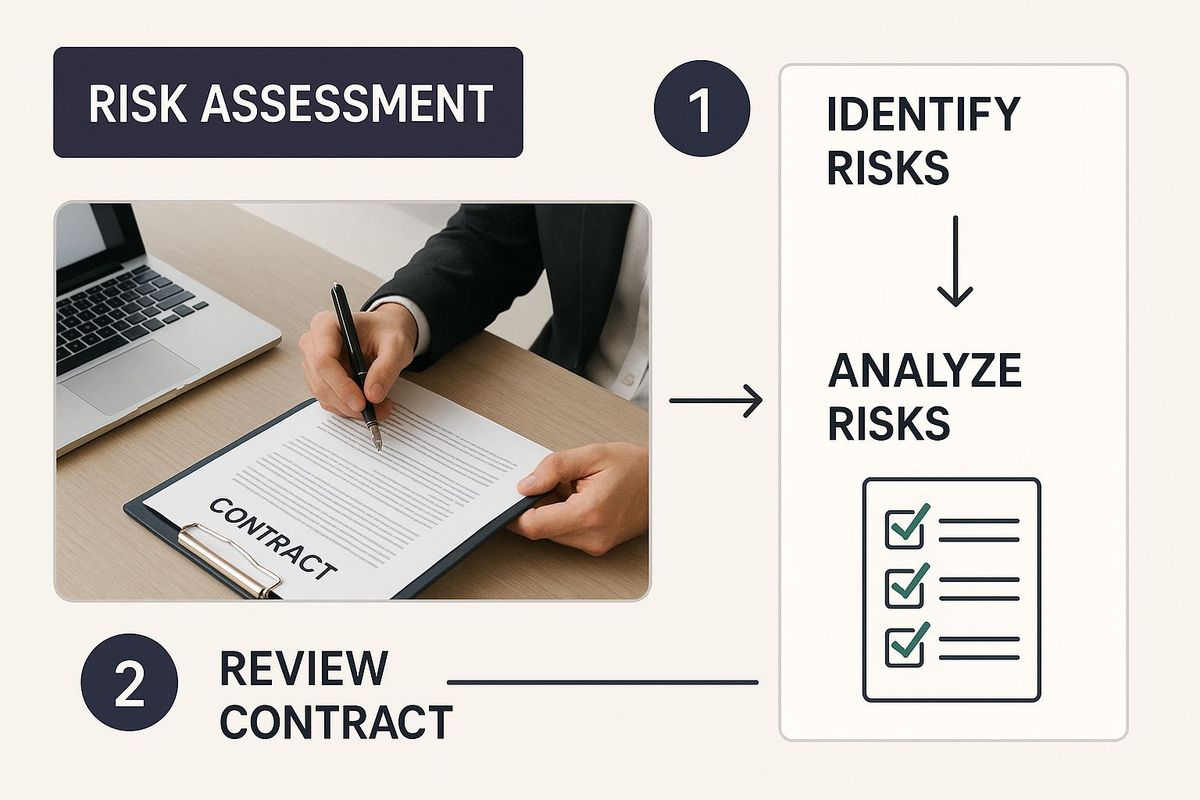
The image really drives home the point: a systematic approach is your best friend for catching potential landmines before they blow up.
Common Red Flags to Never Ignore
Beyond the specific clauses, certain general red flags should always make you hit the brakes. They often signal a lopsided agreement or set the stage for future arguments. If you want some help spotting these issues, you might try using an AI Legal Contract Analyzer.
A contract should be a balanced document that reflects a fair agreement for both parties. If it feels heavily skewed in one direction, that's your cue to slow down and ask questions.
Here are some tell-tale signs of a problematic contract:
- Vague Language: Watch out for fuzzy terms like "reasonable efforts" or "as soon as possible." These are subjective and a recipe for disagreement. Always push for specifics, like "within 10 business days."
- Unilateral (One-Sided) Terms: Does the contract give one person all the power, like the right to change terms or cancel anytime, while the other person is locked in? That imbalance is a major red flag.
- Automatic Renewal Clauses: Be very wary of "evergreen" clauses. These automatically renew the contract unless you give notice to cancel, often months in advance. They’re designed to lock you into services you might not want or need anymore.
Failing to spot these issues has a real financial cost. In fact, poor contract management leads to an average of 8.6% value erosion for companies. That’s a direct hit to your bottom line, all because of what's hiding in the fine print.
Navigating Contracts Across Borders
Working with someone in another country opens up some incredible opportunities, but it also throws a few curveballs into your agreements. When your business partner is an ocean away, you can't just assume your local laws will apply if things go south. This is where international contracts need a much closer look.
Suddenly, two clauses that might seem like boring legal jargon become the most important parts of the entire document: Governing Law and Jurisdiction. Mess these up, and you could find yourself in a ridiculously expensive and complicated legal battle in a foreign country. Trust me, it's a nightmare scenario you want to avoid at all costs.
The Two Pillars of International Agreements
Let's put this into a real-world context. Imagine you're a US-based consultant working for a client in the UK. What happens if they just decide not to pay you?
- Governing Law: This clause decides which country's laws are used to figure out who's right and who's wrong. Will it be the laws of New York or the laws of England and Wales? The legal systems can be worlds apart, so this choice has a huge impact on your rights and the outcome.
- Jurisdiction: This clause determines where any lawsuit will actually happen. Will you have to book a flight to a London courthouse, or can you handle it from your local court? The cost and headache of fighting a legal battle abroad are massive.
These clauses are absolutely critical when you're figuring out how to read a contract with global partners. They set the rulebook and the home field for any potential disputes, giving you some predictability in an otherwise complex situation.
When you get an international contract, the very first thing you should do is find the Governing Law and Jurisdiction clauses. These terms will shape the entire landscape of a potential dispute, and here's the good news: they are almost always up for negotiation.
International deals are everywhere these days. In fact, they make up as much as 30% of all global commercial contracts, and it's become common for businesses to strategically choose foreign laws to govern their agreements. This just goes to show how vital these decisions are. You can get a deeper dive into these legal strategies from research published by Northwestern University.
The best-case scenario for you is always to have both the governing law and jurisdiction set to your home state or country. It gives you the most protection and is obviously the most convenient. But this is a common sticking point in negotiations. If the other party is digging in their heels for their own location, that’s a major risk you need to think through. Don't be afraid to suggest a compromise, like a neutral third-party location—think of a major international arbitration center in a place like Singapore or Switzerland.
How to Negotiate Changes with Confidence
Finding a clause you don’t like in a contract doesn’t mean the deal is dead. Far from it. The best contracts are conversations, not commands. Negotiation is a totally normal, expected part of finalizing any agreement, and it’s your chance to shape a one-sided document into a fair partnership.
Think of it this way: the first draft you receive is just the other party's wish list. It’s their version of a perfect world. Your job is to bring it back to reality by proposing changes that protect your interests, creating an agreement that works for everyone. The key is to approach it collaboratively, not combatively.
Frame Your Requests the Right Way
How you ask for a change is just as important as what you’re asking for. Instead of just pointing out what’s wrong (“I don’t like this clause”), you need to frame your request as a solution. This shifts the dynamic from a confrontation to a problem-solving session.
Let’s say a client’s contract has a “net 60” payment term, meaning they want to pay you in 60 days. If your standard is net 30, don’t just demand they change it. Explain your position professionally and propose the alternative.
Pro Tip: Vague feedback gets you nowhere. Instead of saying "the deadline is too tight," propose a specific, realistic date. This gives the other side a concrete counter-offer to consider and keeps the conversation moving forward.
When you provide a clear rationale for your requests, you're showing the other party that you’ve actually read and thought through the agreement. It proves you’re serious about finding common ground. For a deeper dive into tactics, our guide on negotiating business contracts is a great resource.
Practical Phrases for Proposing Changes
Knowing how to communicate your requests clearly and professionally is half the battle. Having a few go-to phrases in your back pocket can help you sound confident and cooperative, even when you're pushing back on a key term.
Here are a few email starters you can adapt:
- For Clarification: "I'd like to suggest a small clarification in Section 4 regarding project deliverables to ensure we're aligned on expectations. How about we revise it to read...?"
- For Adjusting a Term: "Regarding the payment terms in Section 6, my standard business practice is net 30. Would you be open to adjusting the timeline to reflect that?"
- For Proposing a Compromise: "I see the non-compete clause in Section 8 is quite broad. To make this work for both of us, I'd like to propose we narrow the geographic scope to the immediate metropolitan area."
Using language like this keeps the tone positive and constructive. It turns a potential conflict into a productive discussion, setting the stage for a solid professional relationship right from the start.
Common Questions About Reviewing Contracts
Even after you've got a handle on the basics, a few tricky questions always seem to pop up during a contract review. Let's tackle some of the most common ones I hear. Think of this as your final check-in before you sign on the dotted line.
When Is It Time to Call a Lawyer?
Look, you can absolutely handle many straightforward agreements on your own. But knowing when to call in a professional isn't about admitting defeat—it's about making a smart, strategic move to protect yourself.
You should always bring in a lawyer for high-stakes agreements. I'm talking about any deal involving:
- Large sums of money or significant financial risk.
- Real estate transactions, whether you're buying, selling, or leasing.
- Business partnerships or sales. These are complex by nature.
- Intellectual property rights, like patents or trademarks.
- Complex employment terms, especially anything with a non-compete clause.
A lawyer is trained to spot the nuanced risks you might easily miss. Trust me, the cost of a legal review is a drop in the bucket compared to the potential cost of a bad contract blowing up on you later.
What Is the Difference Between an Amendment and an Addendum?
These two get mixed up all the time, but they do very different things. Getting them straight is key to understanding how a contract can change after it’s been signed.
An amendment physically changes the original terms of an existing contract. Both sides have to agree to it, and it's often used to do things like alter a deadline, adjust a price, or change the scope of work.
An addendum, on the other hand, adds something new to the original contract without changing the existing text. For example, you might attach an addendum that provides a detailed list of project deliverables that weren't fully fleshed out in the main agreement.
Think of it this way: an amendment edits a chapter that's already written, while an addendum adds a brand new chapter to the end of the book.
Are Online Contract Templates Safe to Use?
Online templates can feel like a quick, cheap fix, but they come with serious risks. They might work as a starting point for extremely simple, low-risk agreements, but they're usually a poor substitute for a properly drafted document.
The biggest problem is that they're generic. A template can't possibly account for the unique details of your situation or comply with specific state or local laws. Using one can leave you dangerously exposed if a dispute comes up.
For anything important, it's always safer to have a legal professional draft or at least review your agreement. That's the only way to ensure it truly protects your interests. And as you start dealing with more contracts, looking into Top Document Management Software can be a lifesaver for keeping everything organized and accessible.
At Cordero Law, we believe a great lawyer empowers you, working alongside you to secure your interests. If you're facing a complex agreement and need a partner to help you navigate it with confidence, visit us at https://www.corderolawgroup.com to see how we can help.