
Before you even think about legal documents or how you’ll split the profits, the real work of building a partnership happens. It happens in the conversations you have before anything is signed. I’ve seen too many entrepreneurs get swept up in the excitement of a new idea and rush this part, only to watch their venture fall apart months later because of a fundamental mismatch.
Think of this initial stage as mapping out the partnership's DNA. Get it right, and the entire structure will be resilient enough to handle the inevitable challenges. The goal isn't just to find someone with skills you lack; it's about finding a partner with a compatible vision and work ethic. A clash in these core areas is far more destructive than any disagreement over marketing copy.
Laying the Groundwork for a Strong Partnership

Aligning on Vision and Values
Every solid partnership is built on a shared destination. You and your potential partner have to agree on the big picture. What's the ultimate goal here? Are you trying to build a rocket ship for a quick, high-multiple sale, or are you crafting a legacy brand meant to last for decades? Neither is right or wrong, but you both need to be on the same page.
Start by asking the tough, open-ended questions that get to the heart of the matter:
- What does success look like to you in five years? This simple question uncovers long-term ambitions and reveals if your timelines are even in the same ballpark.
- What are your non-negotiable business values? This could be anything from radical honesty with clients to maintaining a healthy work-life balance. These values will be the compass for every decision you make together.
- What’s your appetite for risk? If one partner is ready to take out massive loans to scale quickly while the other prefers slow, bootstrapped growth, you’re setting yourselves up for constant friction.
A friend of mine launched a boutique marketing agency with a partner who was a creative genius. But my friend wanted to build a sustainable, client-focused business, while his partner was chasing high-risk, high-reward projects, hoping for a quick acquisition. The partnership didn't even make it to the two-year mark because their visions were fundamentally at odds.
Vetting Your Partner Beyond the Resume
Once you feel aligned on the vision, it's time to get practical. This is where you really dig into how you'll work together day-to-day. You need to assess reliability, communication style, and, most importantly, how they handle pressure.
A person's professional reputation is a great starting point, but you need more than that. If you can, talk to their former colleagues or clients. How do they perform when a deadline is looming and everything is going wrong? Do they deliver on their promises consistently? It’s crucial to understand the business partnership advantages and disadvantages, because a partner's weaknesses can easily become your company’s biggest liability.
A partnership is a lot like a marriage; compatibility in how you handle conflict and stress is far more important than agreeing on everything. The real test isn't when things are going well, but how you navigate the tough times together.
Defining Roles and Responsibilities Early
Finally, you have to resist the "we'll figure it out as we go" mentality. It's a trap. Vaguely defined roles are a guaranteed recipe for duplicated work, missed deadlines, and simmering resentment. Even if it's just the two of you, clarity is king.
Sit down and list every major function of the business—sales, marketing, operations, finance, product development—and assign a primary owner to each one. This doesn't mean the other person can't weigh in, but it establishes who has the final say. Who makes the call on a new hire? Who is ultimately responsible for the budget?
Answering these questions now prevents ugly power struggles down the road. It sets the stage for a partnership that’s efficient, collaborative, and built to last.
Choosing Your Legal and Operational Framework

With a shared vision locked in, it’s time to build the actual scaffolding for your partnership. This is the nuts-and-bolts part where you decide on the legal and operational rules of engagement. These choices will dictate everything from personal liability to how you handle day-to-day decisions.
Think of it as choosing the right blueprint before you start building the house. Choosing your legal entity isn't just a box to check on a form; it has profound, long-lasting implications. It determines how you’re taxed and, critically, where the line is drawn between business assets and your personal assets. A poor choice here can leave you exposed if the business runs into debt or legal trouble.
Selecting the Right Legal Entity
The structure you pick should line up with your risk tolerance, your financial situation, and where you see this business going long-term. There are a few common options, and the right one depends entirely on your specific circumstances.
Let's walk through a simple scenario: a graphic design studio is partnering with a freelance developer to launch a new web app. Both founders want to be actively involved.
General Partnership (GP): This is the default. If you just go into business with someone without filing any paperwork, congratulations, you've formed a General Partnership. Both partners have equal say and are personally on the hook for all business debts—even those the other partner racks up. For our duo, this is the riskiest path. If the developer signs a pricey software contract the business can't afford, the designer’s personal savings could be at risk.
Limited Partnership (LP): An LP has two types of partners. There’s at least one general partner with unlimited liability who runs the show, and one or more limited partners who are basically passive investors. They contribute cash but have limited liability and no say in management. This doesn't fit our designer and developer, since they both want to be in the driver's seat.
Limited Liability Partnership (LLP): Now we're talking. In an LLP, all partners have protection from the business's debts and—this is the key part—from the professional missteps of other partners. If the developer makes a critical coding error that leads to a lawsuit, the designer's personal assets are shielded. For most active partnerships, an LLP strikes a great balance between flexibility and security.
Your legal structure is your first line of defense. Don't default to a General Partnership out of convenience. Taking the time to form an LLP or LLC can save you from financial ruin down the road.
Building Your Operational Playbook
Once you've got the legal entity sorted, you need a plan for how you’ll actually work together day in and day out. This operational framework is just as critical for keeping the peace and running an efficient business. A rock-solid legal structure doesn't mean much if your daily operations are pure chaos.
It's also worth noting that modern partnerships often exist within a bigger network. Businesses today rarely go it alone. They thrive in interconnected ecosystems of technology providers and service partners. Understanding these key partnership strategies at Impartner.com can give you a real competitive edge, letting you combine strengths for a more powerful market offering.
At a minimum, your operational playbook should nail down a few core areas:
Decision-Making Authority: Get specific about who makes the final call. Major strategic moves, like taking on debt, might require a unanimous vote. Minor operational choices, like picking a new software tool, could be handled by a single partner.
Communication Cadence: Don't leave communication to chance. Set up a regular rhythm—maybe daily stand-ups, weekly strategy sessions, and quarterly reviews. Agree on your primary tools (Slack for quick chats, Asana for projects) to keep everyone in sync and avoid frustrating information silos.
Workflows and Processes: Actually document how things get done. For our designer and developer, this means mapping out the entire process from client intake and project kickoff to final delivery and invoicing. Clear, documented workflows prevent bottlenecks and ensure every client gets the same great experience.
Crafting an Ironclad Partnership Agreement
Once you’ve settled on the legal and operational structure, it’s time to get everything down on paper in one of the most important documents you'll ever create: the partnership agreement. I can't stress this enough—don't think of this agreement as a sign of mistrust. It’s the exact opposite. It's an instruction manual for your business relationship, built on clarity and mutual respect.
A handshake deal is a recipe for disaster. Good intentions are great, but they don't hold up when cash flow gets tight or a major disagreement arises. This document is your single best defense against misunderstandings that can lead to costly legal fights and, frankly, destroy friendships. The goal is to leave absolutely nothing up for interpretation.
The image below breaks down the essential pillars of a solid agreement, from defining roles to planning for the what-ifs.
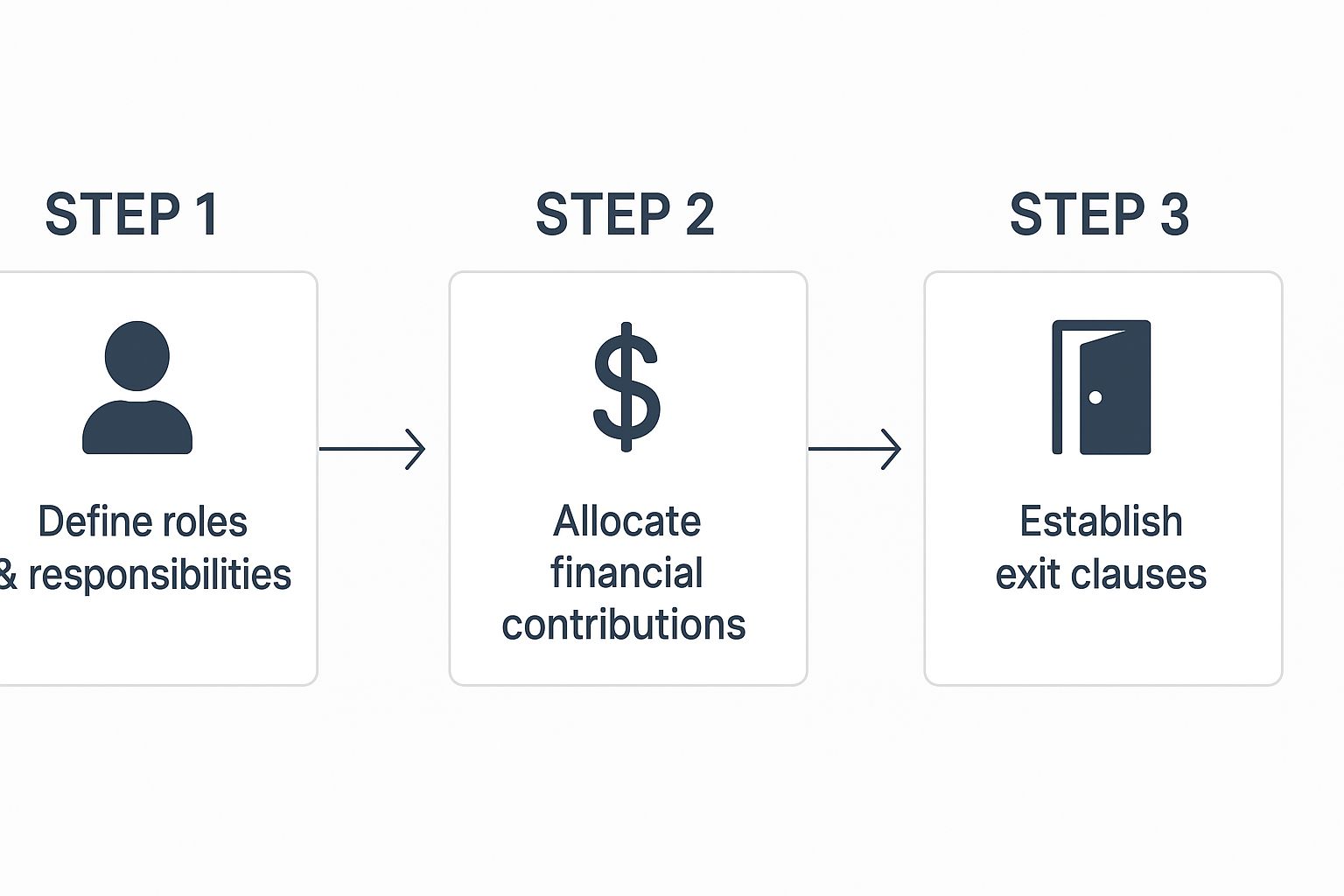
This process lays out the backbone of your agreement: spelling out who does what, how the money is handled, and how you can part ways professionally if the time comes.
Defining Roles and Decision Making Authority
Vagueness is the enemy of a healthy partnership. Your agreement needs to be incredibly specific about each partner's roles, responsibilities, and authority. Who gets the final say on hiring a new developer? Who's in charge of the marketing budget? Who can sign a check for over $5,000? Be granular.
For example, in a tech startup, you might lay it out like this:
- Partner A (The Coder): Holds final authority on the technology stack, product roadmaps, and all engineering hires.
- Partner B (The Networker): Holds final authority on sales contracts, marketing spend, and strategic partnership deals.
Any decision that could fundamentally change the business—like taking on a huge loan or pivoting the entire company—should require a unanimous vote. Putting this in writing prevents one partner from going rogue and making a move that jeopardizes the whole operation. Honing your ability in negotiating business contracts is key here; you're essentially setting the terms for your own working relationship.
Capital Contributions and Financial Distributions
Let's be honest: money is where most partnerships fall apart. Your agreement must be crystal clear on all things financial. Start by documenting exactly what each partner is putting in from day one. And it’s not just cash. We’re talking about equipment, intellectual property, or even a valuable client list. Assign a fair, agreed-upon monetary value to every single non-cash contribution.
Next, hammer out how profits and losses get distributed. A 50/50 split sounds fair, but it isn't always. Maybe one partner is bringing in all the sales. In that case, consider tying distributions to performance metrics. You could also include guaranteed payments, which ensure partners get a base salary even in lean months—a lifesaver in the early days.
Don't just plan for the good times. What happens when you have a bad quarter? Your agreement needs to spell out how losses are shared and if partners are on the hook for more capital to cover a shortfall. It's an uncomfortable conversation now, but it will save you from panic and finger-pointing later.
Dispute Resolution and Exit Clauses
No matter how well you get along, disagreements are inevitable. A good agreement provides a process for resolving them without immediately lawyering up. A great first step is including a clause that requires mediation. This brings in a neutral third party to help you find a solution before the conflict escalates into a full-blown legal battle.
Finally, every partnership agreement needs an exit plan, often called a buy-sell agreement. Think of it as a prenup for your business. It answers all the tough "what if" questions:
- What happens if a partner wants to retire or just walk away?
- What's the plan if a partner becomes disabled or passes away?
- What if one partner isn't pulling their weight and the others want to buy them out?
This clause should pre-define how the business will be valued and the exact terms for buying out a partner's share. It’s not romantic, but it’s incredibly smart. And it’s not just us saying it—proactive planning is a huge business trend. In fact, 43% of middle-market executives are planning to form new strategic partnerships, showing just how vital these clear structures are for growth.
Structuring Finances and Splitting Profits Fairly

Let's cut right to the chase: money is the number one reason partnerships go south. When there's any gray area around finances, you're basically setting the stage for resentment and conflict down the road. If you want this thing to last, you have to hammer out a transparent and fair financial system from day one.
It all starts with meticulously documenting what everyone brings to the table. A simple 50/50 split almost never works in the real world because partners rarely contribute in perfectly equal measure. One person might put up the cash, while another brings critical equipment, a fat client list, or just years of invaluable industry know-how.
Valuing Every Contribution
To get this right, you have to assign a fair, agreed-upon dollar value to every single asset that goes into the business. This isn't just about what's in the bank account; it's about making sure all forms of value get recognized.
Here's how you can start thinking about different types of contributions:
- Cash: This one's easy. It’s valued at its face amount.
- Tangible Assets: For things like computers, machinery, or even office furniture, you need to use the current fair market value, not what was paid for it years ago.
- Intellectual Property (IP): This is your patents, trademarks, or proprietary software. You’ll probably need an independent valuation expert to put a fair number on these assets. They might be intangible, but they can be incredibly valuable.
- Sweat Equity: This is all about compensating for the time and work someone pours into the business. A common approach is to assign an hourly rate or a projected salary for the work being done, which then converts into an equity stake over a set period.
Nailing this down prevents those future "but I did more!" arguments. It puts everything on paper so that everyone’s initial investment—whether it’s cash, gear, or pure hustle—is formally respected.
The smartest partnerships treat their financial agreement like a prenup. It's that upfront, honest conversation about value and expectations that saves the relationship when things inevitably get complicated.
Moving Beyond the 50/50 Profit Split
Once you’ve valued all the initial contributions, you can build a profit distribution model that actually makes sense for how the partnership will run. A classic 50/50 split is simple, sure, but it can quickly kill motivation if one partner is putting in way more ongoing effort than the other.
Think about a more tailored approach. Let’s say you have a real estate partnership. Partner A puts up $100,000 in capital but plans to be mostly hands-off. Partner B only contributes $20,000 but will be the one managing daily operations and grinding out sales full-time. A 50/50 split would start feeling pretty unfair to Partner B in a hurry.
Here are a few more sophisticated models to kick around:
Guaranteed Payments: This gives a partner a fixed, salary-like payment before any remaining profits get divided up. It’s perfect for partners who are giving up a steady paycheck to work in the business, making sure their bills get paid even when things are slow.
Tiered or Performance-Based Splits: You can structure the split to change as the business hits certain goals. For example, maybe profits are split 60/40 in favor of the active partner up to the first $250k in revenue. After that, it shifts to 50/50. This creates a powerful incentive for growth that benefits everyone.
Hybrid Models: Don't be afraid to mix and match. For our real estate duo, a fair structure might give Partner B a guaranteed monthly payment for their operational role. Then, any profits left over could be split 60/40 in favor of Partner A to reflect their much larger capital risk.
When you design a financial system that aligns with each partner’s contribution and ongoing role, you build a structure that feels fair and keeps everyone pulling in the same direction. This kind of financial clarity is the bedrock of a partnership built to last.
Planning Your Partnership Exit Strategy from Day One
It probably sounds a little strange, planning for the end of a partnership right when it’s getting started. But trust me, it’s one of the smartest, most professional moves you can make.
Having a clear exit strategy isn’t about expecting failure; it’s about preparing for the reality that things change. Life happens. Priorities shift. Having a plan ensures that if a partner leaves, it’s handled with respect and fairness, not resentment and a legal battle.
This plan is usually formalized in what’s called a buy-sell agreement. Think of it as a pre-negotiated roadmap for when a partner wants or needs to leave. It protects everyone’s investment and prevents the kind of messy, emotionally charged disputes that can destroy a business and the friendships behind it.
Identifying Common Exit Triggers
First things first, you have to anticipate the "what ifs." Every partnership will face potential curveballs, and your agreement needs a clear protocol for the most common scenarios. By thinking through these situations now, you take all the guesswork and emotion out of a future decision.
Here are the common triggers you should absolutely plan for:
- Voluntary Departure: One partner simply decides to move on, retire, or chase a different dream.
- Disability or Death: An unexpected tragedy can leave a partner unable to fulfill their duties, creating massive uncertainty for the business and their family.
- Breach of Contract: A partner fails to hold up their end of the bargain, gets involved in illegal activities, or acts against the company's best interests.
- Irreconcilable Differences: The unfortunate reality is that sometimes, even with the best intentions, partners just can't work together anymore.
For each of these triggers, your agreement needs to outline a specific process. For instance, if a partner leaves voluntarily, you might require a 90-day notice period and include a two-year non-compete clause. If a partner becomes disabled, you need to define what "disabled" actually means and how the buyout process gets started.
Locking in a Fair Valuation Method
This is where things can get really ugly. Agreeing on what the business is worth is often the most contentious part of any split. If you wait until someone is walking out the door to figure this out, you’re basically guaranteeing a bitter fight. Each partner will have their own emotionally-driven idea of the company’s value.
You have to agree on a valuation method in your partnership agreement before you ever need it. This takes personal bias out of the equation and replaces it with a pre-approved, objective formula.
Here are a few common ways to handle it:
- Fixed Price: You set a specific buyout price in the agreement and agree to review and update it every year. It’s simple, but it can get outdated fast if you don't stay on top of it.
- Formula-Based: You use a clear formula, like 3x the average annual profit over the last three years. This is more dynamic because it reflects the company's recent performance.
- Third-Party Appraisal: You agree to hire one or more professional business appraisers to determine the fair market value when an exit is triggered. This is often the fairest route, but it can also be the most expensive.
By locking in a valuation method now, you're not just setting a price. You are agreeing to a fair process, which is the key to a professional and amicable separation if the time ever comes.
Planning for an exit is also about building a resilient business for the long haul. Research from the dot-com bubble showed that firms with strong external partnerships were better at adapting during tough times. You can actually read more about how these strategic alliances build resilience at Clemson University.
In the same way, a solid exit plan is a core piece of business continuity. It provides a clear path forward, ensuring the business can survive and even thrive after a founder leaves. This kind of foresight is a must for anyone serious about succession planning for small business. Building this framework from day one is a true investment in your company’s future.
Common Questions About Structuring Partnerships
When you're trying to figure out how to structure a business partnership, a ton of questions come up. Even with a solid plan, certain situations can feel tricky. Let's tackle some of the most common questions entrepreneurs ask, so you can handle these challenges with confidence.
What Is the Biggest Mistake People Make?
Hands down, the single most destructive mistake partners make is jumping in without a detailed, legally sound partnership agreement. It's a classic story: two friends have a brilliant idea, they're fired up with excitement, and they launch the business on a handshake. They figure their trust in each other is all they need.
That informal approach is a ticking time bomb.
When the business faces its first real stress test—a cash flow problem, a major disagreement on direction, or a surprise buyout offer—that verbal understanding shatters. Without a written agreement, critical things like profit splits, who has the final say, and how someone leaves the business are left dangerously open to interpretation.
A partnership agreement isn't about planning for failure; it's about creating a clear, mutually agreed-upon rulebook for success. Putting everything in writing from day one is the ultimate sign of respect for your partner and the business you're building together.
How Do We Handle a Partner Not Pulling Their Weight?
This is an incredibly common—and sensitive—issue. It’s exactly why a well-drafted partnership agreement is non-negotiable. The solution is to proactively define what's expected and what happens if those expectations aren't met, long before it becomes a problem. Your agreement must have a section that clearly outlines each partner's specific roles, duties, and performance standards.
When you have that documented, addressing underperformance becomes a professional conversation, not a personal attack. The agreement should also detail a clear process for handling a breach of these responsibilities. This process usually includes steps like:
- A Formal Notice: A written warning that points out the specific areas where a partner isn't meeting their obligations.
- A Mediation Period: A set timeframe for the partner to fix the issues, sometimes with the help of a neutral third-party mediator.
- Defined Consequences: If things don't improve, the agreement should trigger specific actions. This could be a temporary cut in profit share, a loss of voting rights on certain decisions, or a clear buyout mechanism.
Having this framework removes the emotion from the situation. It gives you a fair, predictable path to resolve the issue while protecting the business.
Can We Change Our Partnership Structure Later On?
Absolutely. Not only is it possible, but it’s often a smart strategic move as your business grows. Many businesses start as a General Partnership because it's simple, then later switch to a structure that offers more protection. The most common move is converting to a Limited Liability Partnership (LLP) or a Limited Liability Company (LLC).
The main reason for this change is to shield partners' personal assets from business debts and lawsuits. As your revenue and operational complexity grow, so does your risk. An LLP or LLC creates a legal wall between you and the business.
But the process requires careful planning. It usually involves:
- Filing official conversion or formation documents with your state.
- Drafting a new operating or partnership agreement.
- Notifying the IRS of the change in your business entity.
This kind of transition has major legal and tax implications. Your tax obligations, for instance, can change dramatically depending on the new structure. It is highly recommended that you work with a business attorney and an accountant to navigate the process. They'll make sure you're compliant with all the rules and that you fully understand the financial fallout of the change.
How Should We Value Non-Cash Contributions?
Figuring out the value of non-cash contributions is one of the most important things you'll do to make sure equity is divided fairly from the start. This is critical when one partner brings cash and another brings essential skills or assets. If you don't get this right, it can become a huge source of resentment down the road.
The key is for all partners to agree on the valuation methods before the partnership is official and to document everything in the agreement. Here’s a practical way to think about different non-cash assets:
- Tangible Assets: For things like computers, vehicles, or specialized equipment, use the current fair market value. That’s what the item would sell for today, not what you paid for it.
- Intellectual Property (IP): This includes patents, trademarks, proprietary software, or a valuable client list. Valuing IP can get complicated, and it’s often best to hire a professional appraiser to determine a defensible monetary value.
- "Sweat Equity": This is the value of work, skills, and time someone invests. A common way to handle this is to assign a reasonable hourly rate or an equivalent annual salary for the work being done. You can then translate that value into an equity stake, often with a vesting schedule over a few years to ensure a long-term commitment.
Structuring a business partnership is complex, and getting it right from the start can save you from costly disputes and legal headaches. At Cordero Law, we specialize in helping entrepreneurs build strong legal foundations for their ventures. If you need expert guidance in drafting an agreement that protects your vision and your investment, we’re here to help. Visit us at corderolawgroup.com to learn how we can empower your partnership for long-term success.