Welcome to the world of intellectual property law in New York. Think of it as the legal shield for your creative work, your brand, and your business's most valuable assets. Whether you're a startup founder grinding it out in Brooklyn, a musician hitting the stage in Manhattan, or an artist creating in the Hudson Valley, your original ideas have real-world value—and that value needs solid protection.
This guide will cut through the legal jargon and show you exactly why New York is a global hub for IP.
Why Your Ideas Need Protection in New York
Imagine you’ve poured years into building a brand, writing a book, or designing a revolutionary product. Now, what if someone could just come along, copy your hard work, and start profiting from it? It would dilute your brand, steal your market share, and leave you with nothing to show for your effort. This is where intellectual property (IP) law steps in.
Think of it like the deed to your house. Just as a deed proves you own a piece of physical property, IP rights establish your ownership over your intangible creations. In a hyper-competitive market like New York, that ownership isn't just a piece of paper; it's what lets you control how your work is used and who gets to profit from it.
The Foundation of Creative Ownership
Figuring out intellectual property law isn't just for massive corporations with teams of lawyers. It's a powerful tool for every single innovator, artist, and entrepreneur out there. In fact, properly securing your IP might be one of the smartest business moves you ever make.
Here's what you gain by protecting your IP:
- Exclusive Rights: You get the sole right to use, sell, or license your creation. It gives you a true competitive edge.
- Brand Protection: Trademarks are your brand's bodyguard. They protect your company name, logo, and reputation, which is crucial for building trust with customers.
- Monetization: Your IP is an asset. You can generate real revenue by licensing your patents, copyrights, or trademarks to other companies.
- Deterring Copycats: When your IP is registered, it's a public notice of your ownership. It tells potential infringers to back off.
Ultimately, intellectual property is the currency of the modern economy. In a city that thrives on innovation—from Broadway theaters to Silicon Alley startups—securing your IP isn’t just a defensive move. It’s a fundamental strategy for growth and success.
To give you a clearer picture, here’s a quick breakdown of the main types of IP protection available to you in New York.
Quick Guide to IP Protection in New York
This table summarizes the core IP types, what they cover, and how long they typically last. It's a great starting point for figuring out what you need.
IP Type What It Protects Example Typical Duration Trademark Brand names, logos, slogans that identify the source of goods or services. The Nike "swoosh" logo or the name "Coca-Cola." Indefinite, as long as it's in use and renewed. Copyright Original creative works like books, music, art, software code. A song's lyrics, a novel, or a photograph. The author's life plus 70 years. Patent Inventions, new processes, and unique designs. A new type of smartphone technology or a pharmaceutical drug. 20 years for utility patents; 15 years for design patents. Trade Secret Confidential business information that provides a competitive edge. The formula for Coca-Cola or Google's search algorithm. Indefinite, as long as it remains secret.
This is just the tip of the iceberg, of course. Each of these categories has its own nuances, which we'll get into.
This guide will break down the essential components of intellectual property law in New York, walking you through the core types of protection and how they apply to your specific needs. Let's get started.
Understanding the Four Pillars of IP
To really get a handle on intellectual property law in New York, you first have to understand its core building blocks. I like to think of IP as a structure held up by four distinct pillars, with each one designed to protect a different kind of asset. They all fall under the big IP umbrella, but knowing which pillar applies to your work is the first, most crucial step toward protecting it.
Let's break down the main branches of intellectual property to see how they all connect.
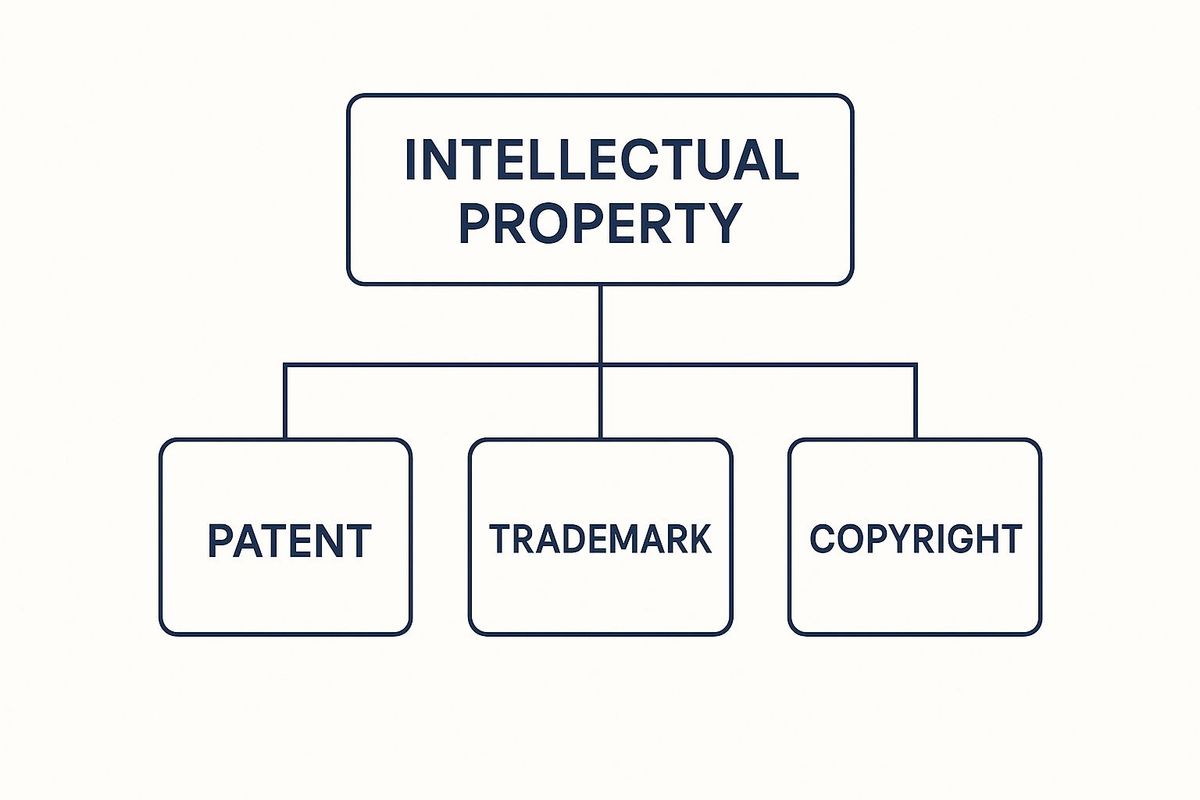
This image lays it out pretty clearly: patents, trademarks, and copyrights are the big three, the primary forms of IP that you can publicly register. Each one serves a unique purpose for creators and businesses alike.
Patents The Blueprint for Invention
Think of a patent as the exclusive architectural blueprint for a new invention. It gives the inventor the sole right to make, use, and sell their creation for a set period—usually 20 years for utility patents. This isn't just for physical gadgets; patents can also cover new processes or even chemical compounds.
For instance, a tech startup in Silicon Alley that develops a brand-new data processing algorithm would absolutely want to get a patent. This stops competitors from ripping off their unique method, giving them a vital edge in the market. Without it, their core innovation is left wide open.
Trademarks Your Brand’s Unique Signature
Next up, we have trademarks. A trademark is all about protecting your brand’s identity—it's the unique signature that tells the world who you are. This covers things like names, logos, slogans, and even specific colors or sounds that make your goods or services stand out. Just think of the iconic Tiffany Blue Box®; that specific shade of blue is a registered trademark.
Taking care of your trademarks is fundamental to your brand's long-term health. You can learn more about how to effectively manage intellectual property to keep your brand distinct and safe in a crowded marketplace. A strong trademark builds customer trust and can easily become one of your company’s most valuable assets.
Copyrights The Rights to Creative Expression
A copyright is what protects original works of authorship. This is the legal shield for artists, writers, musicians, and software developers. It covers everything from novels and songs to photographs, architectural designs, and even computer code.
Unlike patents, copyright protection kicks in automatically the moment a creative work is "fixed in a tangible form." But here's the thing: formally registering your copyright with the U.S. Copyright Office is absolutely critical if you ever need to enforce your rights in court.
Imagine a songwriter in Greenwich Village who pens a new song. The copyright gives them the exclusive right to reproduce, distribute, and perform that work. It ensures that they, and only they, can profit from their creative labor.
Trade Secrets The Secret Sauce
Finally, there are trade secrets. This is your company’s confidential "secret sauce"—any private information that gives you an edge over the competition. The most famous example, of course, is the Coca-Cola formula, which has been fiercely guarded as a trade secret for over a century.
For something to qualify as a trade secret, it has to meet two key criteria:
- It must have commercial value because it's a secret.
- The owner must take reasonable steps to keep it a secret.
This could be a customer list, a unique marketing strategy, or a specific manufacturing process. For a New York restaurant, it might be a cherished family recipe. Unlike the other pillars, trade secrets can be protected forever, as long as they stay confidential.
Why New York Shapes Global IP Law
When you think of New York City, you probably picture Wall Street or Broadway. But beyond the finance and culture, NYC stands as a global powerhouse for intellectual property. The reason is simple: it’s a magnet for the world's biggest creative industries. Publishing houses, major record labels, advertising giants—they all call New York home.
This massive concentration of creative work makes the state an inevitable battleground for high-stakes IP disputes. When a new legal question about copyright or trademarks pops up, it’s usually a New York-based company or artist at the heart of it. This dynamic turns the state from just a location into a legal trendsetter for the entire country.
The Power of the Second Circuit
A huge piece of this puzzle is the U.S. Court of Appeals for the Second Circuit, a federal court that covers New York. Think of it as a kind of Supreme Court for some of the thorniest IP issues. Because so many of America's media and creative industries are based here, the Second Circuit ends up hearing a massive number of groundbreaking cases.
Its decisions on concepts like copyright's "fair use" doctrine or what counts as trademark infringement don't just stay in New York. These rulings create powerful precedents that other courts across the United States look to for guidance.
In essence, a legal decision made in a Manhattan courthouse can ripple outward, shaping how intellectual property is understood and protected from California to Florida. This makes navigating intellectual property law in New York a matter of national importance.
This powerful legal ecosystem is also supported by influential groups focused on IP law. The New York Intellectual Property Law Association (NYIPLA), for instance, was formally established back in 1960 during a time of huge change in U.S. patent law. The association immediately jumped in, forming key committees that helped shape the state's legal framework from the get-go.
A Strategic Advantage for Creators
This environment has created an incredibly deep pool of legal talent. Attorneys in New York are constantly tackling cutting-edge IP challenges, giving them a level of experience that’s hard to find anywhere else.
For any business or creator, this is a clear strategic advantage. Having sharp local counsel means you’re not just getting legal advice; you’re tapping into a system that is actively writing the future of intellectual property law.
So, what makes New York so influential? It boils down to a few key factors:
- Industry Concentration: A massive presence of media, publishing, fashion, and tech industries all in one place.
- Legal Precedent: Landmark rulings from the Second Circuit set the tone for the rest of the country.
- Expertise Hub: A high density of experienced IP lawyers and legal professionals who live and breathe this stuff.
Ultimately, understanding the legal landscape in New York is critical because the rules established here often become the rules everywhere else. It’s the stage where the future of creative ownership is constantly being decided.
A Practical Guide to Securing Your IP
Knowing the different types of intellectual property is one thing, but actually taking action to protect your work? That's where the real value gets built. Securing your IP rights isn't a "set it and forget it" kind of deal. It's an active process that demands a smart strategy and some specific steps to legally shield your creations from getting ripped off.
Think of this as your personal checklist for getting it done. The journey starts long before you ever think about filling out a form. It begins with great record-keeping and a proactive attitude.
Document Everything Diligently
From the first napkin sketch of a logo to the initial lines of code for your new app, documentation is your absolute best friend. Keeping detailed, dated records creates a crystal-clear timeline of your creative process. If you ever have to prove ownership down the line, this paper trail can be your silver bullet.
This is especially critical for trade secrets. To keep their legal protection intact, you have to show that you took reasonable steps to keep them under wraps.
- Log Your Progress: Keep dated notes, drafts, prototypes, and meeting minutes.
- Use Confidentiality Agreements: Get Non-Disclosure Agreements (NDAs) signed by employees, contractors, and partners before you share anything sensitive.
- Control Access: Make sure only the people who absolutely need to know have access to confidential information.
Navigating the Registration Process
For patents, trademarks, and copyrights, getting formally registered with the right government agency is what gives your protection real teeth. While a copyright technically exists the moment you create something, you can't actually sue someone for infringement in federal court without that official registration.
The registration process transforms your ownership from a simple claim into a public record, providing a powerful deterrent to potential infringers and strengthening your legal standing significantly.
Getting these rights secured, especially trademarks and patents with the U.S. Patent and Trademark Office (USPTO), involves a few key hurdles.
Key Steps for Federal Registration
- Conduct a Thorough Search: Before you even think about filing, you need to be reasonably sure your idea is unique. For a trademark, that means digging through the USPTO database for anything that looks or sounds similar. For patents, it's a deep dive into "prior art" to confirm your invention is genuinely new and not just an obvious next step.
- Prepare and File Your Application: Each type of IP has its own incredibly detailed application. A patent application, for instance, requires extensive technical descriptions and meticulously written claims that define the exact scope of your invention. It’s not for the faint of heart.
- Respond to Office Actions: It’s completely normal for a USPTO examiner to send back an "Office Action," which is basically a letter raising objections or asking for clarification. How you respond—and how quickly—is critical to keeping your application moving forward.
This system has a long history. The evolution of U.S. patent law has directly shaped New York's IP environment, including major steps like the 1887 decision to join the Paris Convention, which connected the American system to international standards.
Once you have that registration, your IP officially becomes a tangible asset. You can sell it, license it out for a steady stream of royalties, or use it as collateral. Knowing how to put together an intellectual property licensing agreement is a crucial skill for monetizing your hard work and growing its impact.
How to Enforce Your IP Rights in New York
Getting your IP registered is a huge milestone, but what's next? What happens when you stumble across someone using your creation without asking? This is where enforcement kicks in.
Protecting your intellectual property isn’t something you can set and forget. It means you have to actively stand up for your rights when someone crosses the line—a situation we call infringement.
The good news? You’ve got a solid toolkit under both federal and New York law to shut down infringers. The process usually starts small and ramps up only if needed. Think of it as a measured response, aimed at fixing the problem without immediately jumping into a massive legal fight.
Starting with a Cease and Desist Letter
Your first move is almost always sending a cease and desist letter. This is a formal, but direct, letter—usually drafted by an attorney—that puts the other party on notice. It states clearly that you own the IP, points out exactly what they're doing wrong, and demands they stop. Immediately.
You'd be surprised how often this works. A lot of infringers, especially smaller operations, might not even know they’re breaking the law. A sharp, professional letter is often all it takes for them to back down and avoid a legal headache. It's a cost-effective first step that can end a dispute before it really begins.
Escalating to a Lawsuit in Federal Court
But what if they ignore you? If the letter doesn't do the trick, your next option is to file a lawsuit. For most IP issues—like patents, copyrights, and federally registered trademarks—you'll be heading to federal court. And this is where being in New York really matters.
The federal courts here, especially the Southern and Eastern Districts, are titans in the world of IP law. They see a massive volume of these cases, from high-stakes tech patent fights to messy copyright battles in the entertainment world. These judges have seen it all.
New York's role here is huge, thanks in large part to its appellate court. The Second Circuit Court has been instrumental in shaping U.S. copyright law, mainly because so many creative industries call this place home. Some of the most important legal ideas we rely on today came from landmark rulings right out of New York courts. You can see just how deep this influence runs in a deep dive into the Second Circuit's impact on intellectual property law.
Filing a lawsuit is a serious move, but it unlocks some powerful tools. If you win, the court can issue an injunction, which is a legal order forcing the infringer to stop what they're doing, period.
Potential Outcomes and Damages
Stopping the infringement is the main goal, but a lawsuit can also get you paid. Depending on the situation, a court might award you:
- Actual Damages: Money to cover the financial losses you can prove you suffered because of their actions.
- Statutory Damages: For copyright and trademark cases, the law sets specific damage amounts. This is huge because you can get this money even if you can't prove exactly how much you lost.
- Infringer's Profits: The court can literally order the infringer to hand over the money they made by illegally using your IP.
Successfully defending your IP does more than just solve one problem. It sends a powerful signal that you value your work and will protect your assets. It safeguards your brand, holds your ground in the market, and makes sure you—not someone else—benefit from your own creativity and hard work.
Common Questions About New York IP Law
Trying to get a handle on intellectual property law in New York can feel overwhelming, especially when you're just starting out. Let's tackle some of the most common questions I hear from creators and entrepreneurs to clear things up.
Do I Need a Lawyer for a New York Trademark?
Legally, can you file a trademark application on your own? Yes. Is it a good idea? Rarely.
Think of it this way: you could technically build your own house, but hiring an architect makes sure the foundation is solid and it won't fall down later. An experienced IP attorney does so much more than just fill out paperwork.
The real value is in the work they do before filing. They'll run a deep, comprehensive search to see if your mark is actually available, which can save you from a hugely expensive legal fight down the line. They also know the ins and outs of the U.S. Patent and Trademark Office's (USPTO) complicated rules and can expertly handle any rejections (called Office Actions). For a New York business, a local lawyer also brings priceless insights into our crowded and competitive market.
How Is a Trade Secret Different from a Patent?
The biggest difference boils down to one simple concept: public disclosure.
A patent is essentially a deal you make with the government. You publicly reveal exactly how your invention works, and in exchange, they give you a government-backed monopoly on it for a limited time (usually 20 years). This is perfect for inventions that someone could easily figure out and copy (reverse-engineer) once they see it.
A trade secret, on the other hand, is protected only for as long as you can keep it a secret. This could be anything from a customer list to a secret recipe. The protection could theoretically last forever, but the moment the secret is out, your legal protection is gone.
Choosing between a patent and a trade secret is a huge business decision. If keeping things confidential is your strong suit, a trade secret might be more valuable in the long run. If your innovation is easy to copy, a patent gives you much stronger, though temporary, defensive power.
What Is Fair Use in Copyright Law?
Fair use is a legal concept that allows people to use copyrighted material in a limited way without asking for permission. It’s designed to strike a balance between the rights of the creator and the public's interest in things like commentary, criticism, news, parody, and education.
But fair use isn't a free-for-all. Courts here in New York's influential Second Circuit look at four key factors on a case-by-case basis:
- Purpose and Character of the Use: Is it for commercial profit or for non-profit educational reasons?
- Nature of the Copyrighted Work: Was the original piece highly creative or more factual?
- The Amount Used: Did you just use a small clip or the entire thing?
- The Effect on the Market: Does your use hurt the original work's ability to make money?
There's no magic formula here; it’s a complex balancing act that depends entirely on the specific situation.
Can I Protect an Idea Under New York IP Law?
This is one of the biggest misconceptions out there. Generally speaking, you can't protect a simple idea with traditional IP law.
IP law protects the tangible expression of an idea, not the idea itself. For example, copyright protects your written book, but not the general idea for the plot. A patent protects a specific, working invention, not the abstract thought behind it. Getting this distinction right is key, and you can dig deeper into it by understanding the difference between a trademark vs copyright.
That doesn't mean your ideas are worthless. You can protect them in other ways. If an idea has commercial value and you keep it confidential, it can be treated as a trade secret. More often, ideas are protected through contracts—specifically, a Non-Disclosure Agreement (NDA). An NDA is a must-have tool for any innovator who is pitching an idea to potential partners or investors in New York.
At Cordero Law, we specialize in helping creators and entrepreneurs protect their most valuable assets. If you're ready to secure your intellectual property and build a strong legal foundation for your brand, we're here to guide you. Contact us today for a consultation.