So you've snagged the perfect domain name—congratulations! That's a huge first step. But simply registering a domain only gives you the right to use it. It does absolutely nothing to stop a competitor from using a really similar name to piggyback off your hard work and confuse your customers.
This is exactly why you need to trademark a domain name. It’s how you turn a simple web address into a powerful, legally protected asset.
Your Domain Is More Than an Address
Think of your domain name like the sign on your digital storefront. At first, it's just an address people type in to find you. But as you build your brand, that name becomes everything—it's your reputation, your quality, and the trust you've built with your audience. This is where the simple act of domain registration falls short and trademarking becomes a critical business decision.
Registering a domain is a lot like claiming a mailing address. It’s yours on a first-come, first-served basis, but that's about it. It offers almost no real brand protection.
A trademark, on the other hand, grants you legal ownership over your brand identity for specific goods or services. It elevates your domain from a simple URL to a defensible piece of intellectual property.
Why Prioritize Trademarking Your Domain Name?
Without a trademark, you’re leaving the door wide open. Imagine a rival launches a site with a slightly misspelled version of your domain. Suddenly, they're siphoning off your hard-earned traffic and maybe even damaging your reputation in the process. A registered trademark gives you the legal muscle to shut that down, and fast.
The digital space is only getting more crowded. The total number of registered domain names hit roughly 368.4 million in the first quarter of 2025, a 1.7% increase from the year before. With so much noise out there, protecting your brand has never been more important. You can dig into the numbers yourself in the latest domain name industry brief.
The core difference is simple: a domain registration is a lease on digital real estate, while a trademark is the deed to the brand you build on it. One gives you presence; the other gives you power.
Let's break down the key differences.
Domain Registration vs Trademark Rights At a Glance
Feature Domain Name Registration Trademark Registration Purpose Secures the right to use a specific web address (URL). Protects a brand name, logo, or slogan used to identify goods/services. Protection Prevents others from registering the exact same domain name. Prevents others from using a confusingly similar name for related goods/services. Scope Global (one URL can't be registered twice). National (a federal trademark protects you across the entire U.S.). Legal Power Limited. Disputes are often handled by ICANN's UDRP. Strong. Gives you the right to sue for infringement in federal court. Symbol None. The ® symbol, which acts as a powerful deterrent.
As you can see, they serve very different, though complementary, roles.
The Real Value of Protection
Trademarking your domain name gives you some serious advantages that go way beyond just owning the URL. It solidifies your exclusive rights and shows you’re serious about your brand's future.
Here are the biggest benefits:
- Nationwide Protection: Any "common law" rights you have are limited to your geographic area. A federal trademark protects your brand across the entire United States, from New York to California.
- Legal Deterrent: The little ® symbol sends a clear message to competitors: this brand is protected, so back off. It often stops infringement before it even starts.
- Increased Business Value: A registered trademark is a tangible asset. It can increase your company's valuation and makes you much more attractive to investors or potential buyers down the line.
Ultimately, understanding the crucial differences between domain ownership and trademark rights is the first step. To get a better handle on this, you can learn more about the relationship between trademarks and domain names.
Can Your Domain Even Be Trademarked?

Before you jump into the application process and start spending money, you have to ask the most important question first: can my domain name actually be trademarked? Not all names are created equal in the eyes of the U.S. Patent and Trademark Office (USPTO), and this is the first hurdle you need to clear.
The whole game hinges on one critical factor: distinctiveness.
A trademark's main job is to be a source identifier. It needs to point directly to your business and your products, separating you from everyone else out there. If a name is too generic or just describes what you do, it fails at this core mission. That’s why "Amazon.com" works for an online retail giant, but a bookseller trying to trademark "Books.com" would almost certainly be rejected.
The USPTO grades names on a spectrum of distinctiveness. Figuring out where your domain lands on this spectrum will give you a pretty clear idea of your chances.
The Spectrum of Trademark Distinctiveness
Think of trademark strength like rungs on a ladder. The higher you go, the more powerful your legal protection, and the easier it is to get that registration approved. Let’s climb this ladder from the bottom up.
- Generic Terms (Weakest): These are common, everyday words for a product or service. They are impossible to trademark. Period. Giving one company the exclusive right to "Shoes.com" for a shoe store would be totally unfair to competitors. You just can't do it.
- Descriptive Marks: These names describe a feature or quality of the service. Think "SpeedyDelivery.com" for a courier. They're considered weak and tough to register right out of the gate. They can sometimes gain trademark status over time through heavy marketing (what lawyers call "secondary meaning"), but it’s a long, expensive road.
- Suggestive Marks (Stronger): Now we're getting somewhere. Suggestive marks hint at a quality without directly describing it, making the customer use a little imagination. "Netflix" hints at movies ("flicks") delivered over the internet. "Coppertone" suggests a tan. These are great because they're inherently distinctive without being blunt.
- Arbitrary Marks: These are real words that have zero connection to the product or service. The classic example is "Apple" for computers. What does a fruit have to do with technology? Nothing. That disconnect is exactly what makes the mark so strong and protectable.
- Fanciful Marks (Strongest): These are the kings of the trademark world. Fanciful marks are completely made-up words invented just to be a brand. Think "Exxon," "Kodak," or "Pepsi." Since they have no other meaning, they get the highest level of trademark protection from day one.
Key Takeaway: The more creative and less descriptive your domain name is, the stronger it will be as a trademark. Aim for a name that is suggestive, arbitrary, or fanciful to maximize your chances of a successful registration and robust legal protection.
How Does Your Domain Stack Up?
So, where does your domain fit in? Be honest with yourself. Does your domain name immediately tell someone exactly what you sell? If so, you're likely in descriptive territory and facing an uphill battle. Or does it require a small mental leap to connect the name to your business? That's a good sign it might be suggestive.
This initial check is crucial. Getting it right helps you avoid common pitfalls and a potential rejection letter from the USPTO. If you're still looking for the perfect name, check out these tips for finding a memorable brand domain. Being strategic now, long before you ever fill out the paperwork, can save you a world of headache later.
How to Conduct a Thorough Trademark Search
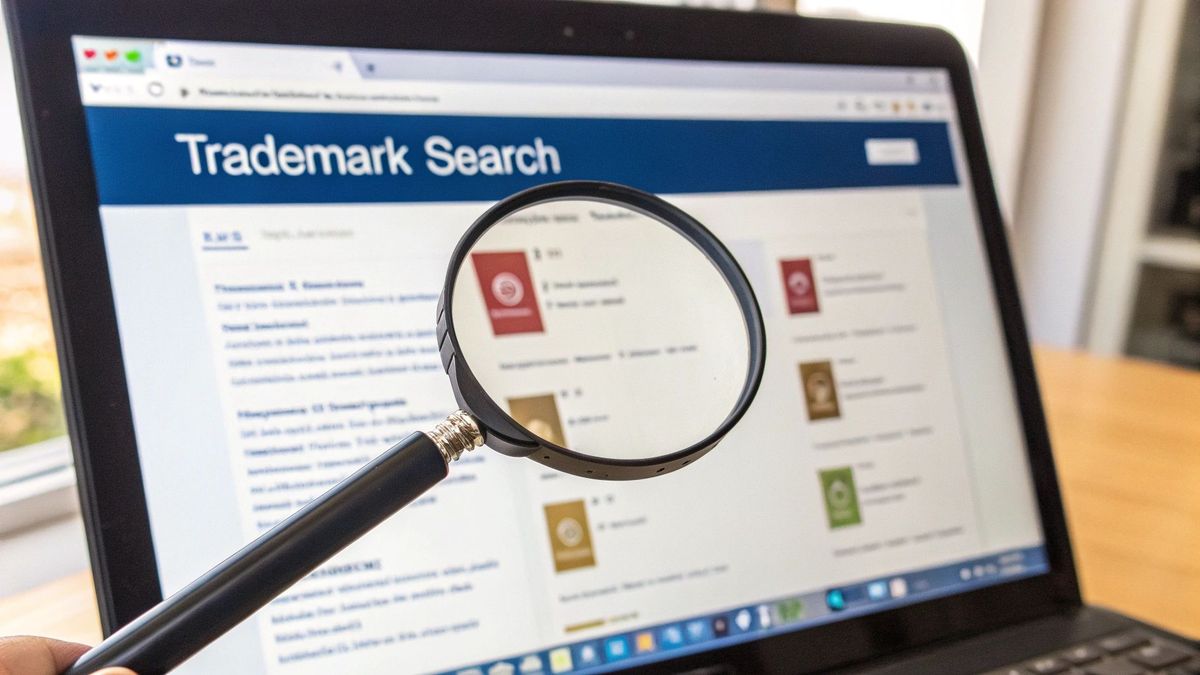
Think of this as essential detective work for your brand. Filing for a trademark without a proper search is like building a house on shaky ground—it's a recipe for disaster and wasted money. Trust me, a quick Google search just won't cut it. You have to dig deeper to make sure your path is clear.
The goal isn't just to find identical names. It's about uncovering anything "confusingly similar" that could lead the USPTO to reject your application. This initial "knockout search" is your first line of defense against future legal headaches.
Starting with the USPTO TESS Database
Your primary tool for this mission is the USPTO's own database: the Trademark Electronic Search System (TESS). It’s a powerful, free resource that lets you search all active and inactive trademark records. It might look a bit intimidating at first, but mastering a few basic searches will give you a solid foundation.
This is your starting point for any federal trademark clearance search in the United States.
To get started, you'll want to use the "Basic Word Mark Search (New User)" option. It's the most straightforward way to begin.
Let’s walk through a real-world example. Imagine you want to trademark "ZenithSpark.com" for business coaching services.
First, search for the exact match: type "ZenithSpark" into the search field. This tells you if anyone has already registered or applied for that exact name.
Next, you need to think like a competitor. Search for variations like "Zenith Spark," "ZenithSparkle," or even phonetic equivalents like "ZenethSpark." This is where the real detective work begins.
You can also broaden your search using the "Free Form" option. For instance, searching zenith[BI] AND spark[BI] will find marks containing both words anywhere in the trademark, not just together.
This initial search helps you spot direct conflicts. If you find an identical or very similar mark used for related services, that’s a huge red flag. You'll likely need to reconsider your name before moving forward. For a more detailed walkthrough, check out our guide on how to do a trademark search.
Going Beyond TESS: A Comprehensive Approach
A federal database search is critical, but it's not the whole story. A truly thorough search expands into other areas to uncover potential "common law" trademarks—brands that have rights through use, not just registration.
- State-Level Trademark Registries: Every state has its own trademark database. A business might have a registered trademark in a specific state that isn't in TESS. You'll need to search the Secretary of State websites for the states where you plan to do business.
- Simple Web Searches: Now you can turn to Google, Bing, and DuckDuckGo. Search for your domain name with and without the ".com." Look for businesses using a similar name, especially in your industry. Don't forget to check social media platforms like LinkedIn, Instagram, and Facebook.
- Domain Name Searches: Check domain registrars to see what similar domain names are already taken. Someone operating "ZenithSpark.co" or "Zenith-Spark.net" could create confusion, even without a registered trademark.
Expert Tip: The key is to look for "likelihood of confusion." The USPTO doesn't just ask if the names are the same; they ask if a consumer would likely be confused about the source of the goods or services. This is a subjective but critical standard.
The need for this thoroughness is growing. As more businesses go online, the link between domains and trademarks tightens. According to the 2025 Trademark Filing Trends Report, the steady rise in trademark applications is directly fueled by the explosion of domain names. This shows just how crucial it is to align your domain strategy with your IP protection from the very start. You can discover more insights about these brand protection trends at Clarivate.
Conducting a comprehensive search is an investment of time, but it's one of the smartest investments you can make. It provides the clarity and confidence you need before spending a single dollar on filing fees.
Navigating the Trademark Application Process
You've done the hard work. Your trademark search came back clean, and you’re ready to stake your claim. Now it’s time to make it official with the U.S. Patent and Trademark Office (USPTO). This part can feel a bit intimidating, but when you know what to expect, it's a completely manageable process.
Everything happens online through the Trademark Electronic Application System (TEAS). This is the USPTO’s portal for filing and managing your trademark. Think of it as a detailed questionnaire about your brand, your domain, and exactly how you're using it in the real world. Getting this right is absolutely critical.
Breaking Down the TEAS Application
Once you get into the TEAS portal, you’ll see a few different forms. For most people filing for the first time, the choice boils down to two options: TEAS Plus and TEAS Standard.
TEAS Plus is the cheaper route, with a filing fee of around $250 per class of goods or services. The catch? You have to use one of the USPTO's pre-approved descriptions for what your business does. TEAS Standard gives you the freedom to write a custom description, but it comes at a higher price—about $350 per class.
Here's what that initial application page at the USPTO looks like. This is where your journey really begins.
Honestly, for many online businesses, the pre-written descriptions in TEAS Plus are more than enough and a great way to save a hundred bucks.
Let's stick with our example: trademarking "PixelPantry.com" for an online digital art marketplace. Before you start filling things out, it helps to gather all your information in one place.
Key Information Needed for Your TEAS Application
Having these details ready will make the actual filing process much smoother. Think of it as your pre-flight checklist.
Information/Document What It Is Why It's Important Applicant Details The legal name and address of the trademark owner (you or your business). This establishes legal ownership. It must be the correct legal entity. The Mark The exact domain name you are trademarking (e.g., "PixelPantry.com"). This is the core of your application. Typos or variations can invalidate it. Mark Type The choice between a Standard Character Mark or a Special Form (Stylized) Mark. This defines the scope of your protection—just the words, or a specific design. Goods/Services A clear description of what you offer under the brand name. This determines which of the 45 international "classes" you file in. Filing Basis Your claim for filing: either "Use in Commerce" or "Intent to Use." This tells the USPTO whether you're already in business or plan to be soon. Specimen A real-world example showing how your domain name is used as a brand. This is your proof. Without a proper specimen, your application will be rejected. Filing Fee Payment for the application, calculated per class of goods/services. The USPTO will not review your application until the fee is paid.
Getting these pieces right from the start can save you from costly and time-consuming office actions (rejections) from the USPTO down the road.
Standard Character vs. Special Form Mark
One of the first big decisions you'll make is what exactly you're trademarking. Are you protecting the words themselves, or a specific design that includes those words?
- Standard Character Mark: This protects the name itself, "PixelPantry.com," regardless of font, color, or styling. This is the way to go for the broadest possible protection. It means you can change your logo or website design, and your trademark rights on the name are still secure. This is what I recommend for most domain name trademarks.
- Special Form (Stylized) Mark: This is for protecting a specific logo. If PixelPantry.com had a cool logo with a paintbrush worked into the text, you'd file this way. This protects that specific visual design but doesn't protect the name "PixelPantry.com" if you were to write it in a different font somewhere else.
For a deeper dive, it helps to review resources on understanding the trademark application process for other brand assets like logos, as you may eventually want to protect both.
Defining Your Goods and Services
This is arguably the most important part of the application, and it's where most DIY-filers trip up. You have to be incredibly precise in defining the goods or services your domain name represents. The USPTO sorts everything into 45 different "classes."
For "PixelPantry.com," you might choose a class covering services like "providing an online marketplace for buyers and sellers of downloadable digital art files." If you're too vague ("I run a website"), the examining attorney will reject it. If you're too narrow, you might not be protected if your business pivots slightly.
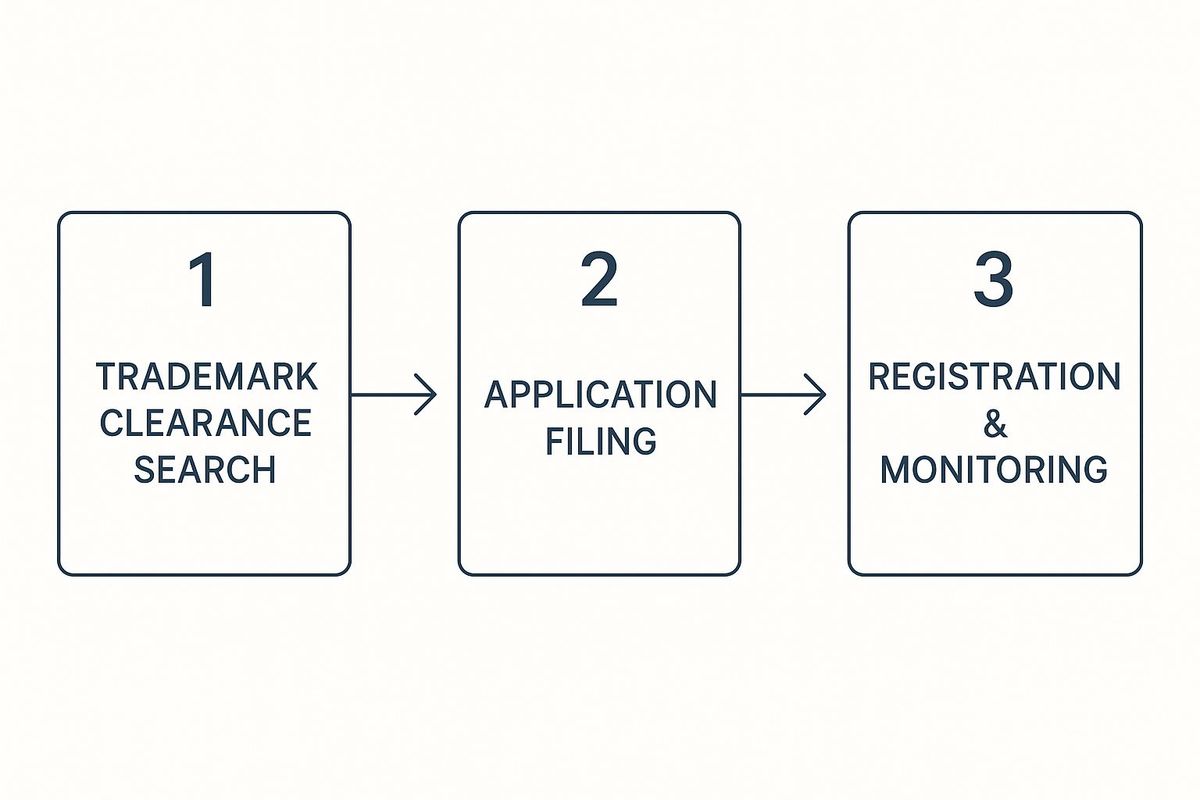
This process is a key step that turns your initial research into a tangible legal asset.
Crucial Tip: The USPTO doesn't let you trademark a "website." You trademark the service your website provides. The domain is just the brand name for that service. This is a distinction that matters.
Providing a Filing Basis and Specimen
Finally, you have to prove to the USPTO that you're actually using your domain as a brand in the marketplace. You'll do this by choosing a filing basis and submitting a specimen as evidence.
- Use in Commerce: This is the most common. It means you are already actively using "PixelPantry.com" to offer your services to customers in the U.S.
- Intent to Use: This is for businesses that haven't launched yet. It's a great way to reserve your name, but you'll eventually have to prove you're using it (and pay another fee) to finalize the registration.
Your specimen is your proof in the pudding. And no, a screenshot of the URL in your browser bar won't cut it.
Acceptable specimens could be:
- A screenshot of your website’s homepage where the domain is used like a brand name (not just as the address) near a description of your services.
- Marketing materials or online ads that feature the domain as your brand.
- The splash screen of a mobile app that clearly shows the branded domain name.
After you've filled everything out, uploaded your specimen, and triple-checked every last detail, you'll sign it and pay the fee. Then, the waiting game begins. You’ve successfully filed your application and put your domain on the official path to becoming a registered trademark.
What to Expect After You File Your Application
You’ve hit submit on your application, and now the waiting game begins. This part of the process can be the most nerve-wracking for clients, but knowing the road ahead makes it much more manageable. The key is to understand that filing is just the start of a conversation with the U.S. Patent and Trademark Office (USPTO), not the end of the story.
Your application doesn't just go into a black box. Within a few months, it will land on the desk of a USPTO examining attorney. This person is the gatekeeper of the federal trademark register. Their job is to review every detail of your application to ensure it complies with all legal requirements. Think of them as your point of contact, whose feedback will guide the next steps.
The Initial Review and Potential Office Actions
The first major milestone is the examining attorney's initial review, which typically happens several months after you file. The attorney conducts their own search for conflicting marks and scrutinizes your application for any procedural errors. There are two primary outcomes here.
The best-case scenario? The attorney finds no issues and approves your mark for publication. Simple as that. But it's very common to receive what's called a non-final Office Action. Don't panic. This isn't a final rejection; it's just a letter from the examining attorney outlining issues that need to be addressed before your application can move forward.
Common reasons for an Office Action include:
- Likelihood of Confusion: The attorney found an existing registered or pending trademark that is too similar to yours for related goods or services.
- Merely Descriptive: The attorney believes your domain name simply describes what you do rather than acting as a unique brand identifier.
- Specimen Refusal: The proof of use you submitted (your "specimen") wasn't acceptable.
- Incorrect Goods/Services ID: The description of your services needs to be clarified or corrected.
An Office Action isn't a dead end—it's an invitation to clarify your position. You're given a specific timeframe, usually six months, to file a response. A well-argued, timely response can often overcome the attorney's initial objections and get your application back on track.
Responding to Common Issues
Let's say you receive an Office Action for a "likelihood of confusion" refusal. This is a big one. Your response would need to present a legal argument explaining why consumers wouldn't actually be confused. For example, you might argue that the marks look and sound different, or that your services are sold in completely different channels than the other mark's.
If the issue is simpler, like a request for more information or a problem with your specimen, the fix is often straightforward. You might need to submit a different screenshot of your website or amend the wording of your services. The key is to respond completely and on time. Fail to respond, and your application will be abandoned. No second chances.
The Publication and Opposition Period
Once you've cleared any Office Actions and the examining attorney is satisfied, your mark is published for opposition in the USPTO’s Official Gazette. This kicks off a crucial 30-day window where the public gets a chance to object to your registration.
During this time, other companies who believe your trademark would harm their own brand can file an opposition. This isn't just a simple complaint; it initiates a formal legal proceeding that is similar to a trial. While oppositions are relatively rare for small businesses, it's a possibility you should be aware of. If no one opposes your mark within the 30-day period, you're on the home stretch.
The final step is registration. If you filed based on "Use in Commerce," the USPTO will issue your official registration certificate. If you filed with an "Intent to Use," you'll receive a Notice of Allowance. From there, you'll need to prove you've started using the mark to finalize the process.
This entire journey, from filing to registration, can often take 12 to 18 months, so patience is essential. And remember, once registered, you'll need to keep up with maintenance filings. Our guide on how to renew a USPTO trademark can help you understand those long-term requirements.
Maintaining and Enforcing Your Trademark Rights

Congratulations, your trademark is officially registered! It's a fantastic milestone, but the real work is just beginning. Owning a trademark is an active responsibility, not a one-time task you can check off a list and forget about.
Think of it like owning a garden. You can’t just plant the seeds and hope for the best; you have to constantly water it, pull weeds, and keep an eye out for pests. In the same way, your trademark needs ongoing maintenance and active enforcement to stay healthy and valuable.
Keeping Your Trademark Alive
The U.S. Patent and Trademark Office (USPTO) needs proof that you're actually using your trademark in commerce. This means filing specific maintenance documents at very specific times. You’ll want to put these dates on your calendar immediately.
- Between the 5th and 6th years after registration, you must file a Declaration of Use (also known as a Section 8 filing). This is your official notice to the USPTO that your mark is still active.
- Between the 9th and 10th years, you'll file another Declaration of Use (Section 8) along with an Application for Renewal (Section 9). You have to repeat this process every ten years after that.
If you miss these deadlines, your trademark registration can be canceled. That means all your hard work and investment go down the drain, and you're back at square one.
Actively Monitoring for Infringement
While maintenance filings keep your registration on the books, enforcement is what gives it teeth. It's entirely up to you—the trademark owner—to police the market for anyone trying to piggyback on your brand. This is probably the most critical part of protecting the name you've worked so hard to build.
You need to be vigilant about spotting others using a confusingly similar name for related goods or services. This means keeping tabs on new domain registrations, social media handles, and new business filings that pop up.
And make no mistake, the threat is very real. In 2024 alone, trademark owners from 133 countries filed 6,168 cases under the Uniform Domain Name Dispute Resolution Policy (UDRP). That's the second-highest annual volume ever recorded. This data, which you can dig into on WIPO’s official site, shows just how persistent cybersquatting is, especially for brands in retail, finance, and IT.
Taking Action Against Infringers
So, what do you do when you find someone using a domain like "Pixel-Pantry.net" to sell digital art, which directly competes with your "PixelPantry.com" trademark? The first move is almost always to send a cease and desist letter.
This is a formal, but not yet a lawsuit, way of putting the infringer on notice. The letter should clearly identify your registered trademark, explain how their use is creating a likelihood of confusion, and demand that they stop using the infringing name immediately.
Often, a strongly worded letter from a law firm is all it takes to resolve the issue without ever setting foot in a courtroom. It shows you're serious about protecting your rights and are ready to escalate things if needed. If they ignore your letter, you can then consider more formal options, like filing a UDRP complaint or a lawsuit in federal court.
Ultimately, consistent maintenance and vigilant enforcement are the two pillars that support the long-term value and strength of your trademarked domain name.
Common Questions About Trademarking a Domain
Jumping into the world of intellectual property can bring up a lot of questions. Deciding to trademark a domain name is a smart move to protect your brand, but it’s totally normal to wonder about the specifics. Here are some quick answers to the questions we get asked all the time.
Can I Trademark a Domain with a TLD?
Generally, no. You’re really trademarking the unique part of your domain—for instance, “PixelPantry”—not the whole thing including the “.com” or “.org.”
The top-level domain (TLD) is seen as a functional piece of an address, not a unique part of your brand. Focusing your trademark on the core name gives you much broader protection that you can use across different platforms, not just on that specific URL.
How Much Does It Cost?
The cost isn't one-size-fits-all. The government filing fee with the USPTO is usually a few hundred dollars for each class of goods or services you're claiming.
Hiring an experienced trademark attorney will add to that initial cost, but their guidance is almost always worth it. They know how to get you through the complex process and help you dodge expensive mistakes that could get your application rejected.
A trademark is a long-term asset. While there are upfront costs, the investment protects your brand's value and provides legal security that is essential for growth. It's a foundational step.
At Cordero Law, we specialize in making intellectual property law accessible and clear for entrepreneurs and creatives. If you're ready to secure your brand's future, we're here to help you through every step of the process.
Learn how we can protect your most valuable assets by visiting us at https://www.corderolawgroup.com.