
Welcome to the world of branding, where your company’s identity is everything. Let's get straight to the point: your trademark is your brand's unique signature—the name or logo that tells customers, "This is us." Think of your domain name as your brand's digital street address—the specific online location where people can find you.
Building Your Digital Foundation
Here’s where a lot of entrepreneurs get tripped up. While trademarks and domain names absolutely work together, they are not the same thing and are governed by completely different sets of rules. Many people mistakenly believe that registering a domain name automatically gives them trademark rights, or that owning a trademark guarantees them the matching domain.
This is a huge misconception, and it can lead to some serious legal and financial headaches down the road. Getting the distinction right is the first, most critical step to building an online presence that can actually stand up to competitors and protect your hard-earned reputation.
The Core Difference Explained
A trademark protects your brand identity out in the commercial world. It gives you the exclusive right to use a specific name, logo, or slogan in connection with your goods or services. Its whole purpose is to prevent customers from getting confused and to stop others from piggybacking on your brand's goodwill. The Nike "swoosh," for example, is a trademark that immediately signals a certain standard of athletic apparel. No one else can use it for that purpose.
A domain name, on the other hand, is just a technical tool. It’s a user-friendly pointer to a specific location on the internet, governed by a simple "first-come, first-served" registration system managed by companies like GoDaddy or Namecheap. Owning YourBrand.com only gives you control over that specific web address, nothing more.
This is where things can get complicated, as these two separate assets often overlap and create potential conflicts.
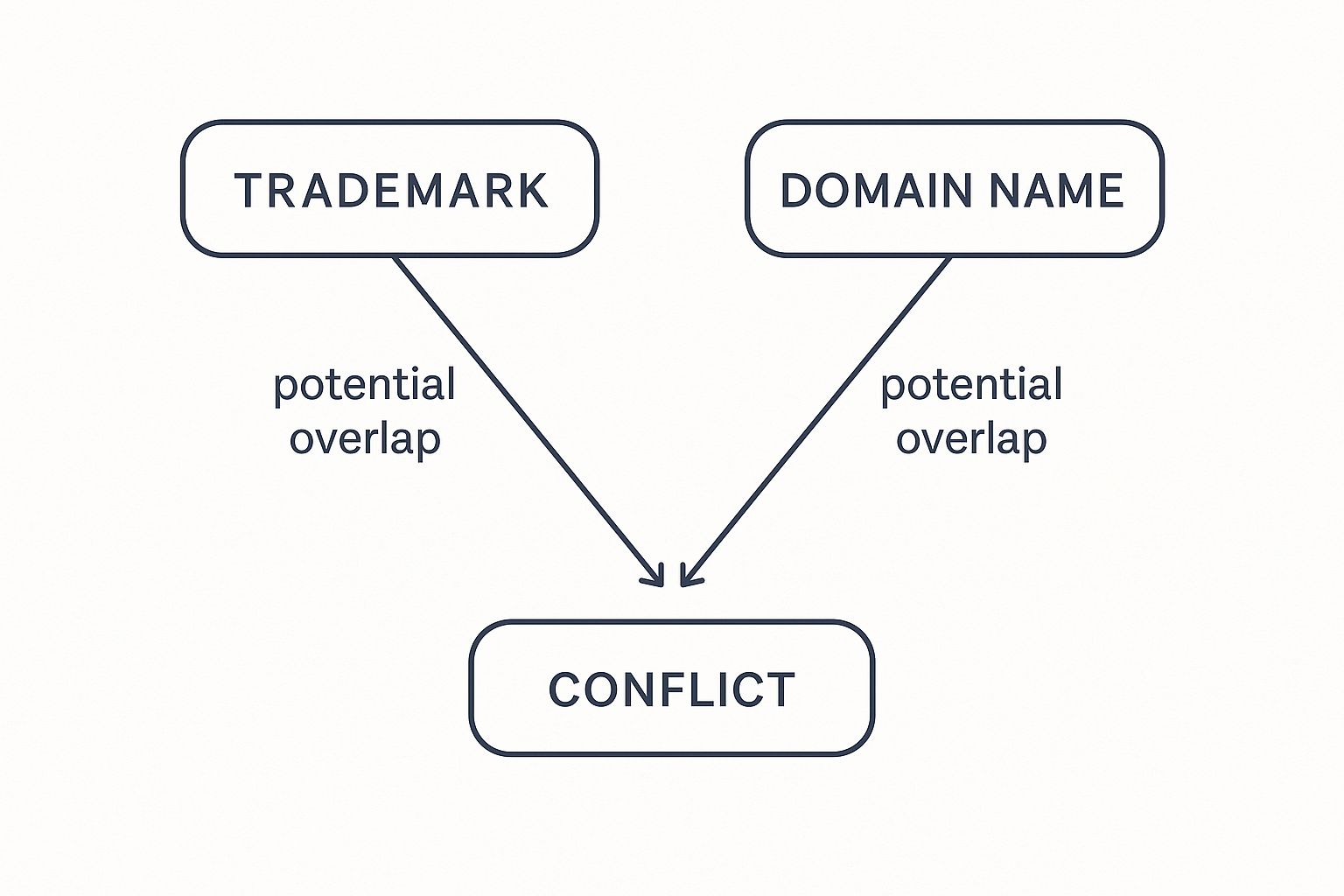
As you can see, while they are distinct, the paths of trademarks and domain names often cross. This intersection is where legal disputes happen, and it requires careful navigation to stay protected.
To make this crystal clear, here’s a quick breakdown of the key differences.
Trademark vs Domain Name At a Glance
| Attribute | Trademark | Domain Name |
|---|---|---|
| Core Function | Identifies the source of goods/services | Serves as a web address |
| Governing Body | Government IP offices (e.g., USPTO) | Domain registrars (ICANN accredited) |
| Protection Scope | Protects brand identity in commerce | Secures a specific URL |
| Legal Basis | Intellectual Property Law | Contract Law (with the registrar) |
| Acquisition | Examination & registration process | First-come, first-served registration |
This table neatly sums it up: one is a legal right tied to your brand's identity, and the other is a technical registration for an online address.
Why This Distinction Matters
The separation between these two systems creates a critical gap where your brand can be vulnerable. Someone could legally register a domain name that includes your trademarked business name—a practice often called cybersquatting. They might do this to divert your traffic, tarnish your reputation, or even try to sell the domain back to you for an outrageous price.
Owning a domain name is not a substitute for trademark protection, and owning a trademark does not automatically grant you ownership of the corresponding domain. Both are essential, parallel tracks for comprehensive brand defense.
Think of it like building a house. You need both the deed and the street address to be secure.
- The Trademark: This is the legal deed to your property. It proves you own the brand identity.
- The Domain Name: This is the physical street address, making it easy for people to find you.
You absolutely need both. Without the deed (your trademark), someone else could legally claim your brand's identity. And without the address (your domain name), no one can find your digital storefront. This guide will walk you through securing both.
What Exactly Is a Trademark and Why It Matters
Let's clear something up: a trademark is way more than just a business name or a slick logo. Think of it as your brand’s unique fingerprint in the marketplace. It’s the promise you make to your customers—a symbol of the quality, consistency, and reputation they’ve come to expect from you. In short, it’s what sets you apart from the pack.
This powerful symbol becomes a mental shortcut for consumers. When you see the golden arches, you immediately know you’re getting McDonald's. That instant recognition is the magic of a strong trademark, telling your entire brand story in a single glance.
This is why protecting your brand identifiers isn't just a legal box to check; it’s a core business strategy. If you don't, you're leaving the door wide open for someone else to ride your coattails, imitate your success, and confuse the very customers you've worked so hard to win over.
The Different Faces of a Trademark
When people hear "trademark," names like Coca-Cola or logos like the Apple icon usually come to mind. And they're right, but that's just scratching the surface. The world of trademarks is much bigger, designed to protect any unique identifier that points customers back to your goods or services.
Here are the most common types you can protect:
- Word Marks: This covers the name itself, like "Google" or "Ford," no matter the font or styling. It's the purest form of your brand name.
- Logos and Symbols (Design Marks): This is all about the visuals—think the Nike swoosh or the Target bullseye.
- Combination Marks: Just what it sounds like. This protects a mix of words and design elements working together.
- Slogans (Taglines): Those catchy phrases that stick in your head? Things like "Just Do It" for Nike or "I'm Lovin' It" for McDonald's can absolutely be trademarked.
But it doesn't stop there. Trademarks can even extend to more unconventional elements, as long as they are distinct enough to signal your brand to the public.
A trademark can be a sound (like the NBC chimes), a specific color (think Tiffany Blue), or even the unique shape of a product's packaging. The key is that the element has to be directly associated with your brand in the mind of a consumer.
This flexibility lets you build a comprehensive shield around all the different pieces that make your brand memorable.
The Legal Power a Trademark Grants You
Registering your trademark with a government body like the U.S. Patent and Trademark Office (USPTO) is a game-changer. It elevates your brand asset into a legally enforceable right, giving you the exclusive right to use that mark nationwide for the specific goods or services you listed.
This legal registration is your primary weapon against copycats and infringers. It gives you the power to:
- Stop Competitors: You can legally prevent others from using a mark that's "confusingly similar" to yours for related products, which could water down your brand's value.
- Sue for Damages: If someone does infringe on your registered trademark, you can take them to court to stop them and potentially recover financial damages for the harm they've caused.
- Block Imports: You can record your registration with U.S. Customs and Border Protection, which helps them stop counterfeit goods from ever entering the country.
Securing these rights is a proactive move that builds a legal moat around your brand identity. It’s a critical step businesses are taking worldwide. In fact, the World Bank reported a staggering 3,789,328 trademark applications globally in 2019 alone. You can explore more about these global intellectual property trends to see just how vital this protection has become.
Understanding Domain Names: Your Digital Address
If a trademark is your brand's unique signature, think of your domain name as its specific, verifiable street address on the internet. It’s that simple string of text—like corderolawgroup.com—that people type into a browser to find you. This is your digital real estate. It's the central hub for your website, your email, and your entire online identity.
But here’s a critical distinction: a domain name's primary job is technical, not legal. It's really just a user-friendly label that points to a server's numerical IP address. Without domains, we'd all have to remember long strings of numbers just to visit our favorite sites—and nobody wants to do that.

This is a crucial point. While trademarks and domain names are both vital for protecting your brand, they operate under completely different systems. Owning a domain gives you exclusive control over that web address, but it grants you zero trademark rights on its own.
The Anatomy of a Domain Name
Every domain name has a couple of key parts that work together. Understanding them helps clear up how the whole system works and empowers you to make smarter choices for your brand.
A typical domain name breaks down into two main pieces:
- Second-Level Domain (SLD): This is the unique, creative part of your address—the "corderolawgroup" in our example. It’s the piece you choose to represent who you are.
- Top-Level Domain (TLD): This is the suffix at the end, like .com, .org, or .net. TLDs help categorize websites by purpose, geography, or industry.
While .com is still the king, the options have absolutely exploded. Today, you can find hundreds of TLDs, from industry-specific ones like .law or .design to trendier options like .io and .co.
The system that governs domain names is fundamentally a race. It operates on a strict first-come, first-served basis. If a domain is available, the first person to register it through an accredited registrar gets it, period—regardless of their intent.
This is exactly where the relationship between trademarks and domains gets so messy. A competitor or even a "cybersquatter" could easily register a domain containing your trademarked name if you don't get there first.
Choosing Your Perfect Digital Address
Picking the right domain name is one of the most important branding decisions you'll ever make. A great one boosts brand recognition, helps with search engine visibility (SEO), and builds credibility. A bad one just creates confusion and makes you harder to find.
Here are a few tips for picking a winner:
- Keep it Memorable and Simple: The best domains are easy to remember, spell, and type. Ditch the hyphens, numbers, and slang that might trip people up.
- Align with Your Brand: Your domain should be a mirror of your business name. Consistency is everything when you're trying to build a connection in your customers' minds.
- Choose the Right TLD: While
.comis often the gold standard, don't be afraid to consider a TLD that fits your niche. A non-profit might be better off with.org, while a tech startup might lean toward.io.
Once you've got a name in mind, you'll work with a domain registrar. These are companies like GoDaddy, Namecheap, or Google Domains. They are accredited by the Internet Corporation for Assigned Names and Numbers (ICANN) to manage domain name registrations. Think of them as the gatekeepers who help you find, register, and manage your piece of digital property.
How Trademarks and Domain Names Intersect
This is where the separate worlds of intellectual property law and website registration collide. While a trademark protects your brand identity and a domain name secures your web address, they absolutely must work together to shield your brand online. When they don't, you're opening the door for conflict.
Imagine you've poured years into building a trusted brand, "Acme Widgets," complete with a registered trademark. Then one day, you discover a competitor has scooped up acmewidgets.net and is using it to sell cheap knockoffs. Suddenly, your customers are confused, your hard-earned reputation is on the line, and your sales are getting hijacked. This isn't just a hypothetical scenario; it's a common, frustrating, and often expensive problem for business owners.

This intentional act of registering a domain that contains someone else's trademark is known as cybersquatting. The goal is almost always to profit from the trademark owner's goodwill, either by misleading customers or by trying to sell the domain back to the rightful owner for a ridiculous price.
Understanding Cybersquatting and Its Impact
Cybersquatting is more than just a nuisance; it's a direct assault on your brand's integrity. A cybersquatter can use a confusingly similar domain to do some serious damage:
- Divert traffic from your real website to their own.
- Tarnish your reputation by associating your brand with scams or low-quality content.
- Sell counterfeit products under a name that looks legit to unsuspecting buyers.
- Hold your brand hostage by demanding a hefty ransom for the domain name.
This is a global issue. The growing focus on brand protection is clear when you look at industry events. The International Trademark Association's (INTA) Annual Meeting, for instance, recently saw over 9,800 registrants from 139 jurisdictions, all focused on tackling challenges like infringement and domain name disputes.
Your Most Powerful Tool: The UDRP
So, what can you do when you find a cybersquatter has hijacked your brand online? Luckily, you don't always have to go through a long, expensive court battle. The Internet Corporation for Assigned Names and Numbers (ICANN) created a streamlined process called the Uniform Domain-Name Dispute-Resolution Policy (UDRP).
The UDRP is essentially a mandatory arbitration process built to resolve clear-cut cases of cybersquatting quickly and without breaking the bank. It gives trademark holders a way to file a complaint and potentially get the infringing domain transferred to them—all without setting foot in a courtroom.
To win a UDRP case, you generally have to prove three things:
- The domain name is identical or confusingly similar to your trademark.
- The person who registered it has no legitimate rights or interests in that name.
- The domain was registered and is being used in "bad faith."
This process gives business owners a powerful and accessible tool to fight back and protect their digital identity. To see how these disputes play out, our guide offers more on the crucial link between trademarks and domain names and how to handle these conflicts.
Proactive Defense is the Best Strategy
While the UDRP is a great tool for cleaning up a mess, the best approach is to avoid the mess in the first place. Don't wait for a cybersquatter to make a move. Taking a few proactive steps to lock down your brand's digital footprint is one of the smartest investments you can make.
Consider these defensive plays:
- Register Variations: Don't just stop at
.com. Secure other popular extensions like.netand.org, plus any country-specific domains if you have an international presence. - Secure Common Misspellings: Think about how customers might accidentally misspell your brand name. Grab those typo-domains and have them redirect to your main site.
- Act Quickly: The moment you settle on a brand name, register the primary domain. Do it immediately—even before you file the trademark. Remember, domain names are strictly first-come, first-served.
Taking Action: A Practical Guide to Securing Your Brand
Knowing the difference between trademarks and domain names is one thing, but taking action is what really counts. Securing these two critical assets involves running two separate plays at the same time. One is a legal game plan involving intellectual property, and the other is a straightforward technical land grab.
Let’s walk through what you actually need to do for each. Protecting your brand isn’t something you do after a problem pops up; it’s about getting ahead of the game. When you register both your trademark and your key domain names, you're building a fortress that makes infringers think twice and gives you solid legal ground if they don't.
How to Register Your Trademark
Getting a trademark is a formal legal process. It’s definitely more involved than buying a domain, but the protection it gives you is massive. Think of it as getting the official deed to your brand's identity, nationwide.
Conduct a Thorough Trademark Search: Before you do anything else, you have to make sure the name or logo you want is actually available. Start with a "knockout search" on the U.S. Patent and Trademark Office's (USPTO) free TESS database. This is your first line of defense to spot any direct conflicts with already registered trademarks.
Perform a Comprehensive Clearance Search: This is the deep dive. You need to look for unregistered "common law" trademarks that people are already using, plus names that sound similar in related fields. A good, comprehensive search can save you a mountain of legal fees down the road by stopping you from chasing a mark that's doomed from the start.
File the Trademark Application: Once you're reasonably sure your mark is clear, it's time to file with the proper office, like the USPTO. You'll have to be very specific about the goods or services your brand covers and show proof (a "specimen") that you're actually using the mark in business.
The sheer volume of trademark filings worldwide shows just how vital this is. Mainland China is leading the charge with a staggering 6.76 million applications, with the United States coming in second at 566,938. India isn't far behind, with over 537,000 filings. It’s a global race to protect brands.
How to Register Your Domain Name
Compared to the legal legwork of trademarking, grabbing a domain name is quick and easy. It’s a first-come, first-served world, so you have to be fast.
First, pick a reputable domain registrar—these are the ICANN-accredited companies that handle the registrations. You’ve probably heard of the big ones like GoDaddy, Namecheap, or Google Domains. A good registrar makes the process simple, with clear pricing and decent customer support.
Then, just use their search bar to see if your dream domain is available. If your first choice is taken, don’t panic. Try some slight variations or look at different extensions (TLDs) like .net, .co, or something specific to your industry.
Once you find an available domain, it’s as simple as adding it to your cart and paying. Pro tip: Register it for at least a couple of years and turn on auto-renewal. The last thing you want is for it to expire and have a competitor snatch it up.
This simple purchase locks down your digital address, the home base for your website and email.
Tying Your Brand Protection Strategy Together
Securing your trademarks and domain names can't be an afterthought; they need to work together. The second you land on a business name, your very next move should be to register the .com domain for it. Do it right away, before you even start the trademark paperwork.
Why? Because this quick, cheap step shuts the door on cybersquatters who might try to grab your online identity while you're busy with the legal process. It’s a small price to pay to avoid a massive headache. With the domain secure, you can then move forward with the more detailed trademark application, knowing your main web address is safe.
Once you have these assets, think bigger. For instance, understanding the licensing of trademarks can unlock new ways to make money and form partnerships. This kind of long-term thinking turns brand protection from a simple cost into a powerful tool for growing your business.
Common Brand Protection Mistakes to Avoid
Trying to figure out intellectual property can feel like walking through a minefield. One wrong step can lead to some seriously expensive and frustrating problems down the road. Too many entrepreneurs learn this the hard way.
By getting a handle on the most common pitfalls ahead of time, you can build a much stronger, more resilient brand protection strategy from day one.
Picking a Generic or Descriptive Name
One of the first, and biggest, mistakes is choosing a brand name that's just too generic or descriptive. Sure, a name like "Fresh Produce Delivery" tells everyone exactly what you do, but good luck trying to trademark it.
Generic terms are basically off-limits for trademark protection because everyone in that industry needs to be able to use them. This leaves your brand legally wide open and incredibly difficult to defend.
Assuming a Business Name Is a Trademark
This is probably the single most common misconception I see. Registering your business name with the state (as an LLC, for instance) is just an administrative step. It does not give you any trademark rights.
That registration just allows you to operate legally under that name in your state. It offers zero protection against someone in another state using the same name to sell similar stuff. Only a registered trademark gives you that nationwide shield.
Letting Your Assets Expire
Both your trademarks and your domain names have expiration dates. Forgetting to renew your domain is a catastrophic mistake—it can be snatched up by a competitor or cybersquatter the second it expires. Losing your primary .com can be devastating, costing you traffic, customer trust, and sales.
Trademarks also need to be maintained. You have to file paperwork periodically to prove you're still using the mark in commerce. If you fail to file, your trademark registration will be canceled, and your brand will be left unprotected.
A proactive brand protection strategy isn't just about getting the rights; it's about diligent maintenance. Setting calendar alerts for renewal dates for both your domain registrar and trademark filings is a simple but critical habit.
Failing to Monitor Your Brand
Getting your trademarks and domains locked down is just the beginning. The last major mistake is not actively monitoring for infringement. If you aren’t keeping an eye out for others using confusingly similar names or logos, you're letting them slowly chip away at your brand’s power and confuse your audience.
Regular monitoring lets you spot potential issues early and take action before they blow up into costly legal battles. This vigilance is crucial for keeping your brand strong and exclusive. You can learn more about how to protect your brand by reading our detailed guide on how to avoid trademark infringement. Trust me, this proactive approach saves a ton of time, money, and future headaches.
A Few Common Questions
When you're trying to figure out the world of trademarks and domain names, a lot of questions can pop up. Let's tackle some of the most common ones I hear from business owners trying to protect their brand online.
Can Someone Actually Trademark My Domain Name?
Yes, they absolutely can. This is a massive blind spot for a lot of entrepreneurs. Just because you own a domain name doesn't mean you own the trademark rights for the goods or services you sell. If you haven't registered the name as your trademark, another company could potentially beat you to the punch and register it themselves.
When that happens, you're looking at a complicated and often expensive legal fight. It's a perfect example of why your trademark strategy and your domain registration need to be working together from day one.
Here's the bottom line: Owning the
.comdoesn't mean you own the brand. A federal trademark registration is the only way to lock down the exclusive legal rights to your brand's name in the business world.
What Should I Do If Someone Took My Trademark as a Domain Name?
Finding out someone registered your trademark as a domain is incredibly frustrating. This is a classic case of cybersquatting, but the good news is, you have some powerful ways to fight back.
Your first move should always be to talk to an attorney who specializes in intellectual property. They can walk you through a process called the Uniform Domain-Name Dispute-Resolution Policy (UDRP).
The UDRP is a game-changer for a few reasons:
- It's Fast: The system is built to resolve these kinds of disputes much quicker than a full-blown lawsuit.
- It's Cheaper: The UDRP process is typically way less expensive than going to court.
- It's Focused: It's designed specifically for clear-cut cases where someone registered a domain in bad faith.
Do I Need to Own a Trademark Before I Can Buy a Domain Name?
Nope, you don't. Anyone can register an available domain name. Registrars like GoDaddy or Namecheap operate on a simple first-come, first-served basis. If the name is free, you can buy it.
But—and this is a big but—already owning the trademark for your brand gives you a huge advantage down the road. It's the legal muscle you'll need to challenge a cybersquatter through a UDRP or a lawsuit if things go south. Think of it as the ultimate insurance policy for your brand.
Protecting your brand isn't just about one thing; it's about having a proactive strategy that covers both your intellectual property and your digital real estate. At Cordero Law, we specialize in helping entrepreneurs and creatives secure their most valuable assets. Don't leave your brand's future to chance. Schedule a consultation today and let's build a powerful defense for your business.