A 360 deal in the music industry is a type of contract where a record label gets a piece of the pie from all of an artist's income streams, not just the music they sell. We're talking about everything: touring money, merch sales, brand deals, publishing royalties—you name it. Think of the label as less of a music seller and more of a venture capital firm investing in the artist's entire career.
What Exactly Are 360 Deals in Music?

To really get your head around a 360 deal, it helps to stop thinking of an artist as just a musician and start seeing them as a small business or a startup. In this world, the record label is the VC firm that comes in with the seed money and resources. They’re bankrolling the entire operation, helping build the artist's brand from the ground up.
In exchange for taking on that huge upfront financial risk, the label gets a cut of the profits from every single part of the business they helped launch. This is a massive departure from the old-school record deals, which were a lot more straightforward.
The Old vs. The New Model
Back in the day, a label’s main job was simple: sell records. Their contract gave them a slice of the revenue from album sales, and that was pretty much it. If an artist sold out a stadium tour or had a t-shirt line that blew up, that money was all theirs. The label didn't see a dime of it.
The 360 deal flipped that script entirely. It gives the label a financial stake in all those other, often more lucrative, areas of an artist's career.
A 360 deal contract enables the record company to take a cut of these additional revenue streams. For an emerging artist, this might seem like a viable option as it often comes with more extensive support from the record label.
From the label's perspective, the logic is solid. If their marketing muscle and investment are what turned an artist into a household name capable of selling out arenas and landing major brand endorsements, they believe they deserve a piece of that success. They helped build it, after all.
This all-in partnership structure has a few key ingredients that make it different from older agreements:
- Expanded Revenue Streams: The contract spells out every income source the label gets a piece of. This can be anything from live performance fees to acting gigs and book deals.
- Greater Label Involvement: With skin in the game across the board, the label is much more motivated to help develop the artist's total brand, not just their next single.
- Shared Risk and Reward: At its core, the model is built on the idea that the artist and the label are true partners in a business venture, sharing both the investment risk and, hopefully, the massive financial rewards.
Traditional Record Deal vs 360 Deal At a Glance
To put it plainly, the scope of the deal is the biggest difference. The table below breaks down how these two contract types stack up against each other.
Feature Traditional Record Deal 360 Deal Primary Focus Recorded music sales (albums, singles) The artist's entire brand and all associated revenue streams Revenue Streams Primarily record sales and sometimes publishing Music sales, touring, merchandise, endorsements, publishing, appearances, etc. Label's Cut A percentage of net income from music sales only A percentage of gross income from all specified revenue sources Label's Role Funds, produces, markets, and distributes records Acts as a full-service partner, investing in and developing the total career Artist Autonomy More control over non-music career aspects (tours, merch) Less autonomy, as the label has a say in all major career decisions Upfront Advance Generally smaller, tied directly to recording costs Often larger, intended to fund broader career development activities
As you can see, the 360 deal is a much more entangled relationship. While it can offer a bigger upfront investment and broader support, it comes at the cost of giving up a percentage of every dollar the artist earns. It’s a classic high-risk, high-reward scenario that defines much of the modern music industry.
The Rise of the All-In Record Deal
To really get why the 360 deal became the new normal, you have to rewind the clock to the early 2000s. For record labels, this was a perfect storm. Their entire world, built on the back of selling physical CDs, was basically imploding right in front of them.
The arrival of digital music and file-sharing platforms—think Napster—sent a seismic shock through the business. Album sales, the absolute lifeblood of every major label, went into a nosedive that terrified everyone. Suddenly, the old playbook was a one-way ticket to going out of business.
Facing an existential threat, labels knew they had to evolve or die. They came to a stark realization: their business couldn't just be about selling records anymore. It had to be about investing in the artist as a whole brand. This wasn't a small adjustment; it was a complete reinvention of their core purpose.
A New Financial Reality
While recorded music revenue was tanking, another part of the industry was absolutely booming: live music. Touring became wildly profitable, and merchandise wasn't just about band tees anymore—it was a major revenue stream in its own right. Artists were making a killing on the road, while their labels were back home struggling to stay afloat.
The labels saw this and had a lightbulb moment: "Hang on. Our marketing dollars, our radio promotion, our investment… that's what made this artist famous enough to sell out arenas. Why are we not getting a piece of that success?"
The logic was simple: If a label's investment builds an artist's brand from the ground up, the label deserves a return on that investment from all aspects of the brand's success, not just one.
This new mindset is what paved the way for the 360 deal. Labels started offering bigger advances and deeper, more comprehensive career support. The trade-off? They wanted a percentage of those other booming income sources—touring, merch, endorsements, you name it. It was a strategic pivot born from pure necessity.
The industry's financial landscape was shifting under everyone's feet. This push toward all-in partnerships was a direct reaction to the collapse of recorded music sales. As listeners moved toward streaming, labels had to find other ways to make money. The 360 model, where labels act as a partner in an artist's entire career for a share of all profits, became the answer.
Even today, with streaming making up a whopping 84% of all recorded music revenue, those other income streams are as important as ever. You can learn more about the history of the 360 deal if you want to dig deeper.
This all-encompassing approach let labels rebuild for a new era, turning them from simple record-sellers into full-blown brand development partners.
How a Typical 360 Deal Is Structured
To get your head around how a 360 deal in the music industry works, think of an artist's career as a single company with a bunch of different departments. You've got the music department (streams, record sales), the live events department (touring), the retail department (merch), and so on. A 360 deal is basically the legal paperwork that makes the record label a partner—a shareholder, really—in every single one of those departments.
The process kicks off by mapping out every possible way an artist can make money. From there, the label negotiates a specific percentage it will take from each of those income streams. These splits are almost never the same across the board. A label will likely take a much bigger piece of the recorded music pie, and a smaller (but still very real) cut from things like touring or brand deals.
Breaking Down the Revenue Streams
These deals are designed to be incredibly broad, scooping up income from every corner of an artist's professional life. While the exact terms can vary, the core pieces almost always include:
- Recorded Music: This is the label's home turf, covering everything from Spotify royalties to digital downloads and old-school physical sales. This is where the label's percentage is usually highest.
- Touring and Live Performances: Labels will argue that their marketing muscle is what sells tickets. Because of that, they'll take a cut of performance fees and ticket sales, often somewhere between 10% to 20%.
- Merchandise Sales: This covers everything. T-shirts sold at a packed arena, hoodies on the artist's official website—it’s all part of the deal.
- Publishing and Songwriting: The label might also claim a piece of the royalties your songwriting copyrights generate.
- Endorsements and Sponsorships: Any money coming in from brand partnerships, TV commercials, or sponsored Instagram posts is considered fair game.
The infographic below really helps visualize how all these separate income sources get funneled back into the main 360 deal structure.
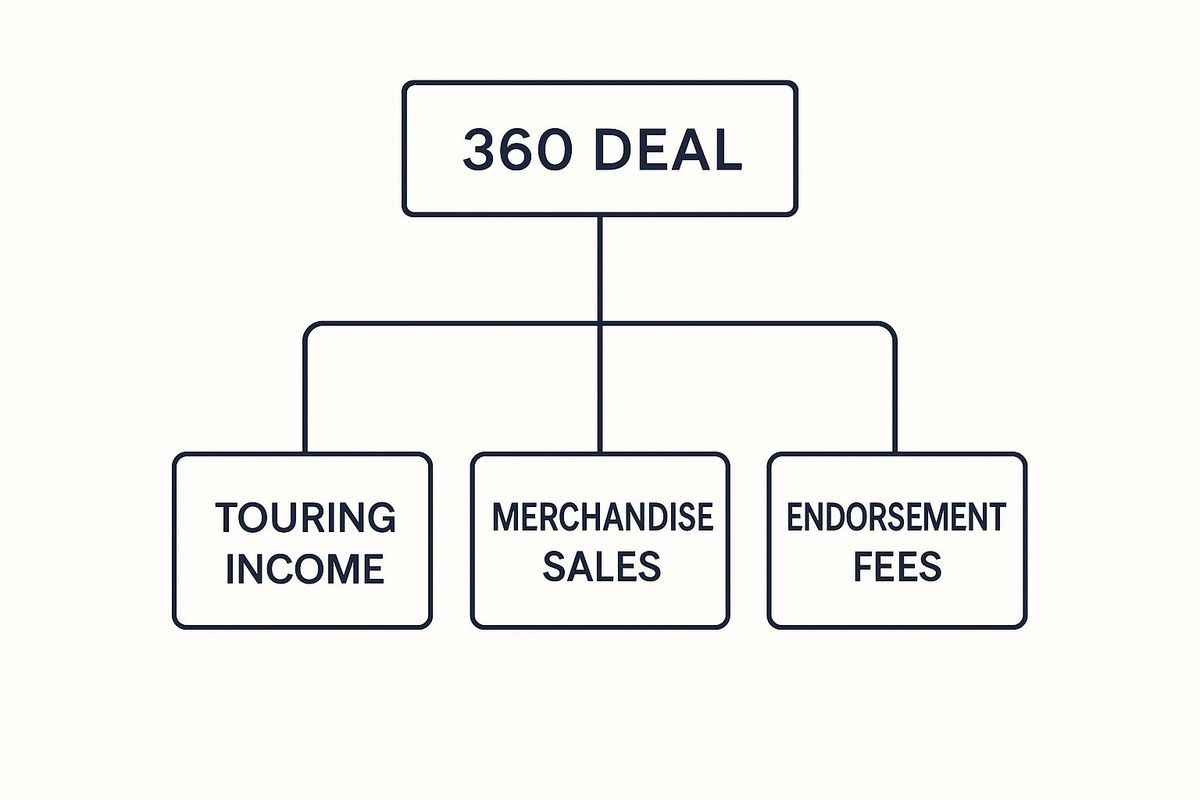
This shows how touring, merch, and endorsement money aren't separate businesses anymore. They're all woven directly into the label's financial partnership with the artist.
The Power of Cross-Collateralization
The real engine driving a 360 deal is a concept called cross-collateralization. The easiest way to think about it is like a single, massive bank account for the entire "Artist, Inc." business. Every penny the label spends—on studio time, music videos, tour support—is treated as a loan, or an "advance," that gets debited from this account.
Cross-collateralization means all of an artist's income streams are pooled together to pay back all advances. A successful tour's profit can be used to recoup the costs of a failed album, and vice-versa.
What this means in practice is that an artist doesn't get paid until that entire account is back in the black. Your merchandise could be flying off the shelves, but you won't see a dime of that profit if the label's initial investment in your album hasn't been fully paid back yet.
This whole structure is a direct answer to how we listen to music now. Physical album sales have tanked, dropping by a staggering 95% since their peak in 2000. At the same time, the money from live shows has grown five times faster than record sales. This massive shift forced labels to find a way in on all parts of an artist's career just to make sure they could get their investment back, using the profitable areas to cover losses in others. You can discover more about how 360 deals evolved and see why this model has become so common.
Weighing the Pros and Cons for an Artist

So, is a 360 deal a golden ticket to stardom or a golden cage? The truth is, it can be both. For any emerging artist, seeing a major label contract on the table feels like a dream come true. But it’s critical to understand the trade-offs before signing your career away.
These deals are a classic double-edged sword. They offer incredible opportunities alongside some pretty serious risks.
The Upside: A Massive Investment in Your Brand
On one hand, a 360 deal in the music industry can be an incredibly powerful career launchpad. A major label brings a level of investment and infrastructure that an independent artist could only dream of.
This isn't just about getting a check for studio time; it's a full-scale partnership designed to build a brand, not just sell a song.
The biggest benefit is the immense upfront support. Labels invest heavily in artists they believe in, and that support often includes:
- Significant Financial Backing: A large advance can cover everything from recording costs and music video production to marketing campaigns and even living expenses. This allows you to focus solely on your art.
- Global Marketing and Promotion: Major labels have dedicated teams and deep industry connections. They can get your music on global playlists, secure radio play, and land press coverage that would otherwise be completely out of reach.
- Strategic Career Development: Beyond the music, the label helps build your entire career. They can connect you with top-tier booking agents for tours, lock in brand endorsement deals, and guide your overall brand strategy.
Essentially, you gain a powerful business partner whose primary goal is to make you a household name. If their investment pays off, your career could skyrocket in a fraction of the time it would take to build on your own.
The Downside: Giving Up a Piece of Everything
However, this massive support comes at a steep price. The all-encompassing nature of a 360 deal means the label’s hand is in every pocket of your career, which introduces some big risks.
The most obvious drawback is the reduced long-term earning potential. By giving the label a percentage of your touring, merchandise, and endorsement income, you're sacrificing a huge slice of your most profitable revenue streams.
The impact can be massive. For instance, artists often receive only about 12% of the total music revenue generated annually. When a deal extends that reach into touring and merch—where the real money is often made—an artist's take-home pay shrinks even further.
A 360 deal forces an artist to weigh immediate, powerful support against long-term financial independence and creative autonomy. It's a high-stakes bet on the label's ability to generate more success than an artist could achieve alone.
Another major concern is the potential loss of creative control. When a label has a financial stake in your every move, they will want a say in everything from your sound and image to the brands you partner with. This can easily lead to conflicts if your artistic vision doesn't line up with the label's commercial goals.
Finally, the pressure of cross-collateralization means you won't see profits until the label has recouped its entire investment across all ventures. That can be a long and frustrating wait. Fully grasping these financial nuances is key, and you can learn more by checking out our guide on how music royalties are explained and calculated.
For any artist at this crossroads, it's essential to weigh these trade-offs carefully. A 360 deal is a massive commitment that will define the trajectory of your entire career.
Below is a table that breaks down the core pros and cons to help you see the full picture.
Weighing the 360 Deal Trade-Offs
Potential Advantages (The 'Pros') Potential Disadvantages (The 'Cons') Major Upfront Investment: A large advance provides financial stability to focus on music. Reduced Long-Term Earnings: The label takes a cut of non-music income (tours, merch, etc.). Powerful Marketing Machine: Access to global promotional teams and industry connections. Loss of Creative Control: The label's financial stake can lead to influence over your art and brand. Comprehensive Career Support: Guidance on touring, branding, and endorsements. Cross-Collateralization: Profits from one area (like merch) are used to pay off debts in another (like the album advance). Accelerated Growth: The label's resources can build a career much faster than going it alone. Unfavorable Recoupment Terms: It can take years to pay back the label's total investment before seeing any profits. Brand Legitimacy: A major label deal can open doors and add credibility early in a career. Risk of Being "Shelved": If you don't perform, the label may shift focus, leaving you in contractual limbo.
Ultimately, there's no single right answer. The decision depends entirely on an artist's individual goals, leverage, and comfort level with the risks involved. Having a clear understanding of what you're giving up in exchange for what you're getting is the most important first step.
Key Points to Negotiate in a 360 Deal
Getting a record contract offer is a huge moment in any artist's career. It's easy to get swept up in the excitement and just sign on the dotted line. But when a 360 deal is on the table, you have to slow down and realize that knowledge is your best protection.
Think of the first contract you see as just an opening offer. It's not the final word. The truth is, everything is negotiable, and focusing on the right terms can completely change the trajectory of your career. The goal isn’t just to get signed; it’s to build a fair partnership that sets you up for the long haul.
Define the Scope and Percentages
The absolute most critical part of the negotiation is the deal's scope. You and your lawyer need to nail down exactly which of your revenue streams the label can touch. Vague language is a huge red flag—it can give a label a piece of income from things you haven't even dreamed of yet.
Your attorney's job is to "carve out" certain income sources, making them off-limits to the label. For instance, if you write a book, have a clothing line, or do speaking gigs totally unrelated to your music, those should be explicitly excluded.
Next up are the percentages. The label might propose taking 20% of your merch sales or 15-20% from touring, but those numbers aren't set in stone. It's your job to push back and argue for lower splits, especially for revenue streams where the label has little to no direct involvement.
Remember: A contract is a business negotiation, not a command. The label wants to work with you. Pushing back is a normal and expected part of the process.
Secure a Sunset Clause
A "sunset clause" is one of the most powerful tools an artist can have in a 360 deal. Simply put, this clause puts an expiration date on the label's right to collect a percentage of your non-record income after your contract with them ends.
Without a sunset clause, a label could theoretically keep taking a cut of your tour and merch money forever, long after they've stopped investing a single dollar into your career. A good sunset clause will typically phase out the label's percentage over a few years post-contract until it hits zero. This ensures that when the partnership is over, it's actually over. For a deeper dive into the legal protections artists need, exploring resources on music and entertainment law is a crucial step.
Critical Questions for Your Attorney
I can't stress this enough: never, ever walk into these negotiations alone. An experienced music attorney isn't a luxury; they are a non-negotiable part of your team who understands the industry's unwritten rules and legal minefields.
Here are the essential questions you need to hash out with your lawyer:
- Term Length: How long are you locked into this deal? Can we negotiate a shorter initial term with options to renew based on hitting certain success metrics?
- Recoupment: How, exactly, will the label recoup advances and expenses? Are there any caps on the marketing or video production costs they can charge back to you?
- Release Commitment: Does this contract actually guarantee that the label will release your music? How many albums or projects are they committed to putting out?
- Exit Strategy: What are the specific conditions that would allow you or the label to terminate the agreement if things go south?
Successfully negotiating a 360 deal in the music industry comes down to creating a fair partnership. By zeroing in on these key points, you can shift the balance of power and secure a deal that truly works for you.
Exploring Alternatives and the Future of Artist Deals
The music business never stands still. The all-encompassing 360 deal definitely isn't the final chapter in the story of artist contracts. As artists get more leverage and direct lines to their fans, we're seeing a much more flexible, customized approach to label partnerships pop up.
Instead of a one-size-fits-all model, the industry is shifting towards "360-lite" or "à la carte" agreements. Think of it like going to a restaurant and ordering from the menu instead of being forced to take the entire prix-fixe meal. An artist can pick and choose the specific label services they actually need—maybe radio promotion or global distribution—without signing away a piece of every single thing they earn.
The Independent Artist Revolution
This change is almost entirely fueled by the incredible power today's independent artists have. Distribution platforms like DistroKid, TuneCore, and CD Baby have completely flipped the script, letting musicians get their songs onto all the major streaming services without a label at all.
This newfound independence has built up an entirely new ecosystem of support. Artists now have a growing list of options that provide label-level services without the tight grip and long-term commitment of a traditional deal.
The future of artist deals is all about flexibility and choice. As artists build their own power through direct fan relationships, they're in a stronger spot than ever to demand partnerships that actually serve their unique career goals.
These alternative paths give artists way more control and a bigger slice of the pie. For instance, an artist services company might offer marketing and promo support for a flat fee or a short-term percentage, leaving the artist’s tour and merch money completely untouched. Or, a publisher might step in to help with complex copyright issues, like when an artist needs to understand tricky topics such as music sampling laws, without getting involved in any other part of their career.
Here are a few of the most common alternatives you'll see:
- Distribution-Only Deals: This is purely about getting your music onto platforms like Spotify and Apple Music. The artist keeps 100% of their rights and the overwhelming majority of the revenue.
- Artist Services Agreements: These companies provide specific services—think marketing, PR, or playlist pitching—for a set fee or a limited-time revenue share.
- Label Services Deals: This is a step up. It offers the infrastructure of a label (distribution, marketing, radio) but the artist hangs on to the ownership of their master recordings.
While 360 deals in the music industry are still a major force, especially for artists looking for that huge initial investment from a major label, the ground has fundamentally shifted. The power is moving, and today’s artists have more ways than ever to build a successful, lasting career on their own terms.
Common Questions About 360 Deals
Even after getting the basics down, the world of 360 deals can still feel a bit foggy. Let's clear up some of the most common questions artists and managers have when one of these all-in contracts lands on their desk.
Think of this as the straight talk you need to understand how these deals really work in the wild.
Are 360 Deals Only for New Artists?
Not exclusively, but they are definitely most common for new artists who need a serious cash injection to get off the ground. That said, you'll sometimes see established artists sign a 360 to get a major label's global machine behind a huge comeback album or a world tour.
The big difference? Leverage. A superstar is in a position to negotiate much better terms—think lower percentages on their non-music income and way more creative freedom than a new act could ever dream of getting.
How Can an Artist Get Out of a 360 Deal?
Let’s be blunt: getting out of any long-term record contract is tough and almost always expensive. These are iron-clad legal agreements designed to keep you tied to the label for several years and multiple albums. The most common way out is by proving the label breached the contract, like if they failed to actually release your music.
Unfortunately, that route usually means a long, draining, and costly legal fight.
Your best move is always prevention, not a cure. Get a sharp music lawyer involved from day one to negotiate a shorter contract term and put clear performance goals in writing for the label. It's the single most effective way to protect your career down the road.
What Is the Biggest Misconception?
The biggest myth is that 360 deals are either "good" or "bad." The truth is, a 360 deal is just a tool. Whether it's the right tool depends entirely on the artist and their situation. For a brand new act that needs a massive investment and a powerful team to break through, it can be a rocket ship.
On the other hand, if you're an artist who's already built a solid independent business with profitable merch and touring, a 360 deal might mean giving up way too much control and money. Its value all comes down to the specific terms you negotiate and, most importantly, what your unique career goals are.
Navigating the complexities of music contracts requires expert guidance. The team at Cordero Law specializes in entertainment law, ensuring artists and creators secure fair terms that protect their long-term interests. Learn more about how we can empower your career at https://www.corderolawgroup.com.