So, can you actually trademark a domain name? Yes, and if that name is the core of your brand, you absolutely should think about it.
It’s a common misconception. You buy a domain name, and you think it’s yours, locked down. But just registering a domain only gives you the right to use that specific web address. It doesn’t stop a competitor from using your brand name in a way that hijacks your customers and confuses the market.
Why Your Domain Needs More Than Just Registration

Many entrepreneurs I talk to believe that once they've bought a domain, the story ends there. But the protection you get from registration is surprisingly thin. While you have the exclusive right to that exact URL, it does nothing to prevent someone from launching a slightly different version—think one with a hyphen, a different “.com” versus “.net,” or a clever misspelling—and siphoning off your hard-earned traffic.
This is where you need to understand the huge difference between domain registration and a trademark.
Think of it this way: domain registration is like renting a specific street address for your shop. A federal trademark is like owning the exclusive rights to your business name across the entire country. To really get it, it helps to understand how domain registration works on a technical level.
The Real-World Impact of Trademark Protection
Let's play out a scenario I see all too often. Imagine you launch a cool e-commerce store called "GlowGrove" at glowgrove.com, selling artisanal candles. You build a loyal following and invest in marketing. Your brand starts to get some real traction.
Then, a competitor notices your success and swoops in. They register glow-grove.net and start selling similar, but lower-quality, candles.
Without a trademark, your hands are mostly tied. Your customers might accidentally buy from the copycat, which hurts your sales and, worse, your reputation. You’d have to get into a costly legal fight to prove you have "common law" rights to the name, which is a tough, uphill battle with no guarantee of success.
Now, let's replay that with a registered trademark for "GlowGrove."
- You Have Immediate Legal Authority. You can fire off a cease-and-desist letter that has actual legal teeth.
- It Protects Against Cybersquatting. The competitor's move is a textbook case of cybersquatting—registering a domain in bad faith to profit from your brand's reputation. Your trademark is the silver bullet against this.
- You Secure Your Brand and Its Value. You gain nationwide, exclusive rights to use "GlowGrove" for selling candles. This prevents competitors from causing confusion, period.
When you trademark your domain, you're not just protecting a web address; you are securing a core business asset. This legal protection turns your brand name into tangible property that adds real, measurable value to your company.
From Web Address to Valuable Asset
Trademarking a domain transforms it from a simple online location into a defensible piece of intellectual property. It’s a proactive step that signals to investors, partners, and the market that you're serious about building a brand that lasts.
This legal shield gives you the peace of mind to grow, knowing your brand identity is secure. Honestly, it's one of the smartest investments you can make for your brand’s future. It ensures all the sweat and effort you put into building your reputation is actually protected.
Checking if Your Domain Can Be Trademarked

Before you spend a single dollar on a trademark application, you need to do an essential pre-flight check. Trust me on this. Not every domain name can be trademarked, and understanding why will save you a world of frustration and wasted fees.
The U.S. Patent and Trademark Office (USPTO) has specific rules about what qualifies for protection. It all boils down to one core concept: distinctiveness.
A trademark’s job is to act as a source identifier. It must clearly point to your business and your specific products or services, setting them apart from everyone else. If your domain is too generic or just describes what you do, it fails this fundamental test.
The Spectrum of Distinctiveness
Think of it like a scale from weak to strong. On the weak end, you have names that are nearly impossible to trademark. On the strong end, you have prime candidates for legal protection.
- Generic: These are the weakest and cannot be trademarked. A generic name is the common term for the product itself. Imagine trying to trademark
Laptops.comfor a computer store. It’s a non-starter because it would block competitors from using a basic word to describe their own products. - Descriptive: These names describe a quality or feature of the service, like
FastWebHosting.net. While it’s possible to trademark a descriptive name, you must first prove it has acquired "secondary meaning"—meaning consumers now associate that term specifically with your brand. This can take years and a significant marketing budget. - Suggestive: These names hint at a quality without being literal. Think "Jaguar" for a car, suggesting speed and agility, or
Evernote.comfor a tool that helps you remember things. These are strong candidates. - Fanciful or Arbitrary: These are the strongest and most protectable. A fanciful name is a made-up word, like "Zorpify" or "Kodak." An arbitrary name is a real word used in a context unrelated to its dictionary meaning, like "Apple" for computers. These are the easiest to get approved.
So, trying to trademark FreshCoffeeOnline.com is a losing battle. It’s just descriptive. But a name like Zorpify.com for a coffee subscription service is fanciful and highly protectable.
Conducting Your Preliminary Search
Once you've sized up your domain's distinctiveness, the next crucial step is what we call a knockout search. You have to check if someone else is already using a similar mark for related goods or services. This is one of the most common reasons for a USPTO rejection.
You can start this process yourself using free online databases to spot obvious conflicts early. A thorough investigation is key, and our guide on how to do a trademark search offers a much more detailed walkthrough.
Your first stop should be the USPTO's own database.
The Trademark Electronic Search System (TESS) is the official database of all active and inactive trademark applications and registrations. While it can seem complex, it's the most authoritative place to start your search.
When you're searching, don't just look for exact matches. You need to think like an examiner and look for variations that could cause consumer confusion. This includes:
- Similar Spelling: Check for common misspellings or phonetic equivalents (e.g., "Kwik" vs. "Quick").
- Similar Sound: Say the names out loud. "X-cell" and "Excel" sound identical and would likely be seen as conflicting.
- Similar Meaning: Look for synonyms or translated terms that convey the same commercial impression.
Keep in mind, this preliminary search doesn't replace a comprehensive one done by a legal professional. An attorney can access more advanced databases and interpret the results with a trained eye, spotting risks you might have missed. But doing this initial check yourself is a smart, cost-effective first step on your trademark journey.
Your Guide to the Trademark Application Process
Okay, so you've done your homework. You've confirmed your domain name is distinctive enough, and you've run a preliminary search to make sure you're in the clear. Now comes the official part: filing the application to trademark your domain. This is where things get a bit more formal, but don't let it intimidate you. When you break it down, it's a very logical process.
The main goal here is to paint a crystal-clear picture for the U.S. Patent and Trademark Office (USPTO). You need to show them what your brand is, what it does, and why it's a unique identifier that deserves legal protection. Getting these details right from the start is absolutely critical for a smooth ride.
This visual gives a great high-level overview of the entire journey, from due diligence to the finish line.
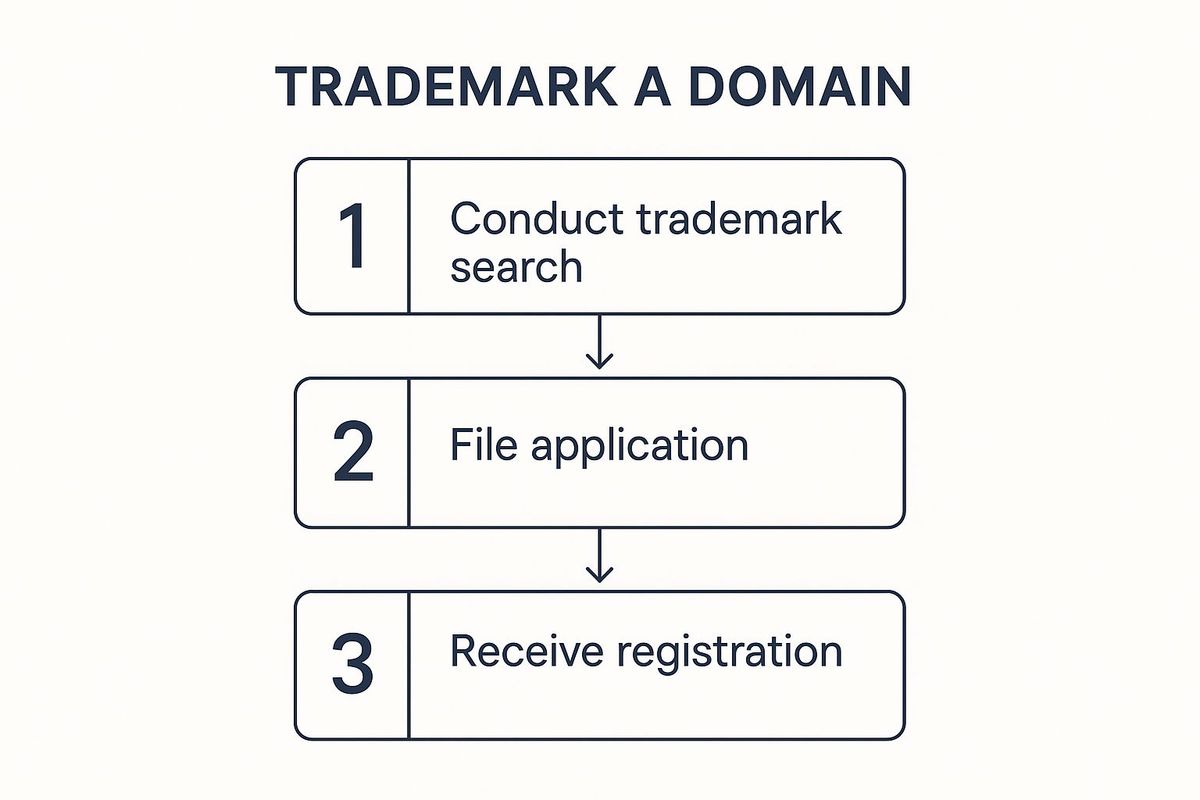
As you can see, it’s a pretty linear path. You start with the prep work, move into the formal filing, and hopefully end up with an official registration.
Gathering Your Essential Information
Before you even think about opening the application form, get your information organized. Trust me, it’s like prepping your ingredients before you start cooking—it saves a ton of time and prevents silly mistakes.
You'll need to be ready with specifics about your business and exactly how you're using the domain name. The application will ask for a few key things:
- Applicant Information: This is simply the name and address of the trademark owner. It can be you, as an individual, or your official business entity, like an LLC or corporation.
- The Mark Itself: You have to specify what you're protecting. Is it a standard character mark (just the words, like "GlowGrove") or a special form mark (if you're including a specific font, logo, or design)?
- Date of First Use: Get ready for two important dates. The first is the date you first used the mark anywhere, and the second is the date you first used it in interstate commerce—which means selling goods or services across state lines. For a domain, this is often the day your website went live and was accessible to customers outside your home state.
Choosing the Correct Trademark Class
This is a big one. It's probably the most common place where people filing on their own get tripped up. The USPTO organizes everything into 45 different "classes" of goods and services. You have to file your application in the correct class (or classes) that matches up with what you actually offer through your domain.
For instance, if GlowGrove.com is an e-commerce site for candles, you'd likely file in Class 04 for candles. But if the site also hosts paid candle-making workshops, you might need to add a second filing in Class 41 for education and entertainment services.
Choosing the wrong class is a classic, costly mistake that can get your application flat-out rejected. Be precise. Selling t-shirts? You're in Class 25. Offering a SaaS product? That's likely Class 42.
With online businesses exploding globally, trademark filings have shot up. It shows that entrepreneurs are getting serious about protecting their digital turf. Just look at the European Union Intellectual Property Office (EUIPO), which received 112,209 trademark applications by September of last year alone—a 4% jump. This is all part of a larger trend to lock down brand identity online.
Describing Your Goods or Services
Your application needs a clear, concise description of what you sell. You can't just write "we sell things online." You have to be specific.
A good description for our GlowGrove.com example might be: "Scented candles; wax melts." It’s direct, accurate, and to the point. The USPTO actually has a Trademark ID Manual with pre-approved descriptions you can use. Sticking to these can simplify the process and might even lower your filing fee.
Providing a “Specimen of Use”
Finally, you need to prove you’re actually using the domain name as a trademark out in the wild. This piece of evidence is called a specimen. It's not just a screenshot of your domain typed out; it has to show the domain being used to actually sell or promote your services.
Here are a few solid examples of what works as a specimen for a domain trademark:
- A screenshot of your website's homepage, with the domain clearly visible in the header or used as the main brand name.
- A screenshot of a product page showing the domain being used to offer goods for sale.
- Digital ads or marketing materials where the domain name is featured as the brand identifier.
The key is that the specimen has to create a direct link between the domain name and the goods or services you listed in your application.
Filing a trademark involves several distinct phases. For a more detailed look, https://www.corderolawgroup.com/blog/2016/registering-a-trademark-the-six-step-process-of-applying-for-a-trademark-in-the-us provides additional context. And while this guide focuses on the U.S. process, procedures can vary by country. For those looking into specific regional procedures, you can delve deeper into the trademark registration process in the UAE.
What Happens After You Submit Your Application

You’ve done the hard work, triple-checked every detail, and finally hit “submit” on your trademark application. It’s a huge milestone, but the journey isn’t over yet. Now, a different kind of process kicks off—one that requires a lot of patience.
Think of it like handing off the baton in a relay race. You’ve just passed it to the U.S. Patent and Trademark Office (USPTO), and now it's their turn to run a few laps. This post-filing period can feel like a total black box if you don’t know what to expect, so let’s pull back the curtain.
Once you file, your application lands in the USPTO queue. It won't get looked at right away. First, it has to be assigned to an examining attorney. This is the specialist who will personally review your application to make sure it complies with all the legal requirements. This initial assignment process alone can take several months.
The Examination Phase
Once an examining attorney gets your file, they conduct a thorough review. This isn't just a quick once-over. They are scrutinizing everything—from your chosen trademark class to the specimen you provided—and running their own comprehensive search for conflicting marks.
The whole point is to determine if your domain name meets the legal standards for trademark protection. If it’s all in perfect order, your application moves forward. But it's actually pretty common to receive what's known as an Office Action.
An Office Action is not a flat-out rejection. It’s a formal letter from the examining attorney asking for clarification, more information, or pointing out a legal issue with your application. Some of the most common reasons I see for an Office Action include:
- Likelihood of Confusion: The examiner found an existing trademark that they believe is too similar to yours.
- Merely Descriptive: Your domain name is considered too descriptive of the goods or services you offer.
- Specimen Issue: The proof of use you submitted wasn't acceptable for one reason or another.
Receiving an Office Action can feel like a major setback, but it’s a totally normal part of the process. You're given a deadline—usually six months—to respond and fix the issues. A thoughtful, well-argued response is crucial here. This is where many DIY applications fall apart.
Publication and Opposition
If your application makes it through the examination stage (either right away or after you've successfully responded to an Office Action), it enters the next big phase: publication.
Your proposed trademark gets published in the USPTO's Official Gazette, a weekly online publication. This opens up a 30-day window for the public to oppose your registration. Why would someone oppose it? Another business might file an opposition if they believe your mark would damage their brand.
If nobody opposes your trademark during this period, you’ve cleared the last major hurdle. The USPTO will then move to officially register your mark.
Trademark Registration Key Stages and Timelines
The entire process, from the day you file to the day you get that registration certificate, is a marathon, not a sprint. Here’s a quick breakdown of the key stages so you know what to expect.
Stage What It Means Typical Timeline Initial Review Your application is assigned to an examining attorney who checks it for completeness and legal issues. 3-6 months from filing Office Action The attorney requests changes or additional information. You have a set period to respond. If issued, adds 2-6+ months Publication Your mark is published in the Official Gazette for a 30-day public opposition period. 1-3 months after approval Registration If no opposition occurs, the USPTO issues your official registration certificate. 2-3 months after publication
As you can see, this entire process can easily take a year or more, especially if there are any bumps in the road. Knowing these steps makes the waiting game much more manageable and helps you stay prepared for any communications from the USPTO.
How to Protect Your Trademarked Domain
So, your application sailed through, and you now have a registered trademark for your domain name. That's a huge win and adds some serious value to your brand. But here’s something a lot of business owners don’t realize: your work isn’t over. A trademark isn't a "set it and forget it" kind of thing; it’s a right you have to actively protect.
Ownership is an ongoing job. If you don't enforce your exclusive rights, you risk watering them down or even losing them entirely over time. This means you need to stay vigilant and be ready to step in when someone crosses the line.
Proactive Monitoring for Infringement
You can't stop infringement if you don't know it's happening. The best defense is a good offense, which means proactively scanning the market for anyone using your trademarked domain—or something confusingly similar—without permission.
Thankfully, you don’t have to spend your days manually searching the web. You can set up some simple tools to be your digital watchdogs.
- Set Up Google Alerts: This is a free, simple, and surprisingly effective first move. Create alerts for your brand name, your domain (with and without the .com), and even common misspellings. You'll get an email whenever these terms pop up online.
- Use Social Media Monitoring Tools: Plenty of platforms can track mentions of your brand across social media. This is great for catching infringers who might be using your name in their social handles or posts to confuse your customers.
- Consider Professional Monitoring Services: For businesses with more on the line, paid trademark monitoring services offer a much more powerful solution. These services scan everything from new trademark applications and domain registrations to online marketplaces, giving you comprehensive reports on potential threats.
Dealing with Cybersquatting and Disputes
One of the most common threats you’ll run into is cybersquatting. This is when someone registers a domain name that's identical or confusingly similar to your trademark, all with the bad-faith intent of profiting off your brand's reputation. They might try to sell the domain back to you for an absurd price or use it to steal your traffic.
Imagine you own the trademark for Zorpify.com. A cybersquatter might register Zorpify.net or Zorpify-shop.com just to trick your customers. Your trademark gives you the power to fight back.
The main weapon in this fight is the Uniform Domain Name Dispute Resolution Policy (UDRP). It's a streamlined, cost-effective process designed to handle these exact disputes without dragging everyone into a full-blown court battle. You don't have to be a legal expert to understand its importance, as our detailed guide on online brand protection strategies explains further.
To win a UDRP case, you generally need to prove three things:
- The infringing domain name is identical or confusingly similar to your trademark.
- The person who registered it has no legitimate rights or interests in the name.
- The domain was registered and is being used in bad faith.
This process has become a cornerstone of digital brand defense. The UDRP, managed by the World Intellectual Property Organization (WIPO), is a vital tool for trademark owners everywhere. In a recent year, brand owners from 133 countries filed 6,168 UDRP cases with WIPO, making it the second busiest year since the policy began in 1999. You can check out more WIPO domain dispute statistics for more insights.
Taking Action When You Find Infringement
Okay, so what do you do when your monitoring actually turns something up? Your first move is usually to send a cease and desist letter.
This formal letter, which is best drafted by an attorney, informs the other party that they're violating your trademark rights and demands they stop immediately. It’s a serious warning shot that shows you're ready to defend your brand. In many cases, a well-written letter is all it takes to resolve the problem.
If the infringer ignores your letter or refuses to stop, you can then escalate the matter. This could mean initiating a UDRP proceeding or, in more serious situations, filing a lawsuit in federal court. Protecting your trademarked domain is an active, ongoing part of brand ownership that secures your reputation and keeps your customers' trust intact.
Common Questions About Trademarking a Domain
Once you get serious about protecting your brand, the questions start popping up. It's only natural. After walking through the main process, let's hit some of the most common things people ask when they're ready to trademark a domain.
Think of this as the practical, "what if" part of the guide.
How Much Does It Really Cost to Trademark a Domain?
This is always the first question, and the honest answer is: it depends. There isn't a single price tag. The total cost is a mix of government filing fees and, if you hire one, attorney fees.
The U.S. Patent and Trademark Office (USPTO) charges a fee for each class of goods or services you file under. You'll choose between two main application types:
- TEAS Plus: This is the cheaper route, usually $250 per class. The catch is you have to pick your service description from the USPTO’s pre-approved list.
- TEAS Standard: If you need to write a custom description for what you do, you'll need this option. It gives you more freedom but costs more, typically $350 per class.
Keep in mind, if your brand covers multiple things—maybe you sell physical products and offer online courses—you need to file in each of those classes. Those fees can stack up quickly. On top of that, attorney fees can range from a few hundred bucks to a few thousand, all depending on how complex your situation is.
Does a US Trademark Protect My Domain Internationally?
This is a huge one for anyone thinking about growing beyond the U.S. The short answer is no. A trademark registered with the USPTO gives you protection across the United States, but those rights stop at the border.
If you have plans to operate or sell in other countries, you have to get protection in those places, too.
Thankfully, you don’t have to start from scratch in every single country. An international agreement called the Madrid Protocol streamlines things. It lets you file one application to extend your trademark into multiple member countries. It makes the process much simpler, but you'll still have to meet each country's specific rules and pay their fees.
A lot of people think one trademark filing gives them worldwide protection. That's a myth. It’s better to think of trademark rights as country-by-country. You have to secure them in every market where you want to defend your brand.
What Happens if My Trademark Application Is Denied?
Getting a final refusal from the USPTO can feel like a punch to the gut, but it’s not always the end of the line. What you can do next really depends on why it was denied.
If it was a major legal issue, like the examiner found a "likelihood of confusion" with an existing trademark, you can appeal the decision to the Trademark Trial and Appeal Board (TTAB). This is a formal legal battle where you make your case to a panel of judges. It’s a long, complicated road that almost always requires an experienced trademark lawyer.
But sometimes, the smarter move is to just pivot. That might mean coming up with a new, more unique brand name that has a better shot at approval. It's not the outcome anyone wants, but it can save you a ton of time and money compared to fighting a losing battle. A good lawyer can give you the straight talk on whether an appeal is worth it or if it’s time to find a new path forward.
At Cordero Law, we specialize in helping entrepreneurs and creatives protect their valuable intellectual property. If you're ready to secure your brand and turn your domain into a defensible asset, we're here to guide you. Learn more about our intellectual property services at corderolawgroup.com.