So you have an idea—a brilliant one, you think. Before you invest a single dollar or hour into developing it, there's a critical first step you absolutely cannot skip: the prior art search.
A patent prior art search is the process of digging up any public evidence showing your invention isn't actually new. This is, without a doubt, the single most important first step an inventor can take to see if their idea has a real shot at becoming a patent.
Why a Prior Art Search Is Your First Step
Jumping into the patent process without a thorough prior art search is like trying to navigate a minefield blindfolded. You might have a groundbreaking concept, but if someone else, somewhere in the world, has already publicly disclosed a similar idea, your patent application is likely dead on arrival.
"Prior art" is the official term for any evidence that your invention is already known. This isn't just limited to existing patents, either. It can be almost anything publicly available:
- Academic papers and scientific journals
- Product manuals and old marketing brochures
- Presentations from industry conferences
- Even obscure blog posts or YouTube videos
If it was made public before you file your application, it can be used to block your patent. A solid search uncovers these potential roadblocks early, saving you from a mountain of legal fees and the gut-punch of a rejection letter from the patent office.
Uncovering More Than Just Roadblocks
But here's something most people miss: a well-executed prior art search does a lot more than just tell you "no." It's an incredible source of strategic intelligence. When you see what's already out there, you can often tweak your invention to make it stronger, more unique, and more patentable. You might even spot a gap in the existing technology that your idea, with a few adjustments, could fill perfectly.
Think of it this way: you wouldn't launch a new product without doing your homework. Just like good market research for new product development validates your business idea, a prior art search serves as your technical validation. It helps you draft a much stronger patent application because you can clearly spell out how your invention is different and better than everything that came before it.
One of the biggest mistakes I see inventors make is assuming their idea is new just because they haven't seen a similar product on store shelves. The reality is, countless inventions are patented but never become commercial products—and they all still count as prior art.
This is why you have to dig deep into global patent databases. An organization like the European Patent Office (EPO), for instance, has one of the most comprehensive collections of technical documents on the planet.
This isn't just a European database. The EPO's collection is so massive that 51.8% of its search reports cite prior art from Asian countries, and nearly 28% reference non-patent literature like academic articles. That tells you a search limited to only U.S. patents is dangerously incomplete.
The Foundation of Your IP Strategy
At the end of the day, a prior art search is the foundation of your entire intellectual property strategy. It influences every single step that follows, from how you write your patent claims to how you negotiate with the patent examiner. Skipping this step is a huge gamble, and it almost never pays off.
By putting in the effort to do a diligent search upfront, you give your invention its best chance for success, sharpen your competitive edge, and move forward with the confidence that your idea is genuinely new.
How to Build Your Search Strategy
A successful patent prior art search doesn't just happen by plugging keywords into a search bar. That's a rookie mistake. You've got to start with a smart, structured plan. Without a strategy, you're just wandering through a massive library with no idea what book you're looking for. A solid plan ensures you cover all your bases without wasting time.
This isn't just a quick keyword brainstorm, either. You need to get inside the head of a patent examiner and break your invention down to its absolute core components. That means identifying not just what your invention is, but what it does and, most importantly, what problem it solves.
Deconstruct Your Invention
First thing's first: describe your invention in a single, clear sentence. Now, pull that sentence apart. What are the key nouns, verbs, and technical terms? For every single one, brainstorm as many synonyms, alternative phrases, or related concepts as you can possibly think of.
Let's say your invention is a "solar-powered automatic pet feeder." The keywords might seem obvious at first, but a real strategy digs much deeper:
- Core Components: feeder, solar panel, timer, dispenser, pet, food.
- Synonyms & Alternatives: trough, vessel, photovoltaic cell, light-powered, scheduler, automated, portion control, domestic animal, kibble.
- Functional Language: dispenses food, powered by light, operates on a schedule, feeds an animal automatically.
This list is your raw material. A well-documented invention description can be an absolute goldmine here. To get a better handle on this, you should review a proper invention disclosure format; it will force you to articulate every piece of your idea.
The goal is to build a rich vocabulary that captures the invention's function, purpose, and context—not just its name. This kind of robust approach has a lot in common with academic research. You can find some helpful parallels in these expert tips and strategies for conducting literature reviews to broaden your thinking.
Think Like a Patent Examiner
Patent examiners don't just look for keywords; they hunt for concepts. Your next job is to pinpoint the core inventive concept of your idea. What's the one unique mechanism, process, or combination of parts that makes your invention new and non-obvious?
Is it the specific way the solar panel connects to the dispensing mechanism? Or maybe it's a unique sensor that knows when the pet is nearby? Zeroing in on this "point of novelty" is critical. It focuses your search on what truly matters and stops you from getting bogged down in thousands of irrelevant results.
Don't get stuck on the commercial name or the cool marketing angle for your product. A patent protects the functional invention itself. Your search strategy has to be built around the technical nuts and bolts of how it actually works.
This kind of conceptual thinking is what helps you move beyond basic keyword strings and start crafting sophisticated search queries that actually uncover relevant prior art.
This three-step visualization shows the typical flow for a patent prior art search.
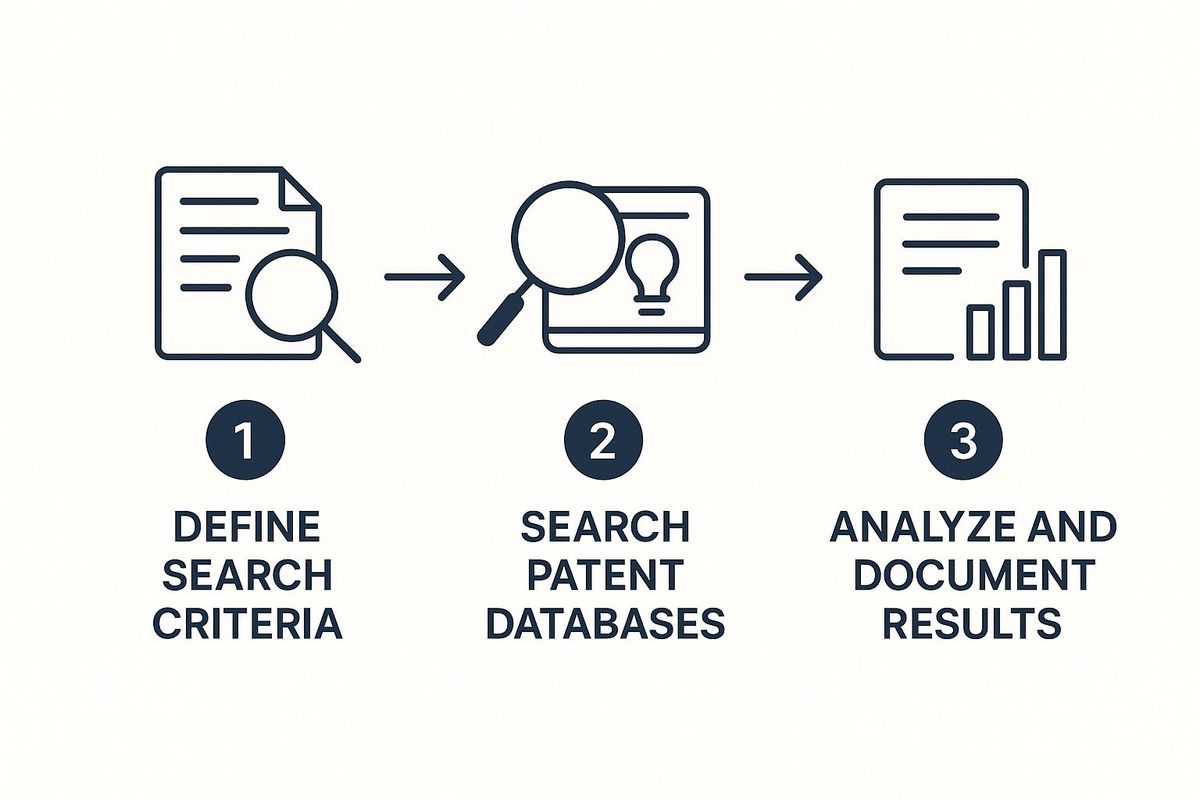
This process shows how a structured approach—from defining what you're looking for to analyzing the results—is the backbone of any effective search.
Unlock the Power of Patent Classifications
Trust me, keywords alone are not enough. Inventors and their lawyers often use obscure or ridiculously broad language in patents, which can make them nearly impossible to find with a simple keyword search. This is where the patent classification system becomes your secret weapon.
The Cooperative Patent Classification (CPC) system is a highly detailed, organized system used to categorize inventions by their technical features. Think of it like the Dewey Decimal System, but for patents. Every single patent and published application gets assigned at least one CPC code.
Finding the right CPC codes for your invention is a total game-changer. It lets you find patents that use completely different words but describe a similar technology. A great way to start is to find one patent that you know is similar to your idea and look at the CPC codes it was assigned.
Once you have a few relevant codes, you can use them to search databases directly, which instantly narrows your results down to a specific technological field. Combining CPC codes with your keyword list creates a powerful, two-pronged attack that is far more comprehensive than just relying on words alone. This is how you make sure you're doing a deep, meaningful search instead of just scratching the surface.
Mastering the Essential Search Tools
With your search strategy mapped out, it's time to get your hands dirty in the digital stacks. The real difference between a quick, superficial search and a professional one often comes down to knowing which tools to use—and how to get the most out of them.
You’re looking for the right mix of accessible free platforms and the more powerful, specialized services that cost a pretty penny. Starting with the free options is always the right first step. You'd be surprised how powerful they are, and they give you a fantastic baseline for what's out there without spending a dime.
Your Go-To Free Search Platforms
The two heavyweights you need to know are Google Patents and the USPTO's own Patent Public Search (PPUBS) tool. This is where most inventors start, and for good reason.
Google Patents is incredibly easy to jump into. If you can use Google, you can use Google Patents. You can search by keyword, patent number, inventor—all the usual suspects. But its real secret weapon is the "find prior art" button. Click it on any patent, and Google’s algorithm will automatically pull up documents it thinks are similar. It's a game-changer for quick discovery.
The USPTO's Patent Public Search (PPUBS) is the official database. It’s the exact same tool the patent examiners use, so you’re getting unfiltered access to U.S. patents and applications. I'll be honest, it has a steeper learning curve than Google, but mastering its more precise search functions is a skill that pays off big time.
Here are a few tips I give clients to get more out of these free tools:
- Use Boolean Operators: Don’t just type a string of keywords. Use operators like AND, OR, and NOT to connect and filter your terms. A query like
(solar OR photovoltaic) AND (pet AND feeder) NOT catimmediately narrows your focus and gets rid of irrelevant junk. - Search with CPC Codes: Remember those classification codes we talked about? Combine them with your keywords. This is a pro-level move that will slash the noise and give you much cleaner results.
- Mine the Cited References: When you find a patent that's dead-on, scroll down to the "References Cited" section. This is gold. It’s a list of prior art an examiner already decided was relevant, basically handing you a pre-made research trail to follow.
Don’t underestimate these free resources. I’ve seen inventors uncover the one piece of prior art that either killed their idea or, better yet, helped them pivot to something much stronger and more patentable—all with nothing more than Google Patents and a smart search query.
When to Consider Professional Platforms
Free tools are your starting point, but the professional, subscription-based platforms are in another league entirely. These are the systems patent law firms and major R&D departments rely on when the stakes are high. Think of them less as search engines and more as deep analytical tools.
Platforms like PatSnap, IPRally, and Amplified go way beyond simple keywords. They often use AI-driven semantic search, which means they understand the concepts behind your words, not just the words themselves. You can often feed them a whole invention disclosure, and they’ll find conceptually similar patents that use completely different terminology.
This is the kind of dashboard you'd see on one of these advanced platforms:
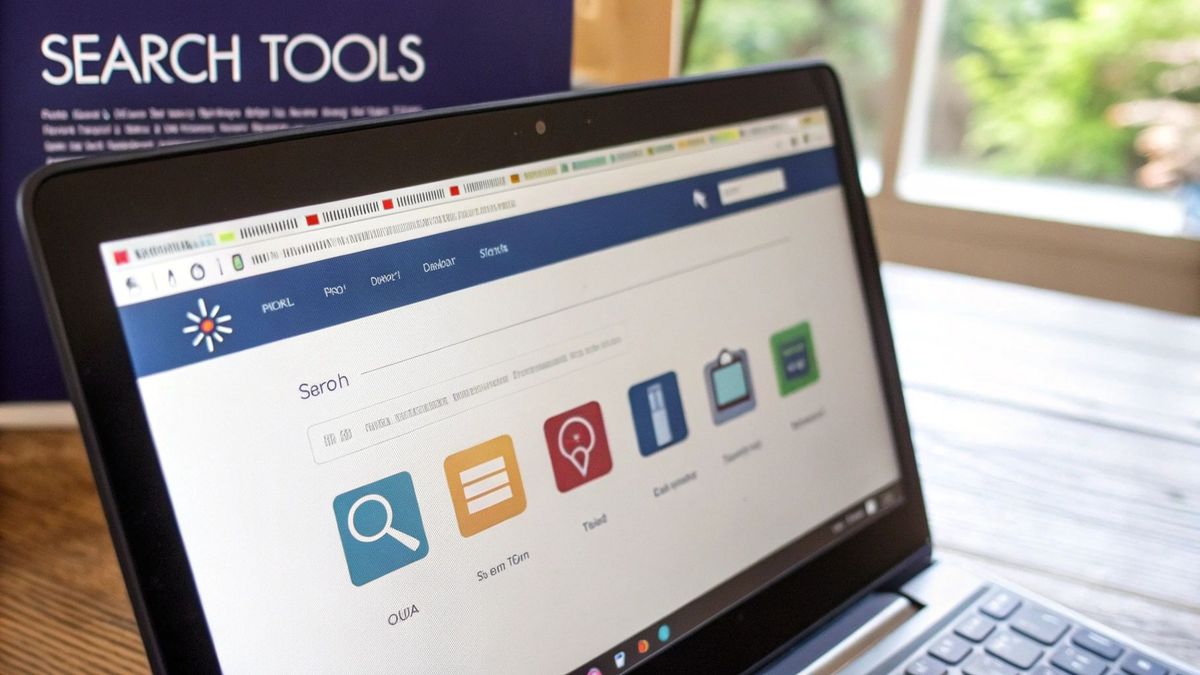
As you can see, it’s not just a list of results. These tools integrate analytics, data mapping, and global patent families into one view, giving you insights into market trends and the competitive landscape that you just can't get from a simple search.
The Rise of AI-Powered Searching
The whole patent world now leans heavily on advanced platforms like Derwent Innovation, which pulls in data used by over 40 patent offices worldwide. These systems give you access to incredible databases, with some covering more than 168 million publications across 76 jurisdictions.
More and more, these platforms are powered by AI trained on massive, curated datasets to deliver more relevant results, faster. It's not just about speed; it's about uncovering connections a human searcher might easily miss. By analyzing technical relationships, AI can surface prior art that would have been invisible to traditional keyword searches, which is a huge advantage in crowded fields.
The insights you get from these platforms can completely change your strategy, influencing everything from how you draft your patent claims to how you navigate the entire patent filing process.
Ultimately, the best approach is usually a hybrid one. Start with the free tools to get the lay of the land and pick off the low-hanging fruit. Once you've done that initial homework, you'll be in a much better position to decide if your invention's complexity—and value—justifies investing in a professional search.
Searching Beyond Patent Databases
A thorough prior art search doesn’t stop at the gates of the USPTO or WIPO databases. The truth is, some of the most damning prior art isn't in a patent document at all. It's hiding in what we call non-patent literature (NPL).
This is a massive category, covering everything from dense academic journals and old product manuals to presentations at some long-forgotten industry conference. Ignoring NPL is one of the biggest mistakes you can make. A single scientific paper can be enough to invalidate your claims. A truly comprehensive search means looking for the concept of your invention everywhere it might have been publicly disclosed, no matter the format.
Venturing into Academic and Technical Worlds
Your first stop for NPL should be the world of scholarly research. This is where new discoveries often show up long before they become commercial products or patented inventions. Platforms like Google Scholar are a great starting point, giving you a familiar search experience for a huge library of academic content.
But for more specialized fields, especially in electronics and computer science, you need to dig deeper into specific databases.
- IEEE Xplore: If your invention is in the electrical engineering or computer science space, this is non-negotiable. It’s a massive collection of technical papers, conference proceedings, and industry standards that patent examiners consider definitive prior art.
- Google Scholar: Its broad net catches everything from peer-reviewed articles to university theses. Get comfortable with its "cited by" feature—it’s a fantastic way to follow a breadcrumb trail from a relevant paper to newer research that builds upon it.
- PubMed: Working on something in the biomedical or life sciences field? This database from the National Library of Medicine is an indispensable source of research articles and abstracts.
When you're in these databases, stick to the same keyword strategy you developed for your patent search. You need to think in terms of technical concepts, not just product names.
Uncovering Clues in Commercial Spaces
Prior art can also hide in plain sight right in the marketplace. Think old product manuals, archived websites, out-of-print trade magazines, and marketing brochures. These are often harder to track down, but they can be just as damaging to a novelty claim.
Dig into the history of your industry. Were there products a decade ago that tried to solve the same problem, even if they failed commercially? Use tools like the Wayback Machine to look at old versions of competitor websites or product pages. Sometimes, the key piece of evidence is buried in a PDF manual for a discontinued product.
A common misconception is that prior art needs to be a successful or even a functional product. The disclosure itself is what matters. An idea described in a company's white paper from 1998, even if the product was never built, can absolutely be used to reject your patent application today.
This part of the search takes some creativity and a bit of detective work, but it’s crucial for covering all your bases.
Breaking the Language Barrier
Your search can't be limited to English-language documents. With so much innovation happening globally, a critical piece of prior art could easily be published in German, Japanese, or Korean. Luckily, this isn't the barrier it once was.
Most major patent databases, like Google Patents, have built-in translation features that are surprisingly good, especially for technical documents. When you find a promising foreign patent or paper, run the abstract and a few key sections through the translator first. While it’s not perfect, it's usually good enough to tell you if the document is relevant.
For the most critical documents, it might be worth investing in a professional translation. But for the bulk of your search, these integrated machine translation tools are a powerful and efficient way to expand your reach. A complete patent search is a global one; don't let language stop you.
How to Analyze Your Findings

So, you've done the digging and have a list of potential prior art references. That’s a huge step, but it's only halftime. The real work is just getting started. Right now, all you have is a pile of raw data, and the next step is to turn that data into real, actionable intelligence. This is where you put on your critical thinking hat and figure out how what you’ve found impacts your invention’s future.
This stage can be overwhelming. I’ve seen inventors find a patent that looks vaguely similar and want to throw in the towel. I’ve also seen them dismiss a critical reference because it doesn't look exactly like their idea. The key is to avoid emotional reactions and instead use a structured process to dissect each piece of prior art, element by element, against your own invention.
No matter the field, solid data analysis best practices for accurate, fast insights are what separate a good search from a great one. Let’s break down how to do it right.
How to Efficiently Read a Patent Document
Patent documents are notoriously dense and full of legal jargon. Trust me, you don't need to read every single word of every reference you find. What you need is a system to quickly pull out the information that actually matters.
When you open a potential prior art patent, here's how I suggest you tackle it:
- Start with the Drawings: Don't even look at the text yet. The figures give you an instant visual feel for the invention. Do they show a mechanism or a process that looks anything like yours?
- Read the Abstract: Next, head to the short summary on the first page. This is the 30,000-foot view of the invention's purpose and key features. You can often disqualify a reference in seconds just from the abstract alone.
- Scan the Specification: If it still seems relevant, do a quick scan of the "Detailed Description" section. You're looking for the parts that describe how the thing works. Pay close attention to any components or processes that overlap with your concept.
After that quick triage, it’s time to get to the most important part. The claims.
Zeroing in on the Patent Claims
The claims are the numbered paragraphs you'll find at the very end of a patent. This is the legally enforceable core of the patent, defining the exact boundaries of what the inventor owns. Everything else—the drawings, the description, all of it—is just there to support the claims.
Your job is to compare each claim in the prior art patent, one by one, against the elements of your own invention.
A single prior art reference can "kill" your patent application if it discloses every single element found in one of your proposed claims. In patent law, this is called anticipation. This is why a detailed, feature-by-feature comparison isn't just important—it's everything.
Let's say a prior art patent's claim lists elements A, B, and C. If your invention includes A, B, C, and D, that old patent still anticipates any claim you might try to write for just "A+B+C." The analysis has to be that granular to be effective.
Prior Art Analysis Checklist
To make sure you're not missing anything, it helps to have a structured approach. This simple checklist can guide you as you evaluate each piece of prior art you've flagged as relevant.
Analysis Step Key Question to Ask Action Item Initial Review Does the abstract or drawings immediately disqualify this reference? If yes, document why and move on. If no, proceed. Detailed Comparison Does this reference describe the same components or steps as my invention? Create a side-by-side list of features for your invention vs. the prior art. Claim Dissection Does any single claim in this patent describe every element of my invention? Go through their claims line by line and check off each element present in your idea. Obviousness Check Could this reference be combined with others to make my invention seem obvious? Think like an examiner: does this patent plus another make your idea a simple next step? Date Verification Is the publication or filing date of this reference before my invention date? Confirm the effective date to ensure it legally qualifies as prior art.
Using a consistent checklist like this for every significant find ensures your analysis is thorough and you're making decisions based on facts, not just a gut feeling.
Assessing Novelty and Non-Obviousness
Ultimately, your analysis is guided by two pillars of patent law: novelty and non-obviousness.
- Novelty: Is your invention actually new? As we just covered, if a single piece of prior art discloses every single feature of your invention, it lacks novelty. Game over for that specific claim.
- Non-Obviousness: This one is a bit trickier. Even if your invention is technically new, a patent can be denied if the differences would have been obvious to someone with "ordinary skill in the art." This often involves an examiner combining elements from two or more prior art references to argue against your patent.
To get a feel for this, ask yourself: "Does this reference, either alone or combined with others I've found, make my inventive leap seem like a simple, logical next step?" You have to be brutally honest with yourself here.
Turning Analysis into Strategy
The result of your analysis isn't just a "yes" or "no" on patentability. It's a strategic roadmap that tells you what to do next. What you find will dictate your options.
- If you find a "knockout" reference: This is a piece of prior art that completely discloses your invention. It’s tough news, but finding it now saves you immense time and money. The best move is often to pivot or abandon the current concept.
- If you find several close references: This is a common outcome. The strategy here is to "design around" the prior art. Can you modify your invention to add a unique, non-obvious element that isn't disclosed in any of the references?
- If you find only distantly related art: Great news! You can likely proceed with the patent application. Your analysis will be invaluable for drafting strong claims that clearly highlight what makes your invention novel and non-obvious.
- If the field is incredibly crowded: Sometimes you find that the space is packed with similar technologies. In this case, you might need to consider if patent protection is even the right path, or if a strategy based on trade secrets or simply being first-to-market is a better bet.
This analysis is also a critical factor in your overall IP financial strategy. Understanding your invention's unique place in the market is the first step in valuing a patent and figuring out its commercial potential. In the end, a strong analysis lets you make a smart, informed decision instead of just rolling the dice.
Common Questions About Prior Art Searches
Even with a solid plan, the whole prior art search process can feel a bit... fuzzy. It's totally normal for questions to bubble up as you go. Let's tackle some of the most common ones inventors have, so you can move forward with a lot more confidence.
Figuring out these gray areas is just part of the process. You're not looking for a single, perfect answer. The real goal is to get enough information to make a smart, informed decision about your invention and where you put your money.
Is a Prior Art Search Ever Truly Finished?
One of the first things people ask is, "How do I know when I'm done?" The honest truth? A patent prior art search is never 100% complete. Think about it: new patents get published every single week, and new academic papers pop up daily. It’s physically impossible to review every document on the planet.
The real finish line is the point of diminishing returns. You’ll know you’re there when your different search angles—keywords, CPC codes, inventor names—keep leading you back to the same handful of key references. Once you feel like you've seen the most relevant stuff out there and more digging probably won't turn up a game-changer, you've done enough to make a good call.
A good prior art search isn’t about finding absolute certainty. It's about shrinking the uncertainty down to a manageable level. That way, you can move ahead with your patent application knowing exactly what the landscape looks like.
Can I Do a Reliable Search Myself?
Absolutely. In fact, you should do a preliminary search yourself. Firing up free tools like Google Patents is a great first step. It helps you get a feel for what’s out there and can uncover obvious roadblocks early, saving you a ton of time and money.
That said, for a truly comprehensive, professional-level search, it's almost always a good idea to hire a patent attorney or a specialized search firm. They bring two huge advantages to the table:
- Access to powerful, subscription-only databases that go way deeper and have broader global coverage than the free tools.
- Deep expertise in advanced search strategies and the legal know-how to actually interpret what they find in the context of patent law.
A lot of inventors find a hybrid approach works best. Do a solid search on your own to get rid of the easy-to-find stuff, then bring in a professional to double-check your work and do a much deeper dive.
Novelty Search vs. Freedom-to-Operate Search
This is a big one. It's really important to know the difference between the two main types of patent searches because they do completely different things.
A novelty search (also called a patentability search) is what we've been talking about. The whole point is to figure out if your invention is new and non-obvious enough to even get a patent. It looks at everything that's publicly available—active patents, expired patents, articles, products—from any point in time.
A freedom-to-operate (FTO) search is all about business risk. It looks only at active, in-force patents in a specific country to see if your product might step on someone else's legal toes. An invention can be patentable but still infringe an older, broader patent.
Here’s the simple way to think about it: a novelty search asks, "Can I get a patent?" An FTO search asks, "Can I sell my product without getting sued?"
Navigating the complexities of a patent prior art search requires both diligence and strategic insight. At Cordero Law, we empower innovators by providing the expert legal guidance needed to protect their groundbreaking ideas. If you're ready to move from concept to reality, we're here to help you every step of the way.
Learn how our dedicated intellectual property team can support you at https://www.corderolawgroup.com.