A performance agreement template is just a pre-made document that spells out the expectations, goals, and duties for a certain role or project. Think of it as a roadmap. It defines what success looks like and protects everyone by making sure you're all on the same page from the jump. It’s a must-have for managing employees, freelancers, or any professional partnership.
Why Performance Agreements Matter More Than Ever

Let's be honest, setting clear expectations can feel awkward. But it's the bedrock of any successful professional relationship. A performance agreement template takes you beyond vague ideas and turns them into a solid plan. This one document is a powerful tool for preventing misunderstandings, boosting motivation, and creating a transparent framework for getting things done.
Whether you're managing a team, working with independent contractors, or booking a performer for a gig, a good agreement makes sure everybody knows the score. It formally defines what 'great' looks like in real, measurable terms.
The Financial Cost of Vague Expectations
Fuzzy expectations aren't just frustrating; they're expensive. When you don't have things clearly documented, you're leaving the door wide open for disputes, missed deadlines, and work that just doesn't cut it. Poor contract management can drain your finances in a hurry.
In fact, organizations lose an average of 8.6% of value because of weak contract processes. The ones with their act together can cut that loss down to as low as 3%. It's no surprise that a staggering 84% of organizations are now looking to standardized templates to keep things consistent and streamlined.
A well-crafted performance agreement template heads off these risks by:
- Defining Scope: Clearly listing the specific tasks, deliverables, and who's responsible for what.
- Setting Metrics: Establishing Key Performance Indicators (KPIs) you can actually measure to track progress.
- Establishing Timelines: Creating a realistic schedule with key milestones and hard deadlines.
- Clarifying Compensation: Detailing the payment terms, right down to any bonuses or penalties.
This structure can turn a potentially tense relationship into a real partnership built on shared goals and mutual understanding.
Beyond a Legal Document
A performance agreement is so much more than a piece of paper to cover your legal bases—it’s a communication tool. It forces a conversation about what really needs to happen for a project or role to be a success. Going through that process of defining success together builds trust right from day one. To dig deeper into the whole process, check out this in-depth guide to performance management.
By setting the rules of engagement upfront, you create an environment where people feel empowered to do their best work. It eliminates the guesswork, cuts down on anxiety, and lets everyone focus their energy on hitting it out of the park instead of trying to read your mind. That initial time investment saves you countless hours of confusion and conflict later.
Building the Core of Your Agreement Template

A great performance agreement is much more than a signature line; it's the detailed roadmap for a successful partnership. When you build a solid template, you're not just filling in blanks—you're carefully thinking through the core components that provide clarity and prevent disputes down the road.
This isn't just about a checklist. We're going to dive into the 'why' behind each clause, with real-world examples to help you construct a comprehensive and legally sound foundation. Think of it like building a house: each clause is a foundational pillar that holds the whole structure together.
Clearly Defining the Scope of Work
In my experience, the most common point of conflict in any agreement is a simple misunderstanding of what’s actually expected. A vague scope of work is an open invitation for trouble. This section has to be incredibly specific, leaving absolutely no room for interpretation.
For example, don't just say a "social media manager will handle Instagram." That's a recipe for disaster. Your performance agreement template needs to get granular:
- Specific Platforms: Management of Instagram Feed, Stories, and Reels.
- Content Cadence: A minimum of five feed posts and seven stories per week.
- Key Responsibilities: Includes community management (responding to comments and DMs within 24 hours), content creation (graphics and captions), and monthly performance reporting.
This level of detail ensures both parties are on the exact same page. For an artist, this might mean specifying the number of songs to produce or the precise details of a live performance, right down to set length and technical riders.
Setting Specific and Measurable Performance Metrics
How will you actually know if the job is getting done well? That's where performance metrics, or Key Performance Indicators (KPIs), come in. Vague goals like "increase sales" are useless in a contract. Strong metrics are objective, measurable, and tied directly to the work being done. They turn abstract goals into concrete targets.
A performance agreement without measurable metrics is just a list of suggestions. To be effective, it must clearly define what success looks like in numerical terms, holding both parties accountable for tangible results.
For a sales professional, success might be measured by:
- Achieving $50,000 in new monthly recurring revenue (MRR) per quarter.
- Conducting a minimum of 15 product demos per week.
- Maintaining a customer churn rate below 4%.
This clarity strips emotion and subjectivity out of performance reviews. It’s all about the numbers. If you want to explore how to structure different types of agreements, a good guide to customizing agreement templates can offer some valuable insights.
Establishing Timelines and Milestones
Every project needs a schedule. This section of your agreement breaks down the entire engagement into manageable phases with clear deadlines. It’s your best tool for tracking progress and ensuring the project doesn’t go off the rails.
For a six-month software development project, the milestones might look something like this:
- Month 1: Finalize project wireframes and technical specifications.
- Month 3: Complete front-end development and initial user testing.
- Month 5: Finish back-end integration and conduct beta testing.
- Month 6: Final deployment and post-launch support initiation.
Setting these milestones creates natural checkpoints to review progress and make necessary adjustments along the way. This proactive approach is a key part of any solid negotiation. To sharpen your deal-making skills, you can find some great tips on negotiating business contracts that will strengthen your agreements.
Articulating the Compensation Structure
Let's talk about money. Ambiguity here is a recipe for disaster. The compensation clause in your performance agreement template must be crystal clear, detailing not just the "how much" but also the "how" and "when" of payment.
To make this simple, I've broken down the essential clauses you'll need in a quick-reference table. These are the non-negotiables for any performance agreement.
Essential Clauses for Your Performance Agreement Template
Clause Name Purpose Key Details to Include Scope of Work To detail all responsibilities and deliverables. Specific tasks, quantity of work (e.g., 5 posts/week), and exclusions. Performance Metrics To define what success looks like in measurable terms. KPIs (e.g., $50,000 MRR), targets, and reporting frequency. Timelines & Milestones To set clear deadlines and project phases. Key dates for major deliverables, review checkpoints, final deadline. Compensation To outline all financial terms clearly. Base pay, bonus/commission structure, payment schedule, invoicing details. Term & Termination To define the contract's duration and exit conditions. Start/end dates, notice period for termination, reasons for cause. Confidentiality To protect sensitive information. Definition of confidential info, obligations of the parties. Intellectual Property To clarify ownership of work created. Who owns the final product, usage rights, licensing terms.
By structuring your compensation and other key terms with this level of detail, you eliminate surprises and build a foundation of trust. A well-drafted agreement ensures a smooth working relationship from day one.
Setting Performance Metrics That Actually Work
Let’s be honest, vague goals are the fastest way to kill a performance agreement. An objective like "improve brand presence" sounds great in a meeting, but it's impossible to measure. This is where so many agreements fall apart, leaving everyone frustrated.
If you want your performance agreement template to have real teeth, you have to translate those big-picture goals into tangible, trackable Key Performance Indicators (KPIs). The whole point is to build a fair, objective system that actually measures what someone contributes and clearly shows where things can get better. It’s about moving away from subjective feelings and grounding everything in cold, hard data.
This infographic breaks down the process of taking a standard template and customizing it with metrics that mean something.
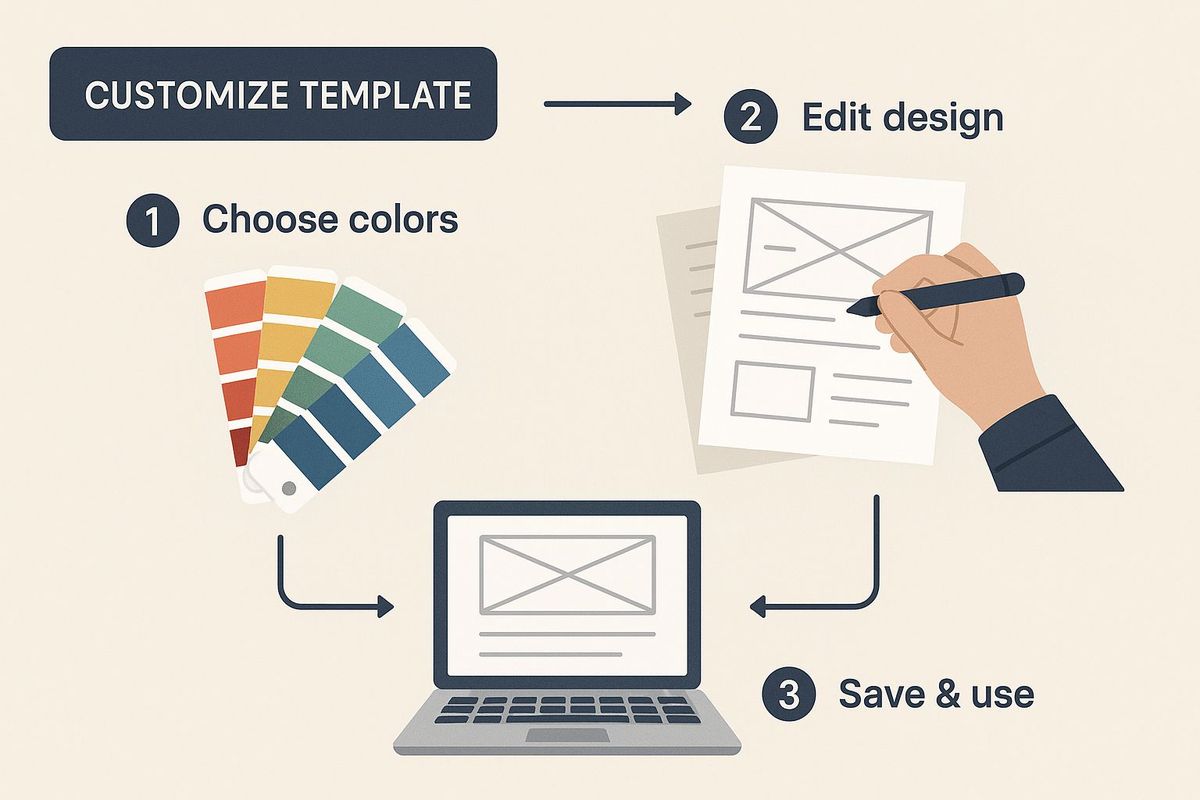
As you can see, the real work starts when you adapt that generic foundation to fit the unique needs of a specific role or project.
The Four Pillars of Performance
To build metrics that truly work, I always focus on four critical pillars: cost, punctuality, reliability, and quality. You can't just focus on one without the others.
Cost management is obviously huge—tracking the financials gives you a clear line of sight into your ROI. Punctuality is all about hitting deadlines, while reliability means you can count on them to consistently deliver. And of course, quality ensures the work actually meets the standards you agreed on. Businesses that nail these four areas almost always report better outcomes and fewer disputes. Cobblestone has some great insights on these key metrics as well.
These pillars give you a balanced view, making sure you aren't just pushing for speed at the expense of quality.
From Vague Goals to Concrete KPIs
Let's see how this plays out in the real world. Imagine you're bringing on a freelance video editor. The vague goal is "edit videos quickly." A strong performance agreement turns that into something you can actually measure.
Here’s what that looks like in practice:
- Quality: Maintain a revision request rate below 15% on all first drafts.
- Punctuality: Deliver 95% of all video projects by the agreed-upon deadline.
- Cost: Complete all projects within the pre-approved budget. Any overages need written approval first.
- Reliability: Acknowledge all new project assignments within four business hours.
See the difference? This approach removes all the guesswork. At the end of the month, you can look at the data and know exactly how the editor is performing.
Examples for Different Roles
The great thing about this framework is how adaptable it is. Whether you're managing a sales executive or a music producer, the principles are the same. It's just the metrics that change.
For a Sales Executive:
- Achieve $100,000 in new business revenue per quarter.
- Secure 10 meetings with qualified leads each month.
- Maintain a lead-to-close conversion rate of at least 20%.
For a Software Developer:
- Resolve 90% of assigned high-priority bugs within 48 hours.
- Keep code review turnaround time under 24 hours.
- Ensure new features have a bug report rate of less than 5% in the first week post-launch.
Remember, the best KPIs are developed collaboratively. Discussing these metrics ensures they are realistic and that the individual feels a sense of ownership over their targets. This isn't just about accountability; it's about alignment.
Building in Reviews and Benchmarks
Finally, your metrics need context. A solid performance agreement template should always include scheduled review periods—monthly, quarterly, or at key project milestones. These check-ins are absolutely crucial for talking about progress, dealing with roadblocks, and adjusting goals if things change.
Setting realistic benchmarks is just as important. If the industry average for a specific metric is 10%, setting a target of 2% might be completely unfair and demotivating. Do your homework. Make sure your KPIs are challenging but achievable.
This kind of careful planning doesn't just define what success looks like; it's also a vital part of effective contract risk management because it helps you spot potential issues before they blow up. This turns your agreement from a static document into a dynamic tool that drives real improvement.
A performance agreement template is a fantastic starting point, but it's never the finish line. A one-size-fits-all approach just doesn't work when the needs of a corporate sales director are worlds apart from those of a touring musician.
The real value comes from transforming that generic framework into a specific, relevant document that protects everyone involved. This is about more than just filling in names and dates; it’s where your template becomes a powerful, versatile tool instead of a generic piece of paper.
For the Corporate Professional
When you're adapting a performance agreement for a corporate role—say, a marketing manager or a financial analyst—the focus has to shift toward long-term, integrated goals. These aren't one-off gigs. The metrics are almost always tied to broader company objectives and team performance.
Your customization should really dig into clauses covering things like:
- Quarterly and Annual KPIs: Think beyond simple task completion. You need to get specific with metrics like lead generation growth, customer acquisition cost (CAC), or budget variance. For instance, a marketing manager's agreement might specify a goal to reduce CAC by 10% over six months.
- Team Collaboration: Corporate work is rarely done in a silo. It’s smart to include language about the employee's role in team projects and their contribution to the department's overall success.
- Confidentiality and Non-Compete: These are absolutely critical in a corporate setting. You need to be extremely specific about what constitutes confidential information and the exact terms of any non-compete, making sure it's reasonable in scope and duration.
- Professional Development: Is ongoing training or certification required to stay current? Spell it out. This sets clear expectations from day one.
This approach makes sure the agreement actually reflects the structured, ongoing nature of corporate employment.
For the Creative Performer
Now, let's pivot to a completely different world—the creative arts. When you’re drafting an agreement for a musical artist, an actor, or a public speaker, the entire structure changes. The focus is on specific events and deliverables, not continuous employment.
I've seen so many agreements for artists fall apart because they were based on a standard business template. For a gig-based performer, you need to get granular on the event itself.
Your performance agreement has to detail the who, what, when, where, and how of the performance. Ambiguity is the enemy of a successful creative partnership, and a detailed agreement is your best defense against "he said, she said" disputes down the road.
Key modifications for a creative’s agreement should include:
- Event Specifics: Don't just say "the gig." State the exact date, time, and location of the performance. Include the duration, like "a 60-minute musical set with one 15-minute encore."
- Technical and Hospitality Riders: These are non-negotiable. Attach detailed riders specifying all technical requirements (sound system, lighting, backline gear) and hospitality needs (dressing room, meals, travel).
- Payment Schedule: Creative work almost always involves a deposit. A common structure is 50% upon signing and 50% on the day of the performance. Detail this clearly, including acceptable payment methods and deadlines.
- Cancellation Clause: What happens if the artist cancels? What if the venue cancels? This clause must outline the financial penalties and notice periods for both parties. It protects everyone’s investment.
For the Freelance Consultant
Freelance consultants, whether they're in IT, business strategy, or design, occupy a middle ground. Their agreements are project-based like a performer's, but they often involve a much deeper integration with a client's business, almost like an employee.
When customizing your template for a consultant, the big three are deliverables, autonomy, and intellectual property.
- Project Deliverables and Milestones: Break the entire project down into clear, tangible deliverables with hard deadlines. For a web designer, this could be "Homepage wireframe by October 1st" and "Final site launch by December 15th."
- Intellectual Property Rights: This is huge. The agreement must explicitly state who owns the final work product. Does the client get full ownership upon final payment, or does the consultant retain rights to use it in their portfolio? Get this in writing.
- Independent Contractor Status: This is a crucial legal distinction. Always include a clause that clearly defines the consultant as an independent contractor who is responsible for their own taxes and benefits. It protects your business in a big way.
By tailoring your template to these specific scenarios, you create a document that is not only legally sound but also a practical guide for a successful working relationship.
Using Technology to Manage Your Agreements
Let's be honest. Relying on stacks of paper or a mess of digital folders to manage your performance agreements is a recipe for disaster. I’ve seen it happen time and again. Manual contract management is slow, full of potential for human error, and just can't keep pace with how fast business moves today.
Thankfully, there's a much better way to handle these critical documents. Moving from static Word files and endless email chains to a more dynamic system isn't a luxury anymore—it's essential if you want to be efficient and protect yourself from risk. Modern software can turn your standard performance agreement template into an intelligent, automated asset.
The Rise of Contract Lifecycle Management
The key is to embrace what we call Contract Lifecycle Management (CLM) software. And no, this isn't just a fancy digital filing cabinet. CLM platforms are specifically designed to oversee the entire journey of an agreement—from its initial draft and negotiation all the way through to execution, monitoring, and eventual renewal or termination.
Imagine automating the whole workflow. Instead of manually filling out a performance agreement template for every new hire or freelancer, the software can spit out a customized document in seconds, pulling in the right clauses and data for you. That shift alone can slash your administrative overhead.
For a more complete strategy for ensuring success and cutting down the risks tied to performance agreements, you'll want to dig into effective agreements management. These systems give you the framework to not just store your contracts, but to actually manage them.
Key Features That Make a Difference
So, what makes this tech so powerful? It really comes down to a few core features that solve the biggest headaches of manual contract management.
- Automated Template Generation: You can instantly create new agreements from pre-approved templates. This ensures every contract is consistent and compliant.
- Real-Time Collaboration: Multiple people can edit, comment on, and approve documents at the same time. This kills the version control chaos and the nightmare of back-and-forth emails.
- Digital Dashboards: Get a bird's-eye view of all your active agreements. You can track key dates, performance milestones, and potential risks without digging through a single file.
This kind of centralized control means you always know exactly where every agreement stands.
Speed and Intelligence with AI
The newest CLM platforms are taking things a step further by building in artificial intelligence. AI-native systems can supercharge your process, making it faster and a whole lot smarter. These tools can automatically scan agreements for risky language, non-standard clauses, or missing info, flagging potential problems before they blow up.
A great example is how AI-native platforms like Juro let users create, agree on, execute, and manage contracts up to ten times faster than with old-school methods. They do this by automating the creation of custom performance contract templates. Features like real-time collaboration and AI-powered risk analysis drastically cut down the time it takes to get a contract signed. You can learn more about AI-powered performance contracts on Juro.com to see it in action.
This AI-driven approach shifts contract management from a reactive chore into a proactive strategy. It helps you spot opportunities and head off risks you might have otherwise missed. This is especially valuable when you're dealing with complex agreements, like those involving intellectual property. For a deeper dive into that world, check out our guide on the intellectual property licensing agreement. By bringing technology into the mix, you not only save a ton of time but also add a layer of strategic thinking to every single performance agreement you handle.
Some Common Questions About Performance Agreements
Even with a great template in your hands, you’re bound to have some questions. These agreements can feel a little intimidating, but once you get a handle on the common sticking points, you'll be able to use them with confidence. Let's walk through some of the questions I hear most often.
We'll cover everything from their legal standing to what you should do when someone just isn't holding up their end of the bargain. The idea is to give you clear, straightforward answers you can actually use.
Is a Performance Agreement Legally Binding?
Yes, absolutely—as long as it has all the essential pieces of a valid contract. For an agreement to be enforceable in court, you generally need an offer, acceptance of that offer, consideration (meaning something of value is exchanged), and for everyone involved to intend for it to be a legal relationship. A solid template gives you the framework for all of these elements.
But here’s the thing: its real power depends on how clear the terms are and whether it follows local and state laws. While a template is an awesome starting point, having a legal professional look over the final document is always a smart play, especially if the stakes are high. That extra step makes sure everyone is protected and the agreement will actually stand up if it's ever challenged.
What Happens If Someone Fails to Meet the Terms?
This is exactly why a well-written termination or remedies clause is so important. A good performance agreement doesn't just lay out what success looks like; it also details the specific consequences of underperformance. This isn't about being harsh; it's about being clear from day one.
Those consequences can look very different depending on the situation:
- For an employee, it might be a formal warning followed by a structured Performance Improvement Plan (PIP).
- For a freelancer who blows a major deadline, it could mean financial penalties, like a reduced fee.
- For a serious breach, like leaking confidential information, it could lead to immediate contract termination.
The agreement needs to clearly define what counts as a breach and map out the step-by-step process for what happens next. This is a huge help because it prevents heated arguments down the road by making the rules—and the consequences—crystal clear from the beginning.
A performance agreement's true strength lies not just in defining success, but also in clearly outlining the path forward when things go wrong. By establishing the consequences for non-performance upfront, you transform potential conflicts into manageable, process-driven conversations.
How Often Should a Performance Agreement Be Reviewed?
This document should never be a "set it and forget it" piece of paper. Its value comes from being a living guide that reflects the current reality of the work being done. How often you should review it really depends on the nature of the relationship.
For ongoing employment, tying reviews to formal performance appraisals—like annual or semi-annual reviews—is a standard and effective approach. For project-based work with freelancers or artists, it makes more sense to schedule reviews at key project milestones. For instance, you could check in after the first draft is delivered or once the initial phase of development is complete. These regular check-ins give both parties a chance to discuss progress, work through challenges, and adjust goals or timelines if needed.
Can I Use a Free Online Template?
You can, but you really need to be careful. A lot of free templates are incredibly generic. They often miss the specific legal requirements for your state or city, and they almost never cover the unique, nuanced details of your specific situation.
Think of a free template as a basic blueprint. It's useful for understanding the general structure and the types of clauses you’ll need. But you absolutely have to customize it heavily to fit what you're actually doing. Relying on a generic, un-reviewed performance agreement for anything involving significant money or business risk is a recipe for disaster. For real peace of mind and proper legal protection, getting it professionally customized is the only way to go.
Navigating the complexities of performance agreements requires more than just a template; it demands strategic legal insight. At Cordero Law, we specialize in crafting and reviewing agreements that protect your interests and empower your professional relationships. Whether you're a business owner, artist, or innovator, we provide the personalized counsel you need to build a solid foundation for success. Learn how we can help you at corderolawgroup.com.