Securing a trademark for your brand in the US is a journey. It involves a deep dive into research, carefully putting together your application, and filing everything with the United States Patent and Trademark Office (USPTO). This process is what locks down your brand identity, but here's the honest truth: your success hinges on the prep work you do long before you even see a single form.
Laying the Groundwork for Your Trademark Application
Before you even think about filing, you need to pause and build a solid foundation. Rushing this stage is a classic mistake that can lead to a costly rejection from the USPTO. This isn't just about paperwork; it's about making sure the brand name or logo you've chosen is strong, actually available, and ready for the official review process.
This prep work is more important than ever. The sheer volume of trademark applications is staggering, with the USPTO receiving nearly 765,000 in a recent fiscal year. What’s really telling is that 45% of these were "use-based" filings. That means almost half of all applicants were already using their brand in the market, showing a clear trend of businesses trying to lock down rights they've already built. This crowded field means your first move—a comprehensive search—is absolutely non-negotiable.
The Critical First Step: Your Trademark Search
A quick Google search for your name is fine for a gut check, but it's nowhere near enough for a real trademark clearance. You have to go where the decisions are made: the USPTO’s own Trademark Electronic Search System (TESS). This is the official database of all registered trademarks and pending applications that could potentially block your own.
Your goal here is to see if your mark is too similar to an existing one, which could create a "likelihood of confusion." This is the number one reason applications get refused. It doesn't mean the marks have to be identical, either. Similarity in sound, appearance, or even the overall commercial impression can be a deal-breaker, especially if the goods or services are related.
Pro Tip: Don't just search for the exact spelling of your name. You need to think like a USPTO examining attorney. Search for phonetic equivalents (like "Kwik" vs. "Quick"), different spellings, and similar concepts. If you don't do this, they will, and you won't like the result.
Here's what the official USPTO trademark homepage looks like. Get familiar with it, as it's your main resource.
This portal is your gateway to the TESS database, the filing systems, and tons of guides that break down the entire registration process.
Before you file, running through a quick checklist can save you a world of trouble. It ensures you've covered your bases and aren't walking into the application process blind.
Trademark Registration Readiness Checklist
Checklist Item Status Why It Matters Comprehensive Search in TESS ☐ Complete This is non-negotiable. It's the only way to know if a conflicting mark already exists. Common Law Search (Google, etc.) ☐ Complete Uncovers unregistered uses that could still have regional rights and cause issues later on. Identified Correct IP Type ☐ Complete Ensures you're not filing a trademark when you really need a copyright or patent, saving time and money. Finalized Mark (Name/Logo) ☐ Complete The mark you file is the mark you get. Last-minute changes mean starting the whole process over. Defined Goods/Services ☐ Complete You must be very specific. This determines the scope of your protection and the filing fee.
Completing this checklist gives you the confidence that your mark stands a real chance of getting approved, which is the whole point of the exercise.
Distinguishing Your Intellectual Property
It’s also crucial to know exactly what a trademark does and doesn't protect. A trademark is a brand identifier—it’s all about protecting the names, logos, and slogans that tell customers your products or services are yours. It's a completely different tool than other forms of intellectual property.
- Trademarks: Protect your brand identifiers, like the Nike "swoosh" or the name "Coca-Cola."
- Copyrights: Protect creative works like books, songs, photographs, and software code.
- Patents: Protect inventions—things like new machines, processes, or chemical compounds.
Getting these mixed up is a common and expensive mistake. You could waste months and hundreds of dollars filing for the wrong kind of protection. For a more detailed look at this, our guide on trademarking a business name goes deeper into what qualifies for trademark protection. Getting this right from the start ensures your application is aimed at the right target.
Choosing the Right Filing Basis for Your Business
Okay, you’ve done the detective work and completed a comprehensive search. Now comes the next big strategic move: picking your filing basis. This isn't just checking a box on a form—it's a declaration about where your business stands right now and determines the kind of proof you'll need to provide later. Getting this right from the get-go is a critical part of registering a trademark without hitting unnecessary roadblocks.
The United States Patent and Trademark Office (USPTO) gives you two main paths. Your choice boils down to one simple question: are you already selling products or services with your brand name, or are you about to launch? Your answer will point you toward either a "Use in Commerce" or "Intent to Use" filing.

Filing as a Use in Commerce Applicant
This is the most straightforward route, known officially as a Section 1(a) basis. You’ll choose this path if your brand is already out in the world and active. This means you’ve made legitimate sales of goods or provided services to customers across state lines or internationally.
Think of it like this: if you have an online shop and you've already shipped t-shirts with your logo to customers in different states, you are using your mark "in commerce." The same goes for a consultant who has billed clients outside their home state under their brand.
To prove it, you’ll have to submit what’s called a specimen of use.
A specimen is real-world proof showing how customers actually see your mark. It’s not a mockup or a simple flyer; it has to be evidence of your mark being used as a brand identifier with the specific goods or services you're claiming.
For products, a good specimen could be:
- A photo of a tag or label physically attached to the product.
- A clear picture of the mark on the product's packaging.
- A screenshot from your e-commerce site where customers can buy the item, showing the mark near the "Add to Cart" button.
For services, acceptable specimens often include:
- Screenshots from your website where the services are advertised and offered.
- A photo of your business sign where you perform the services.
- Marketing materials, like a brochure, that directly promote the services under your brand.
Trust me, submitting a weak or incorrect specimen is one of the most common reasons an application gets flagged by a USPTO examiner.
Filing with an Intent to Use
But what if your brand is still in the works? That's exactly what the Section 1(b) or "Intent to Use" (ITU) basis is for. This option is an incredibly powerful tool for entrepreneurs who want to lock down their trademark rights before the official launch.
An ITU application lets you reserve your place in line by establishing a priority date for your mark. This is huge. It can stop a competitor who starts using a similar name after you file from gaining rights over you. You're essentially telling the USPTO, "I have a genuine, good-faith intention to use this mark in commerce, and I'm getting there."
The process is a bit different. You file the initial application without a specimen. If the USPTO examining attorney gives your mark the green light, it will be published for opposition. If no one objects, you'll receive a Notice of Allowance.
From here, the process merges back with the "Use in Commerce" path. Once that Notice of Allowance is in your hands, you have six months to either:
- File a Statement of Use (SOU), which includes an acceptable specimen and the required fee.
- Request a six-month extension if you need more time to start using the mark.
You can request up to five extensions, giving you a total of 36 months from the date of the Notice of Allowance to show proof of use. This flexibility is a lifesaver for businesses with long development cycles or those still nailing down their launch strategy. After successfully completing your initial search, which you can learn more about in our guide on how to do a trademark search, picking the right filing basis truly sets the stage for a smoother journey ahead.
Navigating the Official USPTO Application Form
Alright, you've done your homework. The search is complete, your strategy is locked in, and now it's time for the main event: filling out the application on the USPTO's Trademark Electronic Application System, or TEAS.
Think of this as way more than just another online form. Every single field you fill out is a strategic decision that will define the legal muscle behind your trademark. Getting this part right is everything.
This is where all that prep work really pays off. The TEAS form asks you to formalize all your decisions, from the exact mark you're protecting to the specific goods and services it covers. Be meticulous. Even tiny mistakes can cause major delays or, worse, an outright rejection from a USPTO examining attorney.
Who Actually Owns the Mark?
One of the first—and most critical—questions is identifying the trademark owner. It sounds simple, but you'd be surprised how often people get this wrong. The owner must be the person or legal entity that actually controls the quality of the goods or services sold under the brand.
So, is it you personally, or is it your business?
- Individual Ownership: If you're a sole proprietor and haven't set up a separate business entity, then you're the owner.
- Entity Ownership: If you've formed an LLC, S-Corp, or C-Corp, the company itself owns the trademark, not you.
Listing the wrong owner can cause huge legal headaches down the line and might even invalidate your entire application. Before you type a single letter, pull out your business formation documents and make sure the owner's name is entered exactly as it's legally registered.
Selecting Your International Classes
Next up, you have to tell the USPTO what your trademark actually protects. This is done by selecting from 45 different "international classes"—34 for goods and 11 for services. This is a big deal because your filing fee is calculated per class, so this choice directly impacts your budget.
For instance, a clothing brand selling t-shirts would file in Class 025 (for clothing). But what if that same brand also runs an online store selling those shirts? That's a retail service, which means they would also need to file in Class 035 (for advertising and business services). Two classes, two fees.
A Critical Warning: Misclassifying your goods or services is one of the fastest ways to get your application rejected. You have to be precise. If you sell downloadable software, that's Class 009. But if you offer that same software as a service online (SaaS), it falls into Class 042. That distinction means everything to an examiner.
Writing a Crystal-Clear Description of Goods and Services
Once you've picked your class(es), you have to write a super clear, concise description of your offerings. Your best bet is to use the USPTO's Trademark ID Manual. It's a goldmine of pre-approved descriptions that examiners already know and accept, which can seriously speed up the review process.
If you can't find a perfect match, you can write your own. But be careful. The language has to be specific. Vague terms like "business services" or "computer products" will get shot down immediately.
Let's say you're launching a coffee brand called "Rocket Fuel."
- Weak Description: "Beverages" (Way too broad).
- Strong, Acceptable Description: "Roasted coffee beans; Ground coffee; Coffee." (Specific, accurate, and perfect for Class 030).
This level of detail leaves no doubt about what your mark covers.
Submitting a High-Quality Mark Drawing
Finally, you’ll submit a "drawing" of your mark. This isn't a sketch—it's the official version of what you want to register. You have two main options here.
- Standard Character Drawing: This is for word marks. Think names or slogans with no particular font, color, or design. You just type the words into the form. This option gives you the broadest protection because it covers the use of those words in any design.
- Special Form Drawing: This is for logos, stylized text, or any mark with a design element. You have to upload a clean, high-resolution JPG or PDF. What you upload is exactly what gets protected, so make sure it's the final version.
Submitting a blurry or low-quality image is a guaranteed way to get an Office Action from the USPTO, forcing you to fix it and delaying your application. Take your time with the TEAS form. Getting every detail right from the start will save you a world of frustration and help you secure the strong legal rights your brand deserves.
Understanding the Real Costs of Trademark Registration
Figuring out the budget for your trademark application is a huge part of the process. Trust me, the final price tag is almost always more than just the initial filing fee you see on the website, so getting a clear financial picture from the very beginning is key.
Let's break down the real costs you can expect. No surprises, just a straight-up look at what it takes to protect your brand.

The first cost everyone notices is the base application fee. But it’s not a single flat rate. The fee is calculated per class of goods or services you select for your mark.
This catches a lot of people off guard. If your brand covers multiple categories—say, you sell branded coffee mugs (Class 021) and also operate a coffee shop (Class 043)—you're going to pay a separate fee for each of those classes.
The Standard USPTO Filing Fees
The USPTO has updated its fee structure recently, moving to a single electronic base application. The standard filing fee is now $350 per class of goods or services.
They've also introduced some new charges designed to encourage people to file more accurate and complete applications from the get-go. For example, if you decide to write your own custom description for your goods instead of picking from the USPTO’s pre-approved ID Manual, you could be hit with an extra $200 per-class fee. These adjustments are meant to improve the quality of filings, but they can definitely bump up your total cost.
These initial fees are really just the starting line. The choices you make as you fill out the application can either save you money or send your budget climbing.
How Filing Choices Impact Your Budget
The way you describe your goods and services has a direct impact on your wallet. As I mentioned, writing a custom description instead of using the Trademark ID Manual tacks on a fee. While a custom description is sometimes unavoidable for a truly unique product, sticking to the manual is one of the simplest ways to keep your initial expenses down.
Let's look at a real-world scenario.
A new apparel brand, "Urban Threads," wants to register its name. They sell t-shirts and hats, but they also offer an online styling service.
- Goods: T-shirts and hats fall under Class 025.
- Services: The online styling service falls under Class 045.
If they use the pre-approved descriptions from the ID Manual for both, their initial filing cost is a straightforward $700 ($350 x 2 classes). But if they get creative and write a custom description for their styling service, that second class fee could jump, increasing their total cost right out of the gate.
The lesson here is pretty clear: being strategic and careful when preparing your application isn’t just about getting approved—it’s also a cost-saving measure. Every single decision, from your goods description to your filing basis, has a dollar sign attached to it.
Potential Costs After You File
And the expenses don't necessarily stop once you hit "submit." There are several situations that can trigger more fees during the review process and even after your mark is registered.
Here are some of the most common post-filing costs to keep on your radar:
- Statement of Use (SOU): If you filed with an "Intent to Use" (ITU) basis, you'll eventually need to file an SOU to prove you're actually using the mark in commerce. This currently costs $100 per class.
- Extension Requests: Need more time to get that SOU filed? Each six-month extension will set you back $125 per class.
- Office Action Responses: This is a big one. If a USPTO examining attorney issues a refusal (an "Office Action"), there isn't a government fee to respond. However, you'll almost certainly want to hire an attorney to draft a strong legal argument, and those professional fees can be significant.
By understanding this complete financial picture, you can budget effectively and avoid the sticker shock that trips up so many unprepared brand owners.
Hitting the 'submit' button on your trademark application is a huge milestone, but it's really just the beginning of the journey. The next phase is all about patience as your application enters the queue at the United States Patent and Trademark Office (USPTO). This is where the real waiting game begins.
Once filed, your application gets assigned to a USPTO examining attorney. This is the legal expert who will review every detail you submitted, from your mark's drawing to the description of your goods and services. Their job is to make sure your application follows federal law and doesn't conflict with any existing registered trademarks.
This initial review isn't quick. It can take months before an examiner even lays eyes on your file for the first time.
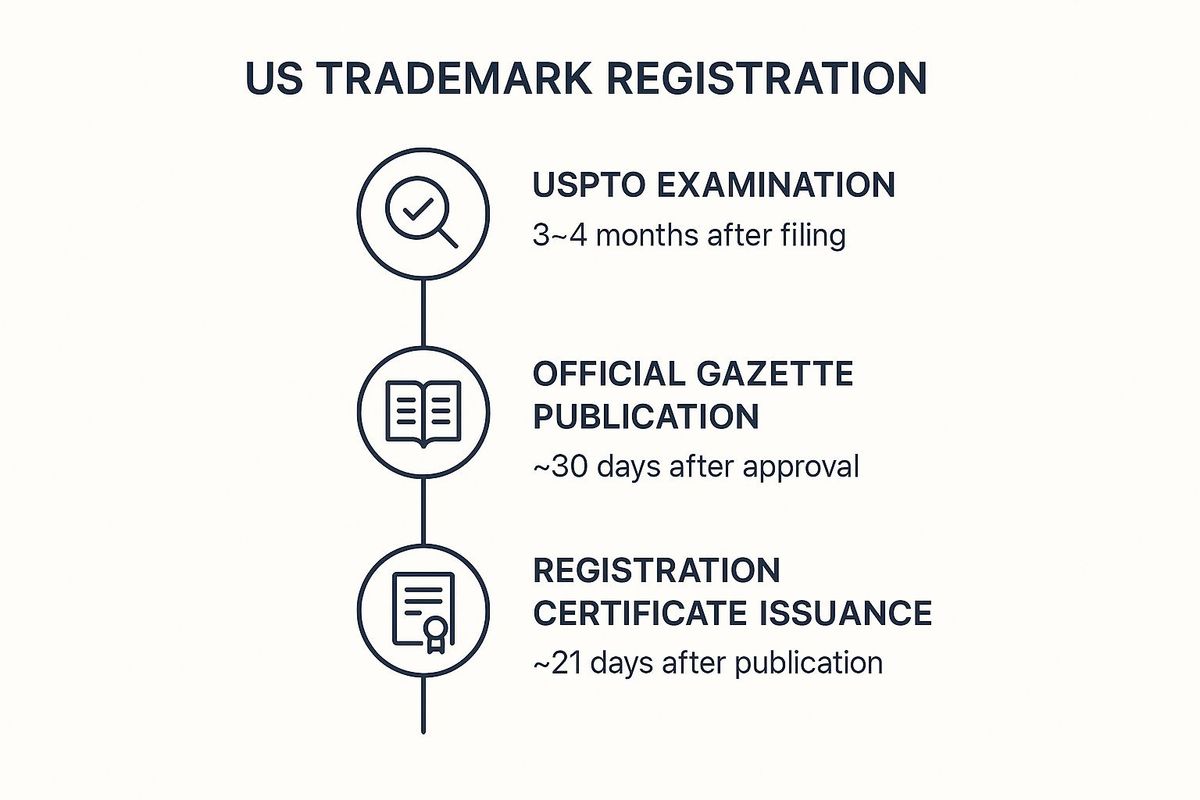
As you can see, a significant chunk of time is spent just waiting for that initial examination. It really sets the pace for the entire process.
Here’s a more detailed breakdown of what that timeline typically looks like after you've filed.
Trademark Application Timeline What to Expect
Stage Estimated Timeframe What Happens During This Stage Initial Review 3-6 Months Your application is assigned to a USPTO examining attorney who reviews it for legal compliance and potential conflicts. Office Action Response 1-6 Months If issues are found, you receive an Office Action. You have up to six months to respond, and the examiner reviews your response. Publication 1-3 Months If approved, your mark is published in the USPTO’s Official Gazette for 30 days, allowing others to oppose its registration. Registration 2-3 Months Assuming no opposition, the USPTO issues your official Certificate of Registration.
This table provides a rough sketch, but remember that every application is different. A smooth process is always the goal, but hiccups can and do happen.
Facing a Potential Office Action
After the examiner’s review, one of two things will happen. In a perfect world, they approve your application for publication. But it's very common to receive what's called an Office Action.
An Office Action is an official letter from the examining attorney detailing legal problems with your application. These can be minor procedural slip-ups or major roadblocks.
Common reasons for an Office Action include:
- Likelihood of Confusion: The examiner believes your mark is too similar to an existing registered trademark, which could confuse consumers. This is the big one.
- Merely Descriptive: Your mark is seen as just describing a quality of your goods or services (think "Creamy" for ice cream).
- Incorrect Specimen or Classification: The proof of use you submitted isn't acceptable, or you've placed your goods in the wrong international class. For a deeper dive, check out our guide on what is a service mark.
You’ll have a strict deadline, usually six months, to file a formal response. This isn't just a quick email; it requires a well-reasoned legal argument and evidence to overcome the objections. Responding effectively is critical—if you don't, your application will be abandoned.
The Publication and Opposition Period
If your application makes it through the examination phase (either right away or after you successfully respond to an Office Action), your mark gets published in the USPTO’s Official Gazette. This is a weekly online publication that puts your mark on public display for 30 days.
The whole point is to allow anyone who believes they would be harmed by your registration to oppose it. For instance, a company that has been using a similar, unregistered name for years might file an opposition, kicking off a legal proceeding similar to a mini-trial within the USPTO.
While oppositions are relatively rare for most small businesses, it's a crucial step. If no one opposes your mark within that 30-day window, you've cleared the final major hurdle.
Key Takeaway: The entire process from filing to registration can be a long one, often taking 12 to 18 months or more. Be prepared for potential delays. With over half a million pending cases, workforce constraints and administrative decisions at the USPTO can sometimes extend wait times, creating uncertainty for businesses.
Receiving Your Registration Certificate
Once the opposition period ends without a hitch, the moment you've been waiting for is finally here. The USPTO will officially register your trademark and issue your registration certificate.
This certificate is the ultimate proof of your federal ownership.
With this document, you have the exclusive right to use your mark nationwide for the goods and services listed in your application. It also grants you the right to use the coveted ® symbol, putting the world on notice that your brand is federally protected. You can now take legal action against infringers in federal court and even work with U.S. Customs to block counterfeit goods from entering the country. Your patience has paid off.
Keeping Your Trademark Strong After Registration
So you did it. You navigated the entire process, and your trademark is officially registered with the USPTO. Take a moment to celebrate—it’s a huge milestone. But the work isn't quite over.
Think of your registered trademark less like a finish line and more like a valuable asset. And like any valuable asset, it needs ongoing care to maintain its strength and legal muscle.
Federal trademark rights aren't a "set it and forget it" deal. They hinge on you actively using your mark in the real world and defending it. The United States Patent and Trademark Office (USPTO) will check in periodically, requiring you to prove you're still using your brand in commerce by filing specific maintenance documents. Missing these deadlines isn’t an option. It leads to the automatic cancellation of your registration, and all that hard work goes down the drain.
Your Post-Registration Maintenance Calendar
The first big deadline pops up way sooner than most new trademark owners expect. Between the fifth and sixth year after your registration date, you have to file a Declaration of Use, which the pros call a Section 8 filing. This is basically a sworn statement confirming your mark is still being used for the goods or services you originally registered it for. You’ll need to submit a current specimen as proof.
The next crucial window is between the ninth and tenth year. This time, you'll file a combined Section 8 Declaration of Use and a Section 9 Application for Renewal. This two-in-one filing is what renews your trademark for another full ten-year period. From here on out, you’ll need to file this combined renewal every ten years to keep your registration alive and well indefinitely.
Mark your calendar now. Here are the filings you can't miss:
- Year 5-6: File a Section 8 Declaration of Use.
- Year 9-10: File a combined Section 8 Declaration & Section 9 Renewal.
- Every 10 Years After That: Keep filing the combined Section 8 & 9 renewal.
Crucial Insight: Missing a filing deadline is one of the most common—and devastating—mistakes a trademark owner can make. The USPTO is incredibly strict about these dates. While there are very limited and expensive grace periods, it’s best to treat these deadlines with the same seriousness as you would your tax filings.
Actively Using and Defending Your Mark
Beyond the required paperwork, keeping a trademark strong means being proactive out in the marketplace. Honestly, your rights are only as strong as your willingness to enforce them.
One of the first things you should do post-registration is start using the federal registration symbol: ®. This little symbol is powerful. It puts the public on official notice that your mark is registered and that you claim exclusive nationwide rights. Using it can seriously strengthen your case in any potential infringement disputes down the line.
You also have to keep an eye on the market for potential copycats. This means watching for other businesses using a name or logo that's confusingly similar to yours. If you spot one, it’s on you to take action. This usually starts with a cease and desist letter from an attorney.
Letting infringers slide can weaken your mark over time. If a court sees that you haven't been diligent in policing your brand, it might rule that your mark has lost its distinctiveness. There's a legal term for this: genericide. It's how powerhouse brands like "aspirin" and "escalator" lost their trademark status and became generic terms for a product.
By consistently using, monitoring, and maintaining your trademark, you ensure that the asset you worked so hard to register continues to be a powerful shield for your brand for years to come.
A Few Common Questions
How long does it take to register a trademark in the US?
I get this one a lot. The honest answer is: it takes a while. You should plan for the entire process to take anywhere from 12 to 18 months.
Now, that timeline can stretch even longer if the USPTO issues an Office Action (basically, a rejection letter we have to respond to) or if another company decides to oppose your application. Just the initial review by the examining attorney can take several months, so patience is key.
Should I hire a lawyer or do it myself?
Look, you can file an application on your own. But the reality is that the process is legally complex, and it’s very easy to make a critical mistake that costs you your application fees and, worse, your brand protection.
Hiring an experienced trademark attorney isn't just about filling out a form; it's about strategy. A good lawyer dramatically increases your chances of success, knows how to navigate the inevitable challenges, and can save you a ton of time and money in the long run by getting it right from the start.
What are the TM, SM, and ® symbols for?
This is a great question because people often use these incorrectly. Here’s the simple breakdown:
- TM (Trademark) and SM (Service Mark) are what you use for unregistered marks. They put the world on notice that you're claiming common-law rights to that name or logo for your goods (TM) or services (SM). You can start using these right away.
- The ® symbol is the big one. It signifies a federally registered mark with the USPTO. You can only use this symbol after your registration is officially approved. Using it before then can get you into serious trouble.
Navigating the world of trademarks is what we do at Cordero Law. We help clients build and protect their brands with smart legal strategy. If you're ready to talk about your trademark goals, let's connect. Visit us at corderolawgroup.com to get the conversation started.