At its core, a publishing deal is a formal, legal partnership between you, the author, and a publishing house. It’s a contract that gives the publisher specific rights to edit, produce, market, and distribute your manuscript.
In return for those rights, you get an advance payment against future earnings and ongoing royalties from sales. Simply put: you bring the creative magic, and they bring the industry muscle to turn your manuscript into a book and get it onto shelves (both physical and digital).
Your First Look at a Publishing Deal
Think of a publishing deal like a joint venture. You've created the most important asset—the story. The publisher is the investor and manufacturer who sees commercial potential in your work. They agree to put their money, team, and resources on the line to bring your book to the widest possible audience, and you both share in the profits.
This whole arrangement is laid out in a detailed contract that spells out exactly who is responsible for what. The publisher gets certain rights to your work, and in exchange, they manage the entire journey from Word doc to bookstore.
Roles and Responsibilities
Getting this relationship right is crucial. While it’s definitely a partnership, each side has very distinct jobs. Your role is primarily creative. The publisher's role is commercial and logistical. The end goal is the same—a successful book—but the day-to-day tasks are clearly divided.
To make this crystal clear, let's quickly break down who typically handles what in this partnership.
Author vs Publisher Roles at a Glance
This table gives you a quick snapshot of the main responsibilities. Of course, the specifics can vary from deal to deal, but this covers the general division of labor.
Responsibility Author's Role Publisher's Role Content Creation Write and deliver a complete, high-quality manuscript. None - this is the author's sole responsibility. Editing & Design Collaborate on edits and provide feedback on cover concepts. Provide professional editing, copyediting, cover design, and interior layout. Production & Printing Review final proofs for errors before printing begins. Manage and fund the entire printing and manufacturing process. Marketing & Publicity Actively participate in promoting the book through events and social media. Develop and execute a comprehensive marketing and publicity strategy. Distribution None - the author does not handle getting books into stores. Secure placement in physical and online bookstores globally. Financial Investment No upfront cost; invests time and creative effort. Pays the author an advance and covers all production and marketing costs.
As you can see, the publisher takes on all the direct financial risk, freeing you up to focus on writing and connecting with readers.
This partnership model is the engine of a huge global industry. In fact, the book publishers market is projected to hit an incredible USD 149,190.80 million by 2035. That kind of growth shows just how vital these author-publisher relationships are for bringing new stories to the world. You can dig deeper into these market trends and their implications for authors if you're curious about the bigger picture.
Understanding the Language of Your Contract

Stepping into the world of publishing deals means learning a new language. These contracts are packed with terms that can feel intimidating at first, but they’re the absolute bedrock of your partnership with a publisher. Getting a handle on these key clauses is the only way to know exactly what you’re signing.
Let's demystify the three concepts you'll absolutely run into: the advance, royalties, and rights. Think of these as the financial engine and the ground rules for your book deal.
The Advance: An Upfront Investment
The advance is the money a publisher pays you before your book ever hits a single shelf. It's that number people are talking about when they say what a book "sold for." You can think of it as an upfront, risk-free loan against your book's future sales.
Here's the best part: if your book doesn't sell enough to cover this initial payment, you don't have to pay it back. That financial risk is all on the publisher. A recent analysis of over 1,400 author responses found the median advance was $25,000, though this figure can vary wildly.
The advance is your security. It’s the publisher's vote of confidence in your work, providing you with funds while you write and before a single copy is sold.
This payment isn't usually one lump sum. It's often split into chunks—for example, you might get a third when you sign the contract, another third when you turn in the final manuscript, and the last third on publication day.
Royalties: Your Slice of the Sales
Once your advance has "earned out"—meaning your cut of the book sales has finally covered that initial payment—you start getting royalties. These are a percentage of sales, and they represent your ongoing income from the book.
Royalty rates aren't one-size-fits-all; they change based on the book's format. A typical contract might break it down like this:
- Hardcover: Often starts at 10% of the retail price, with the potential to increase as you sell more copies.
- Paperback: Usually a bit lower, sitting around 7.5%.
- Ebook: This is generally the highest rate, often around 25% of the net receipts (what the publisher gets after the retailer takes its cut).
This structure means the format your readers prefer has a direct impact on what you make from each sale.
Rights: What You Give and What You Keep
Finally, the contract will lay out the specific rights you are granting to the publisher. This is a critical point to grasp: you aren't selling your story outright. You are licensing specific rights for them to use.
These rights detail how and where your book can be published and are usually split into two main buckets:
- Primary Rights: These almost always cover the basics, like the right to publish in print, ebook, and audiobook formats within a certain territory (like North America).
- Subsidiary Rights: This is everything else. We're talking foreign translation rights, film and TV adaptation rights, and even merchandising.
Negotiating which of these subsidiary rights you hold onto can be a huge part of the contract process. Having a skilled agent or lawyer in your corner can help protect these valuable assets for the future. To see how these principles work across different creative fields, you can explore more about the nuances of contracts for entertainment professionals.
Comparing Different Types of Publishing Deals
Not every publishing deal is cut from the same cloth. The path you choose really comes down to your personal goals, your creative vision, and just how much control you want to keep over your work. Getting a handle on the basic differences between the models is the first real step toward finding the right home for your book.
The most famous route is the traditional publishing deal. This is the classic setup where an author partners with a major publishing house. The publisher then foots the entire bill for everything—editing, design, printing, marketing, and distribution. In exchange, the publisher acquires the rights to the book and pays the author an advance against future royalties.
Think of the big names like MacMillan Publishers, Penguin Random House, and Harper Collins Publishers. They are the heavyweights in this space. If you want to dig deeper into the global trends, you can explore some fascinating insights on book sales statistics.
The Rise of Independent and Hybrid Models
Moving beyond the giants, independent presses offer another fantastic option. These smaller publishers often give you a much more personal, hands-on experience. Sure, their marketing budgets and distribution networks might not have the same muscle as a major house, but they are known for championing unique voices and giving authors more creative input. An indie press could be the perfect place for a niche book that a bigger publisher might pass on.
Then you have the hybrid publishing model, which is exactly what it sounds like: a mix of traditional and self-publishing. In this setup, the author pays an upfront fee to cover some production costs. The trade-off? You get a much, much higher royalty rate—often 50% or more—and you usually hang on to more of your rights. This path is great for entrepreneurial authors who are confident their book will sell and want a bigger piece of the pie.
Choosing a publishing path is about aligning the deal's structure with your definition of success. Do you want the prestige and reach of a major publisher, the creative partnership of an indie press, or the high-earning potential of a hybrid model?
Each option comes with its own distinct balance of risk and reward. Traditional publishing offers validation and a wide reach with zero upfront cost, but your slice of the royalties is smaller. On the flip side, hybrid and self-publishing models put more of the financial and creative control right back in your hands.
This infographic breaks down some of the key financial and rights differences between a traditional deal and full self-publishing, which sits at the other end of the control spectrum.
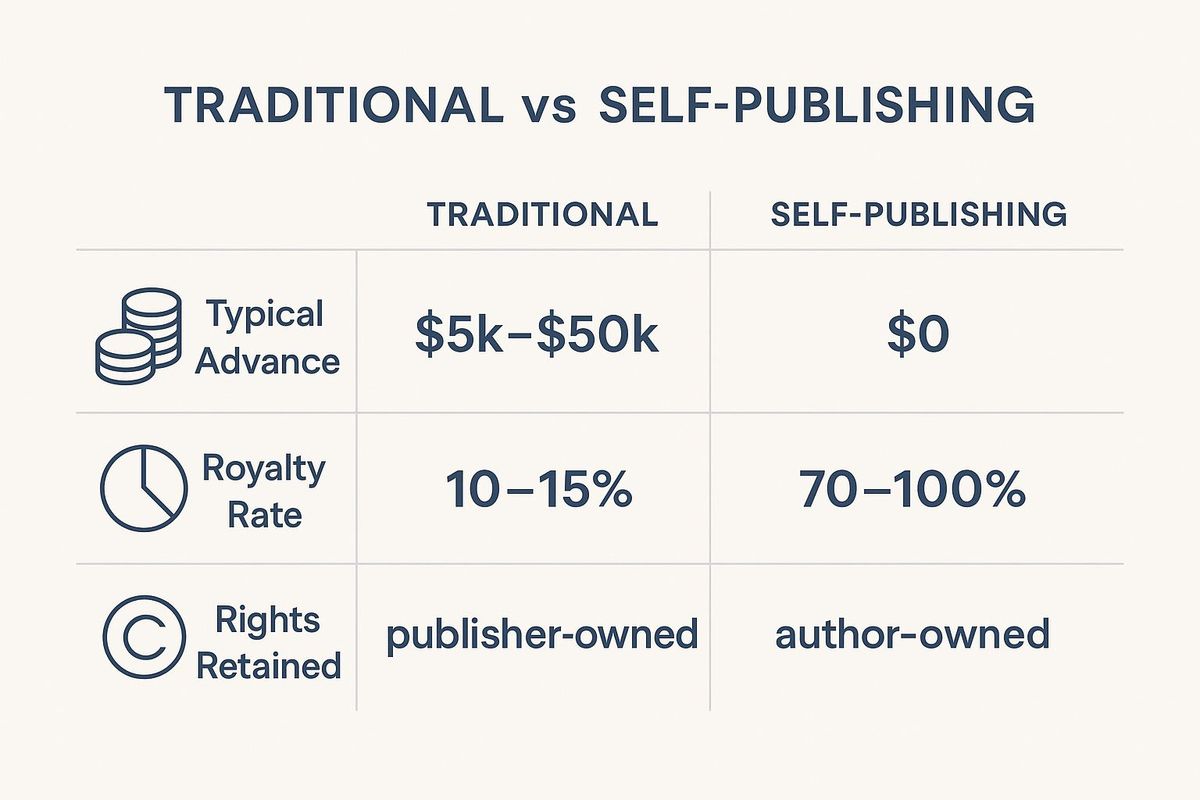
As you can see, it's a clear trade-off. Traditional publishers pay an advance but take a much larger cut of the royalties and control more rights. Self-publishing gives the author full ownership and higher earnings per sale, but you have to make the upfront investment and shoulder all the risk yourself.
Comparing Publishing Deal Models
To make things even clearer, let's break down the key differences side-by-side. This table should help you weigh the pros and cons of each model as you think about what works best for you and your manuscript.
Feature Traditional Publishing Independent Press Hybrid Publishing Upfront Cost None for the author. None for the author. Author pays a fee to cover production costs. Advance on Royalties Yes, typically offered. Sometimes, but usually smaller. No, author invests upfront. Royalty Rates Lower (5-15% is common). Can be slightly higher than traditional. Much higher (often 50% or more). Creative Control Publisher has the final say on most aspects. More collaborative; author has more input. Author retains significant creative control. Distribution & Reach Extensive network (global reach is possible). More limited, often focused on specific niches. Varies by publisher; can be extensive. Marketing Support Publisher handles major marketing campaigns. Varies; often a collaborative effort. Author often leads marketing with publisher support. Rights Ownership Publisher typically acquires most rights for a set term. Often more flexible; author may retain more rights. Author usually retains most or all subsidiary rights.
Ultimately, there's no single "best" option—only the best option for you. Consider your financial situation, your willingness to be involved in the business side of things, and your long-term career goals. Each path can lead to success, but they require very different things from an author.
How Digital Formats Are Changing the Game

If you think a publishing deal is still just about hardcover books lining a bookstore shelf, it's time for an update. The game has completely changed. These days, any solid publishing deal has to tackle the world of ebooks and audiobooks head-on, because that's where a huge chunk of your audience—and your income—is waiting.
The shift to digital isn't a small ripple; it's a tidal wave. We're looking at a global digital publishing market set to explode from USD 97.36 billion in 2024 to an incredible USD 248 billion by 2034. What's fueling this? Subscription models, which already make up over 61% of the market, are a huge part of it, thanks to the sheer convenience of reading on our phones and tablets. You can get a deeper look into the future of digital publishing on market.us.
Understanding Digital Royalty Rates
One of the biggest differences you'll spot in a modern contract is how digital royalties are calculated. They just don't look like print royalties. For a hardcover, you might see a rate of 10-15% based on the cover price. For an ebook, the standard is usually around 25% of the net receipts.
So, what are "net receipts"? In plain English, it's the cash the publisher actually gets from a retailer like Amazon after they've taken their cut. Since ebooks don't have printing, shipping, or warehouse costs, the publisher’s margins are much healthier, which allows them to offer you a better royalty rate.
The same logic holds for audiobooks. While there are production costs to consider (paying a narrator, booking studio time), you skip all the physical printing and distribution expenses. This means your audiobook royalties will almost always be based on net receipts, too, making sure you get a fair piece of the digital pie.
The Publisher's Role in a Digital World
In a world where readers are scrolling, not strolling through bookstores, a publisher's job is so much more than getting your book onto a physical shelf. Their role in digital distribution is arguably even more critical for reaching a worldwide audience.
Here’s a snapshot of what a good publisher handles on the digital front:
- Platform Distribution: They navigate the maze of getting your ebook and audiobook properly listed on all the major players—Amazon Kindle, Apple Books, Kobo, Audible, you name it.
- Metadata Optimization: Your publisher makes sure your book’s metadata (think keywords, categories, and descriptions) is fine-tuned so that readers searching for their next favorite book actually find yours.
- Digital Marketing: They're the ones running targeted online ad campaigns on platforms like Facebook, Amazon, and BookBub to push digital sales and downloads.
- Price Promotions: A savvy publisher knows how to strategically discount your ebook for limited-time promotions, which can rocket it up the bestseller charts and give it a huge visibility boost.
Don't skim over the digital clauses in your contract. They aren't just minor details; they are absolutely central to your book's long-term financial success. A publisher with a sharp digital strategy can dramatically increase your earnings and grow your readership for years to come.
And what about subscription services like Kindle Unlimited? That's the publisher's territory, too. They understand how these "all-you-can-read" models work, where authors are paid from a shared pool based on pages read. It's yet another income stream that a skilled publisher knows how to maximize for you.
Weighing the Benefits and Risks of a Deal

Signing a publishing contract is a huge moment in any author's career, but it’s not a golden ticket without a price. You need to look at both the incredible opportunities and the very real trade-offs. At its core, it's a partnership where you get a massive boost in resources but give up a good deal of control.
It’s a bit like hiring a world-class expedition team to get you up Mount Everest. They bring the expert guides, the top-of-the-line equipment, and a proven map to the summit—things you’d never manage on your own. The catch? You have to follow their route, on their schedule.
The Major Upsides of Signing
The biggest win is the publisher's financial investment and industry expertise. They foot the bill for everything upfront, which can easily climb into the tens of thousands for professional editing, cover design, printing, and marketing. Having that financial risk taken off your shoulders is a game-changer.
Plus, you get an entire team of professionals whose only job is to make your book succeed. This machine usually includes:
- Professional Editing: Developmental editors to shape the story, copyeditors to fix the grammar, and proofreaders to catch every last typo. They'll polish your manuscript to a shine.
- Expert Design: A team dedicated to creating a marketable cover and interior layout that grabs your target reader's eye.
- Established Distribution: The publisher has a sales team whose job is to get your book into major retailers like Barnes & Noble and countless independent bookstores—a nearly impossible task for a solo author.
- Marketing and Publicity: A dedicated crew working to land reviews, schedule interviews, and manage advertising campaigns to get the word out.
The validation that comes with a traditional deal is powerful. It’s an industry expert saying, "We believe in this book, and we're willing to bet our own money on it." That alone can be a massive career boost.
The Potential Downsides to Consider
Of course, this kind of partnership means you have to compromise. The biggest pill to swallow is often the loss of creative control. While the process is usually collaborative, the publisher ultimately has the final say on the title, the cover design, and even significant editorial changes. If you have a very specific vision for your book, that can be a tough pill to swallow.
Then there's the money. The royalty rates in traditional publishing are a lot lower than what you’d make self-publishing. You might earn 10% on a hardcover sale, while a self-published author can pocket up to 70%. That's the direct trade-off for the publisher’s huge upfront investment.
Finally, you have to be patient. Really patient. It’s not uncommon for a book to hit shelves 18 to 24 months after the contract is signed. For authors who want to get their work into the world quickly, this pace can feel glacial. These kinds of trade-offs aren't unique to books; you'll find similar dynamics in other creative fields when you look into how music publishing is explained. Getting a clear-eyed view of these pros and cons is the only way to make a decision that’s truly right for your career.
How to Navigate Negotiations Like a Pro
The first offer you get for your publishing deal is almost never the final one. You should think of it as the opening move in a conversation, not a final command. This is the stage where you can really shape the terms of your partnership, and having a professional in your corner is your single biggest advantage.
A literary agent or an intellectual property lawyer isn't just a guide; they're your champion. They know the industry inside and out and can spot a bad clause from a mile away. While you get to focus on the creative side of things, they’re in the trenches fighting to get the best possible terms for your career.
Key Areas for Negotiation
A lot of the clauses in a standard contract are more flexible than you might think. A good representative will zero in on a few key areas to strengthen your position and make sure you're set up for long-term success.
- The Advance: This is often driven by what the market expects, but there's usually some wiggle room. You can often negotiate a higher upfront payment, especially if you have more than one publisher interested in your work.
- Royalty Percentages: Even a tiny bump in your royalty rates can make a huge difference. For example, moving from 10% to 12.5% on hardcovers after you sell a certain number of copies could mean thousands of extra dollars over the life of the book.
- Subsidiary Rights: Publishers will often try to scoop up a wide range of rights, like film, TV, and foreign translation rights. A sharp negotiator will fight for you to keep control of certain rights, which lets you go out and make those deals on your own terms.
A publishing deal is so much more than a simple financial transaction—it's a long-term business partnership. The negotiation process lays the groundwork for that relationship, making sure it’s built on fairness and mutual respect from the get-go.
Red Flags to Watch For
A strong deal protects your work and your future. As you look over an offer, be careful of clauses that seem too aggressive or are just plain vague. For a great overview of the principles behind these kinds of talks, you can learn more about negotiating business contracts.
Keep an eye out for these potential red flags:
- Vague Accounting Terms: The contract needs to be crystal clear about how and when you get paid. It should spell out exactly how "net receipts" are calculated, leaving no room for confusion.
- Aggressive Rights Grabs: Be wary of any language that gives the publisher rights to "all future works" or takes an unusually large cut of subsidiary rights that you could otherwise sell yourself.
- Limited Reversion Clause: Make sure there's a clear "out of print" clause. This allows the rights to your book to come back to you if it stops selling, so it doesn't get stuck in limbo forever.
A Few Common Questions About Publishing Deals
Let's dive into some of the questions that pop up most often when authors start looking at publishing deals. Getting clear, straightforward answers here can make the whole journey feel a lot less intimidating.
How Much Can I Expect for an Advance?
This is the million-dollar question, isn't it? The truth is, advances for new authors can be all over the map, from a few thousand dollars to well into the six-figure range. It really depends on the publisher's size, your book's genre, and how much buzz they think they can build around it.
A smaller or mid-size press might put an offer on the table in the $5,000 to $15,000 neighborhood. But if a major publisher sees true bestseller potential in your book—especially if it sparks a bidding war between a few houses—that number can climb dramatically.
Do I Really Need a Literary Agent?
While you might find some smaller presses that accept submissions directly, the vast majority of major publishing houses won't even look at a manuscript unless it comes from a literary agent. Think of an agent as more than just a key to unlock the door; they're your advocate, your negotiator, and your champion. They fight to get you a much stronger contract than you could likely get on your own. For anyone serious about a career in traditional publishing, having an agent is pretty much non-negotiable.
An advance is the publisher's bet on your book's future success. The best part? Even if your book doesn't sell enough to cover that initial payment, you never have to pay it back.
What Happens if My Book Doesn't "Earn Out"?
You can relax on this one—you don't have to pay it back! If your royalties don't end up covering the full amount of your advance (which is what "earning out" means), the publisher takes that financial hit. The risk is all theirs. That said, it could make them a bit more cautious about offering you another large advance for your next book.
Navigating the fine print of publishing contracts requires a sharp legal eye. Cordero Law specializes in entertainment and intellectual property law, making sure artists and creators get fair deals that protect their hard work. Secure your creative future and schedule a consultation with Cordero Law today.