An artist management contract is the legally binding agreement that solidifies the partnership between an artist and their manager. Think of it as the official playbook for your career. It lays out all the responsibilities, financial terms, and shared goals to make sure everyone is on the same page and working together.
Essentially, it turns a handshake deal into a clear, professional relationship.
What Is an Artist Management Contract

At its heart, this contract is the foundation you build a successful music career on. It's not just a bunch of rules; it's a tool for alignment and, just as importantly, protection for both sides. This document makes sure the artist and manager know their roles, rights, and obligations from day one, preventing the kinds of misunderstandings that can completely derail a career down the road.
Without a written agreement, you're just operating on memory and verbal promises. That’s a massive risk in an industry where careers and fortunes are on the line. A well-drafted contract provides a roadmap, setting clear expectations for everything from who has the final say on decisions to how the money gets handled.
The Purpose of a Management Agreement
The main goal here is to create a structure where everyone benefits. This legal framework empowers the manager to act on the artist's behalf while protecting the artist's long-term interests and creative control. A strong contract is the bedrock of a healthy, productive partnership.
And the need for professional management is only growing. The global market for artist agencies was valued at around USD 18.2 billion in 2023 and is expected to hit USD 28.7 billion by 2032. That explosion shows just how vital professional representation—and the contracts that define it—have become.
This contract is way more than a formality; it's the constitution of your professional relationship. It establishes the laws by which your partnership will operate, grow, and hopefully, succeed.
Before we get into the nitty-gritty, it's helpful to have a basic grasp of the foundational contract law principles that all these agreements are built on. Understanding that context makes it much clearer why certain clauses are written the way they are.
Core Components of an Artist Management Contract
A quick look at the essential elements inside every artist management agreement. This table provides a high-level overview of the key terms we'll explore in detail.
Contract Element What It Defines Commission The manager's percentage of the artist's income. Term The length of the agreement (how long it lasts). Exclusivity Whether the manager is the artist's sole representative. Scope of Services The specific duties and responsibilities of the manager. Power of Attorney The manager's authority to act on the artist's behalf. Termination The conditions under which the contract can be ended. Post-Term Commission Manager's right to earn commission after the contract ends.
These are the building blocks of any solid agreement, and getting them right is crucial for a stable and successful partnership.
Key Functions of the Contract
An effective agreement has several critical functions that keep the artist-manager relationship on solid ground. It’s not just one document; it’s a complete guide for your professional journey together.
A solid contract will always:
- Define Responsibilities: It clearly lists what the manager is expected to do, from career guidance and negotiating deals to coordinating the rest of the team.
- Establish Financial Terms: It locks in the manager’s commission rate, clarifies exactly what income is commissionable, and details how expenses will be covered.
- Set the Timeline: The contract defines the "term"—the length of the agreement—and spells out the conditions for renewing it or ending it early.
- Protect Both Parties: It includes clauses that safeguard the artist’s creative freedom and ensure the manager is paid fairly for their work and results.
Ultimately, a detailed agreement is non-negotiable for navigating the music business. For a deeper look, our guide on band manager contracts offers some extra perspective.
How Managers Get Paid: The Commission Clause
At the heart of every artist management contract, you'll find the commission clause. This isn't just a line item about how much your manager gets paid; it's the financial engine that powers the entire partnership. When you get paid, they get paid. This setup is powerful because it means your manager is deeply invested in your success.
In this section, we're going to pull back the curtain on how manager commissions really work. We'll look at the industry standards, break down the critical difference between "gross" and "net" with some real numbers, and talk about what income streams are typically on the table. Getting this part right is fundamental to building a fair and transparent relationship.
Gross Versus Net: A Critical Distinction
One of the single most important negotiation points in any management deal is whether the manager’s commission is based on your gross income or net income. The difference might sound small, but it can have a huge impact on your bottom line.
- Gross Income: This is the total, top-line number you earn before a single expense is paid out. If a venue cuts you a check for $10,000, that entire amount is your gross income.
- Net Income: This is what's left after you've paid certain pre-approved costs. These are often called "off-the-top" expenses.
Let’s put it into practice. Imagine you book a gig for a $10,000 fee. But to pull it off, you had to spend $2,000 on sound equipment rental and travel for your band.
Gross vs. Net Commission Example:
- Gross Deal: The manager takes 15% of the full $10,000. Their cut is $1,500. You're left with $8,500 to pay your $2,000 in expenses, leaving you with $6,500 in your pocket.
- Net Deal: The manager takes 15% after the $2,000 expense is deducted. Their commission is 15% of the remaining $8,000, which comes out to $1,200. You're left with $6,800.
That $300 difference might not seem like a game-changer for one show, but think about it over an entire tour or a full year of activity. The numbers add up fast. Any experienced artist or lawyer will fight for a commission based on net income—it just makes sense to pay your manager on your actual profit, not just your revenue.
What Is a Standard Commission Rate?
While every deal has its own quirks, the music industry has some well-trodden ground when it comes to commission rates. The industry average for a manager's commission hovers right around 15% of the artist's gross revenue. But that number is anything but concrete. It can shift based on an artist's career level and needs. For instance, if a major artist has both a personal manager and a separate business manager, that total commission might climb to 20%, with each getting a 10% slice. You can dig deeper into the mechanics of management over at Soundcharts.com.
Ultimately, the rate you land on comes down to leverage.
- Newer Artists: If you're an emerging act, you're more of a risk. You might see a higher rate, like 20%, to make it worth the manager's time to build your career from the ground up.
- Established Artists: A global superstar with a proven track record and multiple income streams has the power to negotiate a lower rate, often in the 10-15% range.
Commissionable Income: What Is Included?
Just as crucial as the percentage is defining what income your manager can actually commission. A manager is going to want a piece of all income generated from your activities in the entertainment industry. This creates a pretty long list of revenue streams.
Here's what is typically considered commissionable:
- Recording Royalties: Money from album sales, streams, and sync licensing.
- Touring and Live Shows: Revenue from ticket sales and performance fees.
- Merchandise Sales: Profits from t-shirts, posters, and other gear, especially at live shows.
- Endorsements and Sponsorships: Cash you earn from brand partnerships.
- Publishing Advances and Royalties: Income from your songwriting. This is almost always a major point of negotiation, so pay close attention here.
Negotiating Carve-Outs and Exclusions
While a manager will push for the broadest definition of "commissionable income" possible, you should be ready to negotiate for specific "carve-outs," or exclusions. These are income sources that are off-limits for commission. It’s a matter of fairness—if your manager had no hand in generating a particular stream of revenue, they shouldn’t get a cut.
Here are a few common carve-outs you should have on your radar:
- Pre-Existing Works: Let's say you had a song placed in a film before you signed with your new manager. Any income from that old deal should be yours alone.
- Tour Support: This is money from a record label specifically meant to cover tour expenses (like renting a bus or paying your road crew). It's not profit, and it shouldn't be commissioned.
- Recording Funds: Similar to tour support, this is money from a label meant to cover studio time, producer fees, and other recording costs.
- "Passive" Income: If you earn money from ventures completely unrelated to your entertainment career, like stock investments or a side business, that should be excluded.
Nailing down these definitions from the start makes the whole partnership cleaner. It prevents arguments down the road when the money really starts to flow.
Your Partnership Timeline: Term and Termination

Every professional relationship needs a clear beginning, middle, and end. In your management contract, the "Term" and "Termination" clauses do exactly that—they set the timeline for your partnership and map out the exit strategy. These aren't just stuffy legal formalities; they define how long you’re in this together and provide a fair, professional way to go your separate ways if things don't pan out.
Think of the Term as the initial trial run. It's the timeframe you both commit to, giving the manager enough runway to build career momentum while giving you the peace of mind of a defined endpoint. Getting this part right is fundamental to building a healthy partnership.
Defining the Length of the Agreement
The "Term" clause is simple: it states how long the contract lasts. There's no magic number here, but most deals start with an initial term of one to three years. This range usually hits the sweet spot, giving you both enough stability for long-term planning without locking anyone into an awkward, multi-year commitment right out of the gate.
A shorter one-year term offers more flexibility. It’s a chance for you and your manager to check in and re-evaluate the fit. If the chemistry is off or goals aren't being hit, you can part ways cleanly. The downside? One year can feel like a ridiculously short amount of time for a manager to land a major, career-defining deal.
On the flip side, a longer term of three or more years gives a manager the confidence to invest serious time and resources into your career. But that stability comes at a cost—if the relationship sours in the first year, you could be stuck for two more. That's a long time in this business.
A fair and increasingly common approach is structuring the contract in "cycles." This might look like an initial one-year term followed by several one-year options to renew, usually tied to hitting specific performance benchmarks.
This performance-based structure is a true win-win. If the manager helps you hit a certain income threshold or lands that publishing deal, the contract rolls over. If they don't, you both have a natural off-ramp to reassess or move on.
Crafting Your Professional Exit Strategy
You always go into a partnership hoping for a long and successful run, but having a clear "Termination" clause is non-negotiable. This section lays out the specific conditions under which either of you can end the contract before the term is up. It’s your professional safety net.
Common grounds for termination include:
- Breach of Contract: If one person isn't holding up their end of the bargain—say, a manager who has gone MIA and isn't actively pitching you for opportunities.
- Mutual Agreement: Sometimes it's just not working out, and both of you can agree to dissolve the contract and shake hands.
- "Key Person" Provision: This one is crucial. If you sign with a big company because you clicked with one specific manager, this clause lets you terminate the deal if that person leaves the company.
Don't gloss over that "key person" clause. Without it, you could be passed off to a new manager you have zero rapport with, completely changing the dynamic you signed up for.
Understanding the Sunset Clause
So what happens to your manager's commission after you've parted ways? This is where the "Sunset Clause" comes into play. This provision ensures a former manager continues to get paid for deals they landed for you while you were working together. It's only fair—they did the work, so they should get compensated for its long-term payoff.
For instance, if your manager secures a five-album record deal, they’ll continue to earn a commission on your advances and royalties from that deal, even after your management contract ends. But a well-negotiated Sunset Clause ensures they don't get paid forever.
A smart sunset provision includes a de-escalation schedule. Their commission might start at the original rate (say, 15%) for the first year after you split, then taper down to 10% in the second year, 5% in the third, and eventually phase out completely. This creates a clean financial break over time and is easily one of the most important points to negotiate in your entire contract.
Manager Responsibilities and Artist Exclusivity

An artist management contract is so much more than a financial document—it’s the blueprint for a strategic partnership. This part of the deal spells out exactly what the manager is supposed to do and locks in the concept of exclusivity.
Getting these boundaries crystal clear from day one is the single best way to avoid drama down the road. It builds the foundation for a relationship that can actually succeed.
A lot of people think a manager's job is just to "make the artist famous." That's not even close. In reality, they are the CEO of your career. Think of them as both the architect and the general contractor for your brand, drawing up the plans and then coordinating every moving part to build something that lasts.
Defining the Manager's Duties
The "scope of services" clause is where your manager’s responsibilities get put into writing. While every deal is a little different, there's a core set of duties you'll find in almost any legitimate management contract. This isn't just a formality; it’s a promise from your manager to be actively grinding on your behalf.
Here are the big ones you'll typically see:
- Providing Career Guidance: This is about offering advice and counsel on pretty much everything, from your creative direction to your public image.
- Securing Opportunities: They’re the ones actively hunting down and negotiating deals with record labels, publishers, promoters, and brands.
- Coordinating the Team: The manager acts as the central hub, keeping your publicist, agent, lawyer, and business manager all on the same page.
- Overseeing Logistics: They handle the nuts and bolts, like managing tour schedules, promotional appearances, and other day-to-day business.
By spelling these duties out, the contract makes it clear what the manager's role is and what the artist should expect. It’s all about accountability.
The Power and Limits of Exclusivity
One of the most standard parts of any management contract is the exclusivity clause. In plain English, this means you agree to have only one manager for the entire length of the deal. For an artist, this can feel a little restrictive, but it’s absolutely essential for building a focused partnership.
Imagine a quarterback trying to follow plays from two different coaches shouting conflicting instructions from the sidelines. It would be chaos. Exclusivity ensures your career has a single, cohesive strategy from one person who is fully invested in your success. It prevents mixed signals and lets your manager build long-term plans without looking over their shoulder.
Exclusivity isn’t about being trapped; it’s about creating a focused, dedicated partnership. A manager invests significant time and resources into your career, and exclusivity protects that investment, ensuring their efforts directly contribute to a shared vision.
This commitment is the bedrock of trust. It gives your manager the confidence to go to bat for you and negotiate with full authority.
Defining the Scope of the Agreement
While exclusivity is standard, how far it reaches is up for negotiation. A huge part of your contract will define the specific areas your manager represents you in—and, just as importantly, where they collect a commission. This becomes critical as your career starts to branch out.
These definitions usually cover two main areas:
- Geographical Scope: Is the manager representing you worldwide, or is the deal limited to a specific territory like North America? For a brand-new artist, a worldwide deal might be the way to go. An established international act, however, may need different teams for different regions.
- Income Streams: The contract needs to be super specific about which entertainment activities fall under the manager's umbrella. Does it only cover your music? What about acting gigs, book deals, or a clothing line? As you grow, these definitions prevent ugly fights over new money.
With the way the industry is changing, this clarity is more important than ever. The global music production and distribution market is projected to hit USD 41.46 billion in 2024 and is forecast to soar past USD 96 billion by 2034. As streaming and digital platforms create brand new revenue streams, your contract has to be airtight on which ones are commissionable. You can dig into more insights on this growing market from Fact.MR.
How To Negotiate Your Management Contract
Walking up to the negotiation table for your first management contract can feel intimidating, but it shouldn't be a battle. Think of it less as a confrontation and more as a conversation—a chance to build a partnership that's fair, balanced, and sets both of you up for success.
This is where you lay the foundation for trust. For the artist, it's about standing up for your future. For the manager, it’s about showing your commitment and value. The goal is to walk away with a contract that feels like a shared game plan, not just a bunch of rules.
Your Most Valuable Player Is Your Lawyer
Before you even think about putting pen to paper, your first move should be hiring an experienced entertainment lawyer. I can't stress this enough—it's non-negotiable. A general practice attorney just won't cut it; they don't live and breathe the weird, wonderful world of the music business.
An entertainment lawyer knows the industry-standard commission rates. They can spot the hidden dangers in a poorly worded sunset clause from a mile away and know exactly how to protect your creative control. Their entire job is to be your advocate, making sure the contract is built to support your long-term career, not create legal headaches down the road.
An attorney will help you fight for key protections, like:
- Performance-Based Renewals: Tying the contract's extension to your manager hitting specific, measurable goals.
- Reasonable Commission Structures: Making sure your manager gets paid fairly without taking an unreasonable slice of your income.
- Clear Termination Rights: Defining a clean, professional exit strategy if the partnership just isn't working out.
Building Trust Through Transparency
For managers, this negotiation is your first real chance to build trust. An artist is literally placing their career in your hands, and how you handle this process says everything about the kind of partner you'll be. Be open, be honest, and be ready to explain your side of things.
Clearly lay out the value you bring and be prepared to justify the terms you’re asking for. A manager who is willing to have a frank discussion about their commission or the termination clause is a manager who is confident they can deliver results. It changes the whole vibe from a tense standoff to a productive conversation.
For both parties, having a solid grasp of effective contract negotiation strategies is an invaluable asset.
The strongest artist management contracts are built on mutual understanding. When both sides feel their priorities are respected and their futures are protected, you create a partnership that is motivated, aligned, and ready to tackle the industry together.
Key Leverage Points For Artists
As an artist, you have more power than you think, even if you’re just starting out. Your talent is the core asset here—the entire reason this partnership exists. Use that to your advantage by focusing on clauses that protect your growth and give you some security.
One of the biggest leverage points is proposing performance-based clauses. It's completely reasonable to suggest that the contract renewal is tied to hitting certain milestones, like securing a record deal, landing a publishing deal, or hitting a specific income level. It shows you’re serious about your career and makes sure your manager is just as invested in tangible results as you are. Getting comfortable with how to approach negotiating business contracts is a skill that will pay dividends throughout your career.
Looking at what both sides want can also demystify the process. Each party comes to the table with different, but equally valid, priorities.
Artist vs Manager Negotiation Priorities
This table breaks down the typical perspectives in a contract negotiation. Understanding where the other person is coming from is the first step toward finding common ground.
Contract Clause Typical Artist Priority Typical Manager Priority Commission Rate Keeping the percentage as low as possible and ensuring it's based on net income, not gross. Securing a percentage that reflects their effort and risk, often pushing for gross income as the base. Commission Base Excluding pre-existing works, non-music income, or certain revenue streams they generate themselves. Including as many revenue streams as possible to be compensated for all career-building activities. Term (Length) A shorter initial term (1-2 years) with renewal options tied to performance milestones. A longer initial term (3-5 years) to allow enough time to build momentum and see a return on their investment. Exclusivity Ensuring the manager's services are exclusive to them, or having a "key person" clause if at a large firm. Retaining the right to manage other artists, as their business depends on a diverse roster. Termination Clear, straightforward "for cause" termination rights if the manager fails to perform their duties. Protection against being terminated without cause, especially after investing significant time and money. Sunset Clause A short sunset period with a commission that de-escalates quickly over time. A longer sunset period with a higher commission to be compensated for deals secured during the term.
Ultimately, the goal isn't for one person to "win," but for both to agree on a framework that feels fair and motivating.
This chart shows a few common commission models you might see.
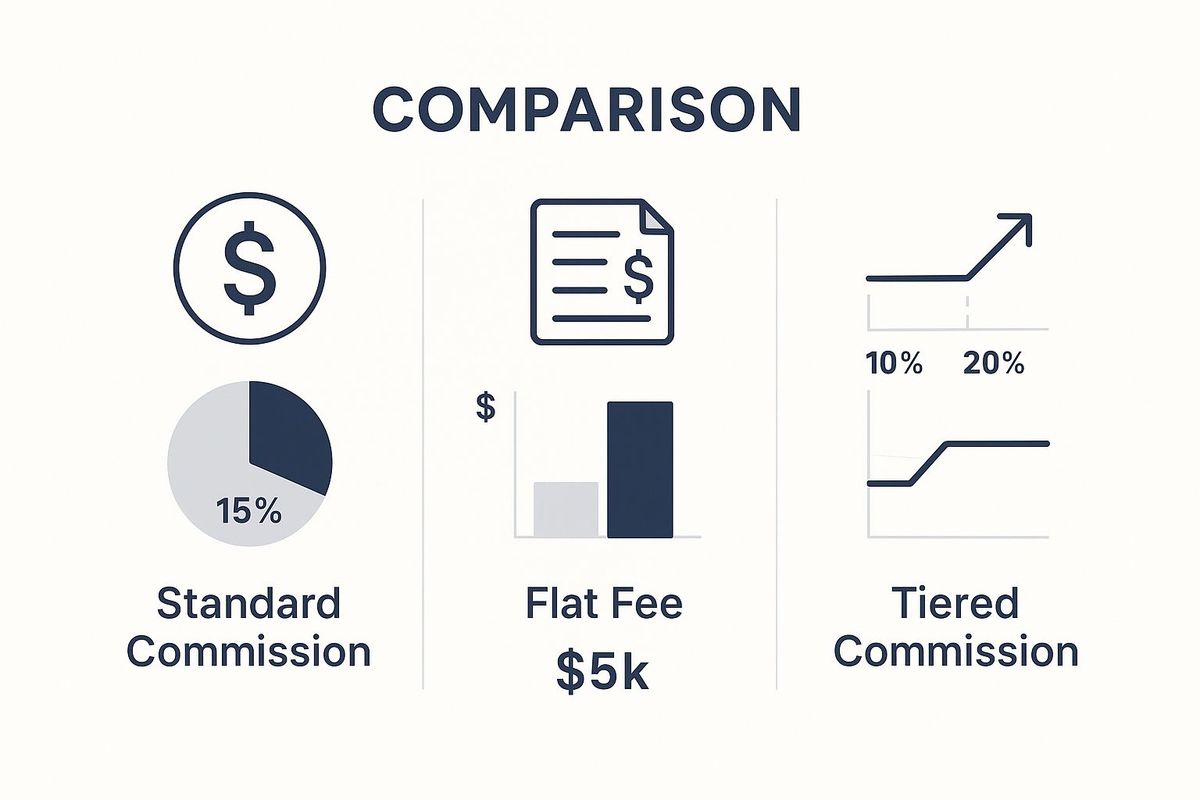
Each one has its pros and cons. A standard commission is straightforward, a flat fee offers predictability, and a tiered system can be a great motivator for growth.
Questions To Ask Before You Sign
Confidence at the negotiation table comes from being prepared. Before you finalize anything, you and your lawyer need to have clear, satisfying answers to these crucial questions. Running through this checklist ensures you’ve covered your bases and are walking into this partnership with your eyes wide open.
- Is the commission based on gross or net income? This is a massive financial distinction that affects every single dollar you earn.
- What specific income streams are commissionable? Are there any carve-outs for work you did before signing, or for income unrelated to your music career?
- What is the initial term length, and how does renewal work? Are the renewal options tied directly to performance milestones?
- Is there a "key person" clause? If your manager is part of a larger company, what happens if that specific person leaves? You're signing with a person, not just a company name.
- How does the sunset clause work? Does the commission percentage step down over time after the contract ends? For how long?
- What are the manager’s specific duties? Are their responsibilities clearly defined in writing, or is it all vague promises?
- What happens if there's a dispute? Does the contract outline a clear process for mediation or arbitration to resolve disagreements professionally?
Getting these questions answered upfront will transform the negotiation from something you dread into an empowering first step toward building a successful, lasting career.
Common Questions About Artist Management Contracts
Alright, we’ve covered the major clauses, but the real world of artist management is full of tricky situations and "what if" scenarios. This is where the rubber meets the road. Even after understanding the big picture, lingering questions can leave you feeling unsure.
Think of this section as your quick-reference guide. We’re going to tackle some of the most frequent questions we hear from both artists and managers. Let’s clear up those final bits of confusion so you can walk into your next negotiation with total confidence.
Do I Really Need an Entertainment Lawyer
Yes. Absolutely. I can't stress this enough—it's completely non-negotiable. Hiring an experienced entertainment lawyer is one of the single most important investments you will ever make in your career. A general practice attorney just doesn’t have the specialized, insider knowledge required to navigate the music industry's unique landscape.
An entertainment lawyer lives and breathes this stuff. They know the difference between a standard commission rate and a predatory one, they understand the complex math of a sunset clause, and they can spot issues with publishing rights from a mile away. They are your dedicated advocate, laser-focused on protecting your interests. Their expertise is the difference between signing a generic piece of paper and crafting a contract that truly serves as a launchpad for your long-term success.
What Is a Key Person Clause
A "key person" clause is basically your protection against a professional bait-and-switch. Let's be real—you're probably signing with a management company because you clicked with one specific manager. You share a vision, you trust their gut, and you believe in their ability to champion your career. This clause officially names that individual in the contract.
So, what happens if that manager leaves the company, gets reassigned, or just stops personally handling your career? The key person clause gives you the right to terminate the agreement. Without it, you could be legally stuck working with a total stranger you have zero rapport with, completely defeating the purpose of the partnership. It ensures your deal is with the person you chose, not just the company they work for.
This clause is a testament to the fact that management is a deeply personal business. It contractually recognizes that your relationship and trust are with an individual, providing a crucial safety net if that core relationship changes.
Keeping tabs on all these detailed provisions can get overwhelming. For managing your agreements more efficiently, it’s worth knowing about the different contract management software features available that can help you organize and track key dates and obligations.
How Does a Sunset Clause Actually Work
A sunset clause is all about figuring out how a former manager gets paid after you’ve gone your separate ways. The idea is to fairly compensate them for the long-term deals they landed for you while they were on your team, like a multi-album record deal or a big publishing agreement. After all, they did the work to secure it.
But a well-negotiated clause makes sure they don't get paid forever. A standard sunset clause will have a "de-escalation" schedule. This means their commission percentage gradually drops over a set period. For example, it might go from 15% down to 10% in the first year after you part ways, then to 5% in the second year, and then finally to zero. This is one of the most important points to negotiate to guarantee a clean and fair financial break.
Can I Have Different Managers for Different Fields
Yes, you can, but it requires extremely careful and precise contract language. You might want one manager for your music career and another for acting. While possible, most managers will push for exclusivity over all your entertainment work because they want to build a single, cohesive brand.
If you’re going to go this route, the "scope" of each management agreement must be meticulously defined. You have to draw clear lines in the sand to prevent commission battles and professional overlap.
- Music Manager's Contract: This agreement needs to state it only covers "all musical activities," such as recording, touring, and publishing.
- Acting Manager's Contract: This one would need to be strictly limited to "all acting services," covering things like film, TV, and theater.
Without crystal-clear definitions, you’re setting yourself up for a mess where both managers claim a commission on the same income. Navigating these specialized agreements really underscores the need for strong legal counsel, a topic we cover more broadly in our overview of music and entertainment law. Airtight language here can save you from a legal and financial headache down the road.
At Cordero Law, we believe that a strong contract is the foundation of a successful career. Our team specializes in entertainment law, helping artists and entrepreneurs build partnerships that are clear, fair, and designed for long-term growth. If you're ready to secure your future with expert legal guidance, contact Cordero Law today.