
So, you snagged the perfect domain name. That means it’s yours, right? Not exactly.
Simply registering a domain gives you the right to use that web address. That's it. Trademarking a domain, on the other hand, grants you legal ownership of the brand itself. Think of it as the difference between renting an apartment and owning the entire building.
Why Trademarking Your Domain Is A Smart Move

Owning a domain name through a registrar like GoDaddy or Namecheap is just the first step. It gives you exclusive use of that specific URL, but it offers zero legal protection for your brand name against someone using a similar name to sell competing products.
This is where trademarking becomes essential.
Let’s get real for a second. A competitor could easily launch a website with a deceptively similar domain—maybe they swap one letter or just use a different TLD like .net instead of .com. Without a trademark, your options for stopping them are limited, expensive, and often a losing battle. A federally registered trademark is your legal shield.
Building A Defensible Brand Asset
A trademark transforms your domain from a simple web address into a valuable, defensible business asset. This legal protection goes way beyond just the URL, covering your brand identity across all platforms. Once you have a registered trademark, you unlock several key advantages:
- Nationwide Priority: Your rights to the name are recognized across the entire country, not just in your local area.
- Legal Deterrent: That little ® symbol tells competitors you’re serious about protecting your brand, often stopping infringement before it even starts.
- Stronger Legal Ground: If someone does infringe on your name, you have a clear, legally recognized claim of ownership, making it much easier to win disputes.
When you think about the value of your online presence—where your website acts as a 24/7 brand ambassador—you see how critical it is to protect that core identity. This is why having an effective website design that reinforces your brand is just as important as securing its legal foundation. You can dig deeper into the relationship between your brand's name and its online home here: https://www.corderolawgroup.com/blog/2025/trademark-and-domain-names
To help clarify things, let's break down the core differences between simply registering a domain and actually getting a trademark.
Domain Registration vs. Trademark Rights: A Quick Comparison
This table clarifies the key differences between owning a domain name and holding a trademark for the brand associated with it, helping you understand the distinct rights and protections each provides.
| Aspect | Domain Name Registration | Trademark Registration |
|---|---|---|
| Primary Function | Secures a specific web address (URL) | Protects brand names, logos, and slogans used in commerce |
| Scope of Protection | Exclusive right to use that specific URL | Nationwide exclusive right to use the mark for specific goods/services |
| Legal Authority | Governed by ICANN and domain registrars | Governed by the U.S. Patent and Trademark Office (USPTO) |
| Dispute Resolution | UDRP process for cybersquatting | Federal court litigation for infringement |
| Symbol | None | ® symbol (for registered trademarks) |
As you can see, they serve very different purposes. A domain is a location; a trademark is an identity.
The reality is that online brand protection is more critical than ever. Trademark owners are increasingly using formal dispute resolution to defend their digital turf, and the numbers back this up.
Brand owners from 133 countries filed a staggering 6,168 cybersquatting cases with the World Intellectual Property Organization (WIPO) in a single year. That's the second-highest number since the system was created back in 1999.
Ultimately, trademarking your domain isn't just another expense. It’s a foundational investment in your brand's future security and value. It provides peace of mind and a solid foundation for growth.
Laying the Groundwork Before You File

Jumping straight into a trademark application without doing your homework is like building a house on a shaky foundation. Trust me, a little prep work upfront can save you from a world of headaches, wasted fees, and crushing disappointment down the road.
Think of this as your pre-flight checklist. The very first, most critical step is a comprehensive trademark search. And no, a quick Google search isn't going to cut it. You need to dive deep into the official records to see if your domain name—or something confusingly similar—is already taken.
Performing a Comprehensive Trademark Search
Your main tool for this job is the United States Patent and Trademark Office's (USPTO) Trademark Electronic Search System, which everyone just calls TESS. This database is the official ledger of every registered trademark and pending application in the U.S.
Here’s a look at the USPTO's search portal, where your investigation begins.
This portal is your gateway to finding potential conflicts before you invest your time and money. Ignoring this step is a gamble you just don't want to take.
Your goal here isn't just to find exact matches. You're looking for anything that could cause a "likelihood of confusion," which is the number one reason the USPTO rejects applications. This means searching for things like:
- Similar Spellings: Think "Kwik" instead of "Quick."
- Phonetic Equivalents: Marks that sound the same, like "4 U" and "For You."
- Similar Meanings: A picture of an apple for a computer company versus the word "Apple."
Getting this search right is crucial, and honestly, it can be a complex process. For a more detailed walkthrough, you can check out our guide on how to do a trademark search. It really breaks down the nuances of using the TESS database effectively.
The global competition for brand names is unbelievably fierce, which makes a thorough search more important than ever. Trademark filings worldwide paint a clear picture of this race. Mainland China leads with about 6.76 million new applications, while the United States follows with approximately 566,938 applications in a recent year. This massive volume highlights the intense competition to protect brand names, which are so often tied directly to domain names.
Is Your Domain Actually Trademarkable?
Once you've cleared the search hurdle, the next question is a big one: does your domain name even qualify for trademark protection? Not all names are created equal in the eyes of the law. The USPTO wants to see marks that are distinctive, not merely descriptive.
A strong, trademarkable name helps consumers identify the source of goods or services. Generic terms are completely off-limits. You can't trademark "The Donut Shop" for a store that sells donuts because it would stop your competitors from being able to accurately describe their own products.
Key Takeaway: A trademark must function as a unique source identifier. If your domain name simply describes what you do (e.g., "QualityCarRepairs.com"), it will likely be rejected as "merely descriptive."
Your mark really needs to fall into one of these stronger categories to have a good shot:
- Fanciful: Invented words with no other meaning (e.g., "Kodak," "Pepsi"). These are the strongest types of marks.
- Arbitrary: Real words used in a way that has no connection to the product (e.g., "Apple" for computers).
- Suggestive: Marks that hint at a quality without directly describing it (e.g., "Netflix" for streaming movies).
If your domain is too descriptive, you might need to rebrand or at least consider adding a more distinctive element to it before filing.
Proving Your Use in Commerce
Finally, you can't just trademark a name you're sitting on for a rainy day. The USPTO has a strict "use in commerce" requirement. This means you must be actively using the domain name as a brand identifier to sell goods or provide services across state lines.
Simply owning the domain isn't enough. You need to show how it's being used out in the real world. This proof is called a "specimen."
So, what actually counts as a valid specimen?
- A screenshot of your website where the domain is clearly used like a brand name in the header, not just in the URL bar.
- Product packaging that prominently features the domain name.
- Marketing materials or advertisements that use the domain to promote your services.
If you haven't launched yet, don't worry. You can file an "Intent to Use" (ITU) application. This basically lets you reserve your spot in line, but you will eventually have to prove use in commerce before the trademark can officially register. Taking these foundational steps seriously puts you in the best possible position for a successful application.
Navigating the Trademark Application Process
Alright, you've done your due diligence. The search is complete, and you're feeling good about your domain's unique place in the market. Now it's time for the main event: actually filing the trademark application.
This is the point where you officially ask the U.S. government to recognize your domain as a brand. Your primary destination for this is the USPTO's Trademark Electronic Application System, which everyone in the industry just calls TEAS.
Once you’re in the TEAS portal, you’ll face an immediate choice that dictates both the cost and the complexity of your application: the TEAS Plus form or the TEAS Standard form. Think of TEAS Plus as the streamlined, more affordable option that comes with stricter rules, while TEAS Standard gives you more flexibility for a higher price.
This is a pivotal step, but it's just one part of a much larger journey.
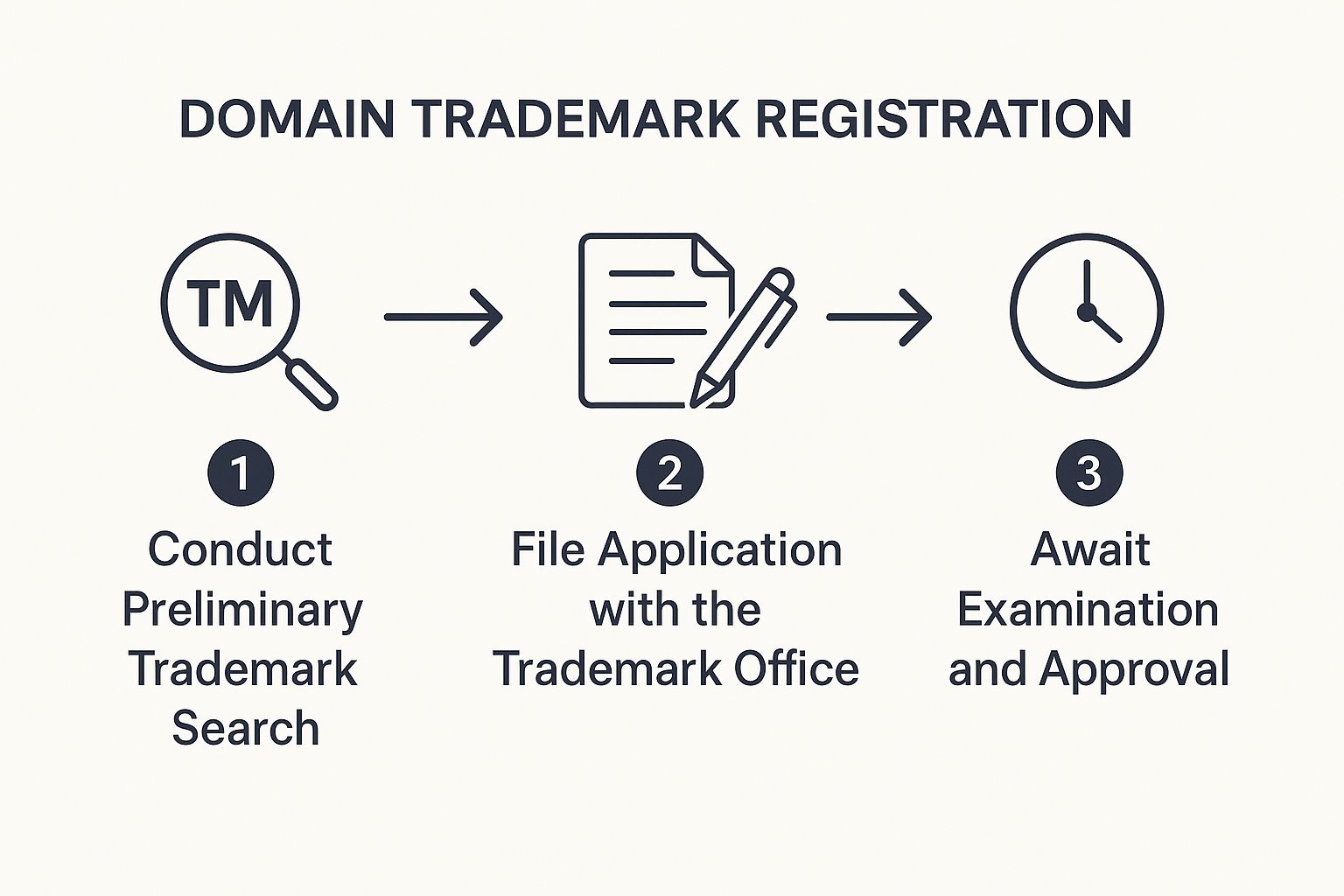
As you can see, filing the application is a huge milestone, but it's definitely not the end of the road to securing your trademark rights.
Choosing Your Application Form: TEAS Plus vs. TEAS Standard
Picking the right form isn't a minor detail; it's a strategic decision that hinges entirely on your specific situation. The main difference boils down to how you describe your goods and services to the USPTO.
TEAS Plus requires you to choose a description directly from the USPTO’s pre-approved list in their Trademark ID Manual. If your business fits neatly into one of their boxes, this is your best and cheapest option. It’s priced lower for a reason—it simplifies the examination process for the USPTO examiner reviewing your file.
On the other hand, TEAS Standard lets you write a completely custom description. This is essential if your services are unique, niche, or just don't align with the pre-written options. You get the freedom to be precise, but you’ll pay a higher application fee for that customization.
TEAS Plus vs TEAS Standard: Which Is Right for You?
To make this choice clearer, let's break down the core differences between the two main online filing options. This table should help you figure out which path makes the most sense for your brand and budget.
| Feature | TEAS Plus | TEAS Standard |
|---|---|---|
| Filing Fee | $250 per class (Lower) | $350 per class (Higher) |
| Goods/Services Description | Must use pre-approved descriptions | Allows for custom-written descriptions |
| Requirements | Stricter; all communication must be via email, fees paid upfront | More lenient on initial filing requirements |
| Best For | Straightforward businesses with common offerings | Unique or complex businesses needing specific language |
Ultimately, this is a classic trade-off. TEAS Plus saves you money but limits your descriptive freedom, while TEAS Standard costs more but gives you full control over how you define your brand's scope.
Defining Your Goods and Services Classes
One of the most common stumbling blocks I see is selecting the correct "class" of goods and services. The USPTO uses a classification system of 45 different classes—34 for goods and 11 for services—to organize trademarks. You have to file your application in the class (or classes) that corresponds to what you actually sell.
For example, let's say your domain is "ArtisanWebTools.com." If you sell downloadable software (which is a good), you'd likely file in Class 9. But if you also offer web design services, you would need to file separately in Class 42.
Keep in mind that each class requires a separate government fee, so it pays to be both accurate and strategic here.
Pro Tip: Be specific, but don't get greedy. Claiming a class where you aren't actively doing business can get your application rejected or, even worse, leave your trademark vulnerable to legal challenges down the road.
This isn't just a U.S. issue, either. If you have global ambitions, you need to understand the local rules. For instance, this guide on how to register a trademark in UAE details how different jurisdictions have their own unique requirements for defining your brand's scope.
Creating a Powerful Specimen of Use
The last critical piece of your application is the "specimen." This is your real-world proof. It's how you show the USPTO that you are actually using your domain name as a trademark in commerce. Just owning the URL isn't enough; you have to prove that your customers see it and recognize it as your brand.
A strong specimen is all about context. It needs to clearly connect your domain name to your goods or services.
Here are a few examples of what works and what doesn't:
- Excellent Specimen: A screenshot of your website's header where your domain logo is displayed prominently next to a shopping cart icon or a "Our Services" menu. This shows the mark being used to offer something for sale.
- Weak Specimen: A screenshot of your domain name simply typed into a browser's address bar. This only shows that it's a web address, not a brand.
- Poor Specimen: An internal company document, an invoice, or an email signature. A specimen must be something that your customers see in the marketplace.
Think of it this way: your specimen has to show the domain name acting as a source identifier—pointing directly to you as the provider of a product or service.
So, you’ve pulled the trigger. You filled out all the forms, paid the fees, and officially submitted your trademark application. This is a huge step, but honestly, this is where the real waiting game begins.

Your application doesn't just get a rubber stamp. It now heads into a meticulous review process at the United States Patent and Trademark Office (USPTO), where a legal expert will pick it apart. Knowing what's coming can turn that nail-biting uncertainty into a manageable part of your strategy.
The Examination Process Begins
After your filing is received, it gets assigned to a USPTO examining attorney. This person is your official point of contact and the gatekeeper responsible for making sure your application follows all federal laws.
Their job is to give your application a thorough shakedown. This includes:
- A New Search: They'll conduct their own deep, comprehensive search for any conflicting marks—one that goes way beyond what most people can do on their own.
- Procedural Review: The attorney checks all the boxes. Did you pay the right fee? Is the drawing of your mark clear? Is the owner identified correctly?
- Substantive Review: This is the most important part. They analyze whether your mark is legally registrable in the first place.
This whole assignment and initial review process isn't fast. Brace yourself to wait several months before you hear anything at all. Patience is your best friend here.
Responding to an Office Action
It's incredibly common for the examining attorney to find problems with an application. When they do, they issue a formal letter called an Office Action. This isn't a flat-out rejection. Think of it as a list of legal issues you need to resolve.
Getting one is normal, so don't panic. It's your chance to argue your case and strengthen your application.
Most Office Actions boil down to two major roadblocks:
- Likelihood of Confusion: The attorney thinks your domain name is just too similar to an existing trademark, which could confuse customers about who is offering the goods or services.
- Merely Descriptive: The attorney argues your domain name simply describes what you do (like "BestPizzaDelivery.com") instead of acting as a unique brand name.
You'll typically have a six-month window to file a response. This isn't just a simple email; it has to be a persuasive legal argument, often backed up with evidence, explaining why your mark should be registered despite their concerns. If you miss that deadline, your application is considered abandoned. Kaput.
Crucial Insight: Your response to an Office Action is a legal document. A weak or incomplete argument will almost certainly get you a final refusal. This is the exact moment when having a trademark attorney in your corner can mean the difference between success and failure.
The Path to Approval or Refusal
Once you submit your response, the examining attorney will review your arguments. If you've convinced them, your mark gets approved for publication. This is a massive win and puts you one step closer to full registration.
But what if your arguments don't land? The attorney will issue a Final Office Action. At this stage, your options get pretty narrow. You can either comply with whatever requirements they've laid out or file an appeal with the Trademark Trial and Appeal Board (TTAB)—a much more complex and expensive legal battle.
Understanding this post-submission timeline is vital. The road from filing to registration is rarely a straight line. By preparing for potential bumps like an Office Action, you can navigate the process proactively and give your domain the best shot at becoming a federally protected trademark.
So, your trademark is officially registered. Congratulations! That’s a huge milestone, but it’s not the end of the road. Think of it as the beginning of a new chapter.
A trademark is a living, breathing asset. Its strength depends entirely on your commitment to defending it. Now your focus shifts from filing and waiting to active management and enforcement. This is how you make sure the investment you made pays dividends for years to come.
The first step? Signaling your new legal status to the world.
Displaying Your Trademark Symbol Correctly
You've seen those little symbols next to brand names—now you've earned the right to use the most powerful one: the ® symbol.
Using this symbol is critical. It puts everyone on notice that your domain name is a federally registered trademark, which can stop potential infringers in their tracks. It also gives you a much stronger legal position if you ever have to take action against someone for misuse.
So, where should it go?
- On your website: Add the ® symbol to your logo in the header and footer. It's also a good idea on key landing pages.
- Marketing materials: This includes business cards, brochures, and any digital ads you run.
- Social media profiles: Pop it in your bio or next to your brand name where the platform allows.
The general rule is to use it at least once where the trademark first or most prominently appears. You don’t need to plaster it after every single mention of your brand—that just looks cluttered and unprofessional. The goal is clear communication, not repetition.
Monitoring for Infringement and Cybersquatting
Your trademark registration gives you the legal high ground, but it doesn't come with an automatic alarm system. You are responsible for policing your own mark. This means you have to actively look for others who might be using your brand name—or one that's confusingly similar—without your permission.
This isn't about being paranoid; it's about being proactive. The most common threats you’ll face are infringement and cybersquatting.
Cybersquatting is when someone registers a domain name containing your trademark in bad faith. Their goal is usually to profit from your brand's goodwill, either by selling the domain back to you for an outrageous price or by using it for scams.
So how do you keep an eye out for this?
- Set Up Google Alerts: Create alerts for your brand name and any common misspellings. This is a free and surprisingly effective way to catch unauthorized mentions online.
- Regularly Search Marketplaces: Check app stores, social media platforms, and online marketplaces like Amazon or Etsy for your brand name.
- Monitor Domain Registrations: Periodically search for new domain registrations that are similar to yours, especially with different extensions like .net, .org, or .shop.
Finding someone misusing your brand can be jarring. While your first instinct might be to fire off an angry email, the best approach is a measured, professional one. Usually, the first step is sending a formal cease and desist letter. If you find yourself in this situation, our guide on how to respond to a cease and desist letter offers some great insights, whether you're sending or receiving one.
Ongoing USPTO Maintenance Requirements
Finally, your trademark registration isn’t a one-and-done deal. It requires periodic maintenance to stay active. The USPTO needs proof that you are still actively using your mark in commerce. If you miss these filing deadlines, your registration will be canceled, and you'll lose all your hard-won protections.
Get these dates on your calendar now:
- Between years 5 and 6: You must file a Declaration of Use (Section 8).
- Between years 9 and 10: You must file a combined Declaration of Use and Application for Renewal (Section 8 & 9).
- Every 10 years after that: You continue to file the combined renewal documents.
Think of these filings as your trademark's long-term care plan. By properly using your symbol, monitoring for misuse, and hitting your maintenance deadlines, you ensure your domain remains a powerful and valuable asset for your business.
Still Have Questions About Trademarking Your Domain?
Even after laying it all out, it's totally normal to have a few questions buzzing around. The world of intellectual property has its quirks, and when you mix that with the digital world of domains, some unique situations pop up pretty often. Let's tackle some of the most common ones I hear from clients.
Can I Actually Trademark the ".com" Part of My Domain?
Great question. The short answer is yes, you can trademark a domain name, but you're not actually protecting the ".com" bit. Think of it this way: your trademark protection applies to the unique, brand-worthy part of your domain.
Let's say your site is "Zendesk.com." The trademark is for the word "Zendesk" as it connects to your customer service software. The ".com" is just a top-level domain (TLD), which the USPTO sees as a functional part of a web address, not part of your brand identity.
Key Insight: When you file your application, you'll list the mark as your brand name (e.g., "Amazon"), not the full URL ("Amazon.com"). The real power here is that your legal protection covers your brand name itself, stopping someone from launching "Amazon.net" or "Amazon.shop" to offer similar services.
What's the Real Difference Between a Trademark and a Copyright?
This one trips a lot of people up, but it's pretty clear once you break down what each is designed to protect. They both cover intellectual property, just different kinds.
A Trademark is all about your brand. It protects things like your business name, your domain name, logos, and even slogans that tell customers, "Hey, this product is from this company." It's a source identifier.
A Copyright protects the creative stuff you make. We're talking about original works like your blog posts, the code that runs your website, the photos you took, videos, and music. It’s about protecting the expression of an idea, not the idea itself.
So, for your website, the domain name itself could be your trademark, but all the brilliant articles and cool images on it? That's copyright territory.
What If Someone Else Already Trademarked My Domain Name?
This is a gut-wrenching scenario and it's exactly why moving quickly is so critical. If another company has a registered trademark for a name that's the same or confusingly similar to your domain, they usually have the upper hand legally.
If they registered that trademark before you ever started using your domain, your options are pretty slim. You might be looking at a full rebrand, which is a massive headache and can be incredibly expensive.
Now, if you can prove you were using the name in business before they filed their trademark application, you might have what are called "common law" rights. This can sometimes be a defense, but trust me, it’s a complicated legal fight you don't want to navigate alone. The bottom line? Federal registration is almost always king.
Do I Really Need a Lawyer to Trademark My Domain?
Legally, no, you can file a trademark application yourself. But honestly? It's usually not the best move. The process is a minefield of legal details, from doing a truly comprehensive search to knowing how to respond if the USPTO sends you an Office Action.
An experienced trademark attorney does this day in and day out. They know the common pitfalls and can build the right legal arguments to get your application over the finish line. A little investment in legal help upfront can save you from losing your application fees and wasting months, or even years, on a failed attempt. Trust me, it happens way more than you think.
Navigating the complexities of intellectual property is a critical step in building a secure and valuable brand. At Cordero Law, we specialize in helping entrepreneurs and creators protect their most important assets. If you're ready to secure your brand's future, let's connect and discuss how we can help you through the process. Learn more about our approach at https://www.corderolawgroup.com.