
Yes, you can trademark a domain name, but it’s a lot more than just registering a URL with a registrar. Here's the thing: a domain name is just a digital address you rent for a while. A trademark, on the other hand, is a business asset you own. It gives you real legal teeth to protect your brand name itself from being used by competitors. Understanding that difference is the first step toward building a secure, defensible brand online.
Why Your Domain Name Needs Trademark Protection

Think about it—your domain name is often the cornerstone of your brand. It’s what customers type into their browsers, see on your marketing materials, and tell their friends about. Without trademark protection, that identity is surprisingly vulnerable.
Simply registering a domain with a provider like GoDaddy or Namecheap doesn’t give you any actual ownership rights to the name itself. It just gives you the exclusive right to use that specific web address for a year or two.
This leaves you wide open. A competitor could easily register a similar domain (think YourBrand.net when you own YourBrand.com) to peel away your traffic. Even worse, they could launch a business using an almost identical name, creating confusion in the marketplace and watering down the brand equity you’ve worked so hard to build.
Moving from Renter to Owner
Here's a simple way to look at it: registering a domain is like leasing a storefront at a specific address. Getting a trademark is like owning the deed to the brand name on the sign out front. Trademarking your domain transforms it from a temporary address into a legally recognized business asset you control.
With a registered trademark in hand, you get some powerful legal advantages:
- Exclusive Rights: You gain the exclusive, nationwide right to use your brand name for the specific goods or services you offer.
- Legal Muscle: It gives you the legal grounds to stop others from using a confusingly similar name, preventing them from profiting off your hard work.
- A Clear Warning Sign: A registered trademark (that little ® symbol) tells competitors you're serious about protecting your brand, which often stops infringement before it even starts.
The Real-World Risks of Skipping Protection
The threat of domain disputes and cybersquatting isn't just theoretical; it happens all the time. Imagine someone buys up common misspellings of your domain and uses them for phishing scams, damaging your reputation. Without a trademark, your options for shutting them down are much more limited and expensive.
This is a widespread problem. Just last year, trademark owners from 133 countries filed a staggering 6,168 domain name dispute cases under the Uniform Domain Name Dispute Resolution Policy (UDRP). That number, one of the highest since 1999, shows just how critical this protection is for businesses of all sizes. You can see the trend for yourself in recent WIPO reports.
By trademarking your domain name, you're not just protecting an address; you're securing your brand's future. It gives you the legal foundation to build brand equity with confidence, knowing your most valuable digital asset is secure.
Ultimately, trademarking your domain name is a proactive move. It’s about heading off potential conflicts at the pass and establishing a clear legal claim to your brand before any issues come up. For a closer look at the legal ins and outs, you can explore our guide on the advantages of trademarking a domain name. This small investment up front can save you a world of financial pain and reputational damage down the road.
Your Pre-Filing Trademark Checklist

Jumping headfirst into a United States Patent and Trademark Office (USPTO) application without doing your homework is probably the fastest way to get a rejection letter. Trust me, I've seen it happen way too many times. Think of this as your pre-flight check. Getting these early steps right will save you a world of time, money, and headaches down the road.
Two of the biggest tripwires for new applicants are failing to do a proper trademark search and completely misunderstanding what the government means by "use in commerce." Let's break down exactly what you need to nail to get your application off to a strong start.
First, You Need to Do a Deep-Dive Trademark Search
This is the absolute, non-negotiable first step. You have to make sure your domain name isn't already taken or confusingly similar to an existing trademark. A quick Google search won't cut it here; you need to dig much deeper to avoid a "likelihood of confusion" refusal from the USPTO.
Your best friend for this task is the USPTO's own Trademark Electronic Search System (TESS). This is the official database of every registered and pending trademark in the country. But an effective search is more than just typing in your exact domain name and calling it a day.
You have to think like a trademark examiner. Your search should include:
- Exact Matches: This is the obvious one. Is
YourBrand.comalready registered as "YourBrand" for similar services? - Phonetic Equivalents: Think about names that sound the same but are spelled differently. If your domain is
KwikFix.com, you better be searching for "Quick Fix" too. - Variations and Misspellings: Look for common misspellings or alternative versions. If someone already owns "Brandtastic," your application for "Brand-tastic" is likely dead on arrival.
- Foreign Word Translations: Does your brand name mean something in another language? A mark that translates to a similar-sounding registered mark can also be a problem.
This process can feel like a lot, but it’s critical. A few hours of searching now can save you from a legal battle later. For a more detailed walkthrough, you can learn more about how to do a trademark search in our dedicated guide.
A thorough search isn't just about finding a direct copy. It's about making sure your brand is distinct enough that customers won't get confused about who they're buying from.
Before you go any further, it's worth taking a moment to see if your domain even has a shot at being trademarked.
Use this quick checklist to see if your domain meets the basic requirements for trademark registration before you spend time and money on the application.
Is Your Domain Name Trademarkable?
| Key Check | What This Really Means | Why It's a Deal-Breaker |
|---|---|---|
| Is it Distinctive? | Your name can't just describe what you do (e.g., "Fast Web Design"). It needs to be unique—fanciful (Kodak), arbitrary (Apple), or suggestive (Netflix). | Descriptive or generic names are almost always rejected because they don't function as a unique brand identifier. Everyone needs to be able to use those words. |
| Is it "Used in Commerce"? | Are you actively selling goods or services under this domain name across state lines? A "coming soon" page doesn't count. | The USPTO won't register a mark that's just an idea. You have to prove you're actually using it in the marketplace. No use, no trademark. |
| Is it Free of Conflicts? | Does your name sound like, look like, or have a similar meaning to an existing registered trademark in your industry? | A "likelihood of confusion" is the most common reason for refusal. If customers might mix you up with a competitor, the USPTO will deny your application to protect consumers. |
If you can confidently check off these boxes, you're in a much better position to move forward with your application.
Understand the "Use in Commerce" Requirement
The USPTO isn't in the business of trademarking ideas. To get federal protection, you have to prove your domain name is actively being used to sell products or provide services across state lines. This is the legal standard known as "use in commerce."
Simply owning the domain name is not enough. Parking it on a "coming soon" page or using it for a personal blog that doesn't offer anything for sale won't meet this critical standard.
So, what kind of proof does the USPTO want? You'll need to submit what's called a "specimen" with your application. This is just real-world evidence showing how consumers see your domain name used as a brand.
Good examples of specimens include:
- A screenshot of your website clearly showing the domain in the header on a page where people can buy something (like a product page with an "Add to Cart" button).
- A screenshot of your services page, where potential clients can contact you or book a consultation.
- Digital marketing materials, like a PDF brochure, that prominently feature your branded domain name in connection with what you offer.
Here’s a subtle but critical point: the domain name must act as a source identifier, not just an address. It needs to be presented like a brand on your site—in the logo, in headings—not just sitting in the URL bar. If you haven't launched yet, you can file an "Intent to Use" application, but you'll still have to prove actual use in commerce before the trademark is fully registered.
Getting Your Application Filed with the USPTO
Alright, you've done the hard work of searching the trademark database and you've confirmed you're actually using your domain name in commerce. Now it's time to make it official with the United States Patent and Trademark Office (USPTO). This part can feel a bit intimidating, but trust me, it’s completely manageable once you know the steps. This is where you formally plant your flag.
Everything happens online through the Trademark Electronic Application System, or TEAS. Your first real decision is which application form to use, and this choice directly affects how much you'll pay and how much work you'll have to do.
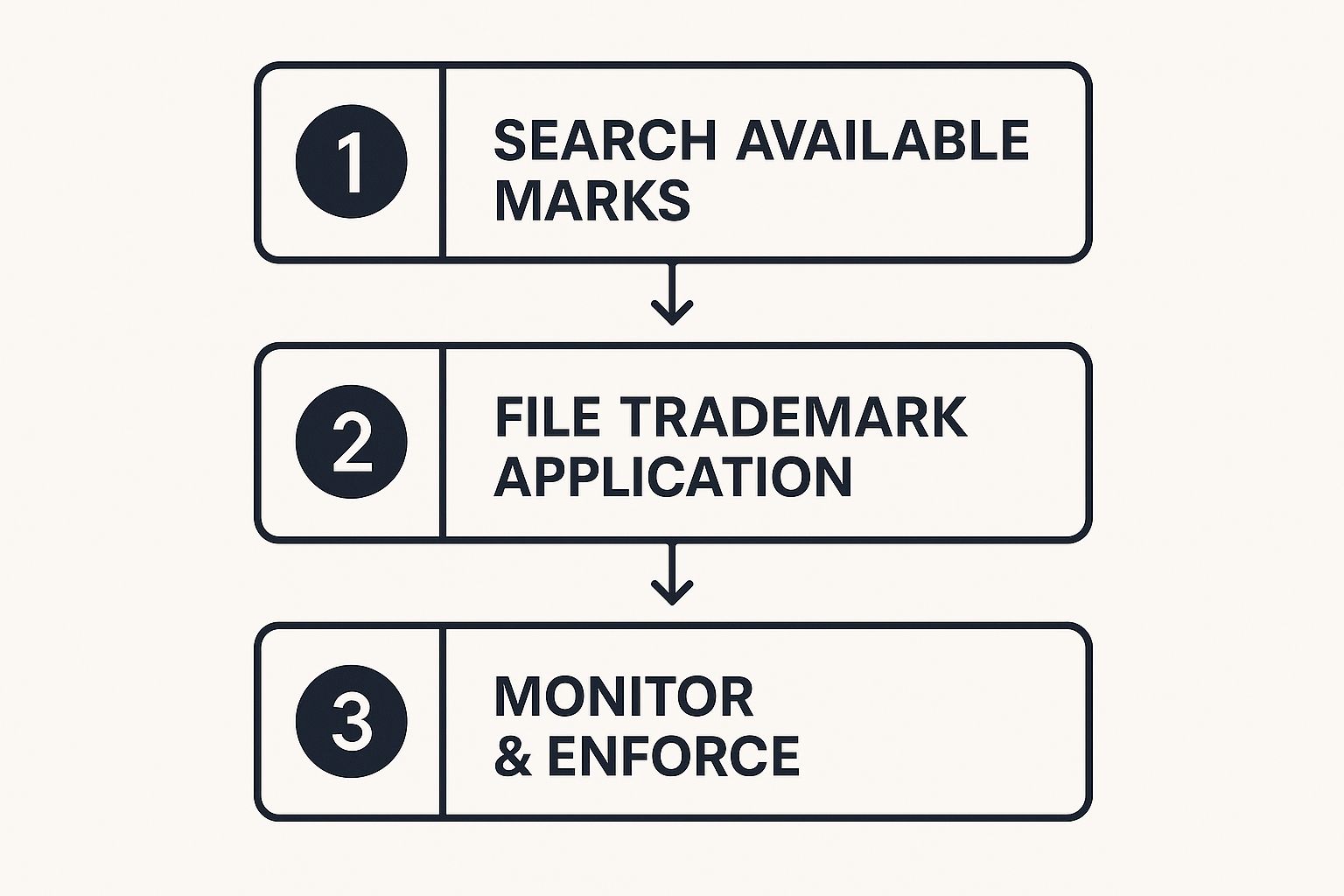
As you can see, filing the application is the pivot point. It turns all your research into a real legal asset and kicks off your long-term responsibility to protect it.
TEAS Plus vs. TEAS Standard: Which Form Is Right for You?
The USPTO gives you two main options, and your choice has real-world consequences for your wallet and the application itself.
- TEAS Plus: This is the cheaper, more streamlined option. The filing fee is usually $250 per class of goods or services. The catch? You have to pick a pre-approved description of your services straight from the USPTO's Trademark ID Manual and agree to handle all communication via email.
- TEAS Standard: This form costs more, typically $350 per class. The extra cost buys you flexibility. You can write a custom description of your goods and services, which is a huge advantage if what you do is unique and doesn't fit into a neat, pre-defined box.
Honestly, for most blogs, online courses, and service-based websites, the TEAS Plus form is all you need. It’s the smart, cost-effective choice. But if your domain is tied to a really niche or brand-new type of service, that custom description in the TEAS Standard application might be essential to properly protect your brand.
My advice? Always start by searching the Trademark ID Manual. If you find a description that fits what you do like a glove, save yourself $100 and go with TEAS Plus. If you find yourself trying to twist the language to make it fit, just pay the extra fee for TEAS Standard. Getting it right from the start is worth it.
Defining Your Goods and Services: The International Class
One of the most critical—and often confusing—parts of the application is choosing the correct "class" for your domain. The USPTO uses an international system of 45 different classes to categorize every product and service imaginable (34 for goods, 11 for services).
Getting this right is non-negotiable. Your trademark protection only covers the specific class(es) you register in.
Let's say you register QuantumLeap.com under Class 041 for "providing a website featuring non-downloadable articles in the field of business coaching." That protects you in the online education space. But it does nothing to stop someone else from launching "Quantum Leap Shoes" under Class 025 (the class for clothing and footwear).
Most domains that provide content, entertainment, or educational services fall squarely into Class 041. If your domain is an e-commerce shop, you’ll file under the class for the specific products you sell. If your brand covers multiple areas (like a blog that also sells merchandise), you might need to file in multiple classes—just remember that each class has its own filing fee.
Assembling Your Application: What You'll Need
Once you've picked your form and identified your class, you're ready to dive into the application. The TEAS portal walks you through it, but it’s much smoother if you have all your info gathered ahead of time.
Here's a quick checklist of what to have on hand:
- Applicant Information: Your legal name and address. If you're an LLC or corporation, use the full, official business name and address. Don't use your personal info here.
- The Mark Itself: This is the brand name you're protecting. For a domain like
YourBrand.com, you’ll enter "YourBrand" as a standard character mark. This is key because it gives you the broadest protection for the word itself, regardless of how it's styled. You'll also have to disclaim the ".com" part, since you can't trademark a top-level domain (TLD). - Description of Goods/Services: Here's where you'll either select that pre-approved description (for TEAS Plus) or write your own (for TEAS Standard). Be precise.
- Filing Basis: Most existing businesses will file under "Use in Commerce." If you're about to launch but haven't yet, you can file under "Intent to Use."
- Specimen of Use: This is your proof. As we covered before, you need a real-world example showing your domain being used as a brand to offer services or sell goods. A clean screenshot of your website, clearly showing your domain name in the header on a page describing your services, is the perfect specimen.
- Signature and Fee: Lastly, you'll digitally sign a declaration that everything you've submitted is true, and then pay the fee.
Take your time with every single field. A simple typo in your business name or the wrong address can cause massive delays or even get your application thrown out. A clean, accurate application is your best shot at a smooth and successful registration.
What to Expect After You File Your Application

Hitting that "submit" button on your trademark application feels like the finish line, but it’s really just the start of the race. Now comes the hard part: the waiting game.
From the moment you file, your application goes into a long queue at the United States Patent and Trademark Office (USPTO). It’s not uncommon to wait six to nine months before an examining attorney even looks at your file. During this quiet period, there’s not much to do but be patient. Just make sure your contact information is up to date with the USPTO in case they need to reach you.
Once an examiner is assigned, they’ll put your application under the microscope. They'll conduct their own search for conflicting marks and decide if your domain name is distinctive enough to function as a true brand. This is the moment of truth where you find out if all your initial research and prep work paid off.
The Office Action: What It Is and How to Respond
If the examiner finds a problem with your application, you’ll receive what’s called an Office Action. Don't panic. This is incredibly common and doesn't mean your application is dead. Think of it as a formal letter from the USPTO explaining why they can't approve your mark just yet.
You typically have six months to respond, and the issues usually fall into two buckets:
- Substantive Refusals: These are the serious hurdles. The examiner might argue your domain name creates a "likelihood of confusion" with an existing trademark, or that it's "merely descriptive" of what you do.
- Procedural Refusals: These are usually much easier to fix. It could be something as simple as needing to disclaim a generic term (like "Pizza" in "Bob's Pizza") or clarifying the description of your services.
To overcome a substantive refusal, you'll need to build a solid legal argument. For instance, if you get a "likelihood of confusion" refusal, your job is to prove why consumers won't be confused. Maybe your services are in a completely different industry, or maybe the names and logos are different enough that no reasonable person would mix them up.
Responding effectively to an Office Action is often the most make-or-break step in the entire process. A weak response will almost certainly get you a final refusal, but a persuasive, well-argued response can turn a potential denial into an approval.
From Publication to Final Registration
So, what happens if the examiner finds no issues, or you successfully argue your way through an Office Action? Your mark gets approved for publication. This is a huge milestone.
Your proposed trademark gets published in the USPTO’s Official Gazette, a weekly online journal. This kicks off a 30-day opposition period. During this month, anyone who thinks your trademark will harm their business has the right to formally oppose it. This is exactly why doing a thorough search at the beginning is so critical—it minimizes the risk of a surprise fight.
If another company does file an opposition, it starts a legal battle that's a bit like a mini-court case. These can get complicated and expensive, which is why they are thankfully rare for most small business filings.
Here’s a simplified breakdown of the timeline you can expect after filing:
| Stage | Typical Duration | What Happens Here |
|---|---|---|
| Initial Review Period | 6-9 months | Your application waits in line for an examining attorney. |
| Examination | 1-3 months | The attorney reviews your application for any legal issues. |
| Office Action Response | Up to 6 months | If problems are found, you have this window to submit a legal response or make corrections. |
| Publication for Opposition | 30 days | Your mark is published for public review, opening the door for potential opposition. |
| Registration | 2-3 months post-publication | If there's no opposition, the USPTO issues your official registration certificate. |
If that 30-day window closes without any opposition (and assuming you filed based on "Use in Commerce"), then congratulations are in order! The USPTO will move forward with registering your mark. In a couple of months, you’ll receive that beautiful, official registration certificate in the mail. Your domain name is now a federally protected asset.
Common Mistakes That Can Derail Your Application
Navigating the trademark application process can feel like a minefield. Trust me, I’ve seen countless applications get rejected for simple, avoidable reasons. Learning from the most common stumbles is the smartest way to strengthen your own application right from the start.
One of the fastest routes to denial is picking a name the USPTO considers "merely descriptive." This just means your domain name describes exactly what you do or sell. For instance, a domain like GreatLawnCare.com is a weak candidate because "great lawn care" is a generic phrase anyone in that industry should be able to use. The USPTO won't grant you exclusive rights to everyday terms.
This is a critical distinction to grasp. A stronger, more protectable name is distinctive. Think about fanciful or made-up names (Verizon.com), arbitrary names that are unrelated to the services (Apple.com for computers), or even suggestive names that hint at a benefit (Netflix.com).
Failing to Conduct a Thorough Search
Another frequent—and costly—mistake is skimping on the initial trademark search. So many entrepreneurs do a quick Google search, see that their dream .com is available, and assume they're in the clear. This is a dangerous assumption.
The real test is whether your name is confusingly similar to an existing registered trademark in your industry, regardless of the domain extension. With over 368.4 million domain name registrations worldwide as of early 2025, the digital space is incredibly crowded. Failing to uncover a conflicting mark can lead to a rejected application or, worse, a cease-and-desist letter after you've already invested heavily in your brand.
The goal of a trademark search isn't just to see if your domain is available—it's to ensure your brand name is legally available. A conflict with a registered trademark for "Brandtastic Services" can sink your application for
Brand-tastic.combefore it even starts.
Submitting an Improper Specimen of Use
A third common pitfall is submitting the wrong kind of "specimen," which is just your proof that you’re using the mark in commerce. The USPTO has very specific rules about what qualifies. Simply showing a screenshot of your domain name in the browser's address bar is not going to cut it.
Your specimen has to show your domain name being used as a brand to sell goods or provide services. Here’s what works versus what doesn't:
- Rejected: A "coming soon" page or an internal company document.
- Accepted: A screenshot of your website's header and a service description page where customers can actually contact you or make a purchase.
- Rejected: The domain name just listed as your contact info at the bottom of a page.
- Accepted: The domain name featured prominently as a logo on marketing materials tied to a point of sale.
The specimen must prove your domain functions as a source identifier—a brand—not just a web address. Understanding the nuances between a trademark and a simple domain registration is crucial for avoiding these common mistakes. For a deeper dive, check out our guide on the relationship between your trademark and domain names.
Answering Your Top Domain Trademark Questions
Navigating the world of intellectual property can feel like learning a new language. When you start the process of trademarking a domain name, a few questions tend to pop up over and over again. Let's clear the air and tackle some of the most common ones you'll run into.
Getting these concepts straight is the key to protecting your brand the right way and avoiding costly mistakes down the road.
Can I Trademark My Domain Name if It Includes the .com?
This is a big one, and the short answer is almost always no. The USPTO sees Top-Level Domains (TLDs) like .com, .org, or .net as functional parts of an internet address, not as a unique part of your brand. You can't claim exclusive ownership over something as generic as ".com."
When you file your application, you will almost certainly be required to disclaim the TLD. This is just a formal statement telling the USPTO that you aren't trying to lock down that generic part of the name. Your protection is for the distinctive part of your domain—the "YourBrand" in YourBrand.com, for example.
What Is the Difference Between Domain Registration and a Trademark?
Think of it like this: registering a domain is like leasing a storefront at a specific street address. It gives you the exclusive right to use that location (123MainStreet.com), but it gives you zero legal rights to the name on your sign ("Main Street Cafe").
A trademark, on the other hand, protects that actual brand name. It's the legal ownership of "Main Street Cafe" itself. This is what gives you the power to stop someone from opening a "Main Street Diner" next door if it's likely to confuse your customers. A trademark protects your identity everywhere, not just at one web address.
A domain registration is a rental agreement for a digital location. A trademark registration is an ownership deed for your brand name. One gives you a place to operate; the other gives you the power to protect your identity.
How Long Does This Process Take and What Does It Cost?
You'll need some patience here. From filing to registration, a completely smooth trademark application process typically takes between 12 to 18 months. That timeline can easily stretch out if the USPTO issues an Office Action (a rejection) or if another company decides to oppose your registration.
The costs break down into a few different pieces:
- Government Filing Fees: The USPTO's filing fee for a standard application is usually between $250 and $350 for each class of goods or services you're applying for.
- Legal Fees: While you can file yourself, hiring a trademark attorney is highly recommended to avoid simple mistakes that can get your application denied. These fees can range from a few hundred to several thousand dollars, depending on how complex your situation is.
- Maintenance Fees: After your trademark is registered, you have to pay maintenance fees to the USPTO between the 5th and 6th years, and then again every 10 years, to keep your registration active.
It's smart to budget for all of these costs from the start. It ensures you can see the process through and keep your brand protected for the long haul.
Navigating the complexities of trademark law can be challenging, but you don't have to do it alone. At Cordero Law, we specialize in helping entrepreneurs and creatives protect their most valuable assets. If you're ready to secure your brand's future, visit us online to learn how we can help.