
Starting a business is exciting, but let's be honest—the legal side of things can feel like navigating a maze blindfolded. When you're ready to form an LLC, the core process involves picking a state, choosing a name, designating a registered agent, filing the official paperwork (called the Articles of Organization), and then creating an internal rulebook known as an Operating Agreement.
This structure is wildly popular for a reason: it hits the sweet spot between protecting your personal assets and giving you the flexibility to actually run your business without endless red tape.
Your Quick Guide to Launching an LLC

The Limited Liability Company, or LLC, is the go-to entity for most new entrepreneurs I work with. The biggest draw? It creates a legal wall between you and your business. This means your personal assets—like your house, car, and savings account—are generally shielded if the business gets sued or racks up debt.
This is a massive step up from being a sole proprietor, where you and your business are legally the same person. If something goes wrong there, everything you own is on the line.
The numbers don't lie. The market for LLC formation services is booming, expected to hit $1.5 billion in 2025. Projections show it growing at a steady clip of 12% a year through 2033, which tells you just how many entrepreneurs are choosing this path.
Key Milestones on Your Journey
Before we get into the nitty-gritty of how to form an LLC, let's zoom out and look at the big picture. Knowing the roadmap ahead makes the whole process feel much less intimidating.
Here's a quick look at the major stages you'll be working through:
- Laying the Groundwork: This is where you make the big initial calls—choosing a unique business name, deciding which state to register in, and picking a registered agent to receive official mail.
- Making it Official: This step involves preparing and filing your Articles of Organization with the state. Once accepted, your LLC legally exists.
- Setting the Rules: Drafting an LLC Operating Agreement is a non-negotiable in my book. It’s your internal playbook that spells out who owns what, how profits are split, and how decisions get made.
- Staying on the Right Side of the Law: After you're formed, you'll need to get an Employer Identification Number (EIN), open a dedicated business bank account, and secure any local or industry-specific licenses.
An LLC provides a shield of legal protection so if your business is sued, you are not personally liable for the debts and losses. It’s the foundational step to treating your venture like a serious business.
For a complete breakdown of everything you'll need to tackle, our small business setup checklist will keep you on track and ensure nothing falls through the cracks.
To help you visualize the entire process, here's a table that breaks down the key stages of forming an LLC. Think of it as your cheat sheet.
LLC Formation Key Milestones at a Glance
| Milestone | What It Involves | Key Consideration |
|---|---|---|
| Choose Your State | Deciding where to register your LLC. Usually, it’s the state where you primarily operate. | Some states (like Delaware) offer unique benefits, but for most small businesses, your home state is the best option. |
| Name Your LLC | Selecting a unique name that complies with state rules and isn't already taken by another business. | Run a thorough name search with the Secretary of State and check for trademark conflicts to avoid issues later. |
| Appoint a Registered Agent | Designating a person or service to receive official legal and tax documents on behalf of your LLC. | The agent must have a physical address in the state of formation and be available during business hours. |
| File Articles of Organization | Submitting the official formation document to the state, which formally creates your LLC. | Accuracy is critical. Typos or incorrect information can lead to rejection and delays. |
| Create an Operating Agreement | Drafting an internal document that outlines the ownership structure and operating procedures of the LLC. | This is your company's rulebook. Even for single-member LLCs, it's vital for proving legal separation. |
| Obtain an EIN | Getting a free Employer Identification Number from the IRS, which is like a Social Security number for your business. | You'll need an EIN to hire employees, open a business bank account, and file federal taxes. |
| Handle Post-Formation Tasks | Opening a business bank account, obtaining necessary permits, and understanding ongoing compliance requirements. | Keeping business and personal finances separate is non-negotiable for maintaining liability protection. |
Having this overview in mind will make each individual step feel more connected to the larger goal: launching your business on a solid legal foundation.
Making Critical Pre-Filing Decisions
Before you even think about filling out forms, the real work begins. These early decisions are the bedrock of your LLC—they determine how it will run, grow, and most importantly, protect you. Getting this stuff right from day one will save you a world of headaches and money down the road.
I see it all the time: the excitement of a new venture makes founders rush through these foundational steps. But take it from me, carefully thinking through where to form your LLC, what to name it, and who will handle official mail are non-negotiable.
Choosing the Right State for Your LLC
Many entrepreneurs get wind of the benefits of forming an LLC in places like Delaware or Wyoming and just assume that’s the smartest move. While those states do offer some slick advantages, like better privacy or business-friendly courts, the reality for most small businesses is much simpler.
You should almost always form your LLC in the state where you are physically doing business.
Why? Let's say you form an LLC in Wyoming but your shop is in New York—you have an office, employees, or just make a lot of sales there. You'll still have to register your Wyoming LLC as a "foreign LLC" in New York. This means you're now paying fees and filing annual reports in both states. You've just doubled your administrative work and your costs for no real gain.
Key Takeaway: If you're running a local coffee shop, a freelance design studio, or a regional construction company, forming your LLC in your home state is the most direct, affordable, and logical path. The hassle of an out-of-state formation rarely pays off for mainstream small businesses.
This decision has become even more critical as new business formations have exploded. In 2023 alone, a record-breaking 5,481,437 new business applications were filed in the U.S., a whopping 56.7% increase from 2019.
Selecting a Unique and Compliant Business Name
Your business name isn't just a creative branding choice; it’s a legal handle that has to follow your state’s rules. The number one rule is that your name must be unique and distinguishable from any other business already registered in your state.
Imagine you want to call your new venture "Apex Digital Marketing LLC." If a company named "Apex Digital LLC" already exists, your name will probably get rejected for being too similar. Before you get too attached to a name, your very first move should be to run a search on your Secretary of State's online business database.
Beyond just being available, your name also has to include an LLC identifier.
- Limited Liability Company
- LLC or L.L.C.
- Limited Company or Ltd. Co.
Finally, watch out for restricted words. You can't just call your business "First National Bank & Trust LLC" and expect it to fly. Using words like "bank," "insurance," "university," or "trust" usually requires special licensing and state approval to make sure you're not misleading the public. For those in New York, our guide on how to get a business license in New York can offer more specific local advice.
Appointing a Registered Agent
Every single LLC is legally required to have a Registered Agent. This is simply a person or company you designate to receive official legal and state mail for your business. We’re talking about tax notices, annual report reminders, and—importantly—any legal papers if your business gets sued.
The Registered Agent needs to have a physical street address in the state of formation (P.O. boxes don't count) and must be available during normal business hours. This rule ensures there's always a reliable point of contact for the state or the legal system to reach your business.
You have a few choices for who can fill this role.
| Option | Pros | Cons |
|---|---|---|
| Yourself or a Member | It’s free and simple. You get all official mail directly. | Your home address becomes public record. You have to be available all day, every business day, which can be a huge pain. |
| A Friend or Family Member | Can be a cheap option if you have a trusted person willing to do it. | This puts a massive legal responsibility on them. If they miss a critical document, your business could face serious trouble. |
| A Professional Service | Keeps your home address private. Guarantees someone is always available. | There's an annual fee, usually between $50 to $300. You're trusting a third party with vital correspondence. |
For most entrepreneurs, especially those who value their privacy or don't want to be chained to one location from 9 to 5, hiring a professional service is a small price to pay for serious peace of mind.
Filing Your Articles of Organization
This is it. This is the moment your business officially comes to life. After making all those early decisions, it's time to file a document called the Articles of Organization. You'll file this with your state's business agency, which is usually the Secretary of State's office.
Think of this document as your company's birth certificate. Once the state gives it the stamp of approval, your LLC is legally formed.
The Articles of Organization is a pretty straightforward public document. It just outlines the essential details about your new company. While the exact info can vary a bit from state to state, the core requirements are mostly the same. It's less about tricky legal theories and more about getting the basic facts right.
What Goes into the Document
I can't stress this enough: accuracy is everything here. A simple typo in your business name or the wrong address for your registered agent can get your filing kicked back by the state. That means correcting it and resubmitting, which costs you both time and money.
Before you start filling out any forms, make sure you have this info ready to go:
- Your Official LLC Name: This has to be the exact name you chose and confirmed is available, including the required LLC tag like "LLC" or "Limited Liability Company."
- Principal Business Address: This is the main physical spot where your business operates.
- Registered Agent Information: You'll need the full name and physical street address of your designated registered agent.
- LLC Members or Managers: The names and addresses of the people who will initially own or run the LLC.
- Business Purpose: Some states want a short statement about what your business does. Often, a general purpose statement like "to engage in any lawful act or activity for which a limited liability company may be organized" is all you need.
Don't overthink the "business purpose" section. Unless your state has really specific rules, a broad, general statement is usually your best bet. It keeps your options open if you want to expand or pivot down the road without having to amend your filing.
This simple process is a big reason why entrepreneurship is booming. The number of entrepreneurs worldwide is expected to hit roughly 665 million in 2025. The streamlined nature of forming an LLC, which offers that crucial liability protection, is a major factor. If you're interested, you can check out more fascinating trends on global entrepreneurship over on Hostinger.com.
The infographic below breaks down the simple, yet vital, flow of getting your articles filed and approved.
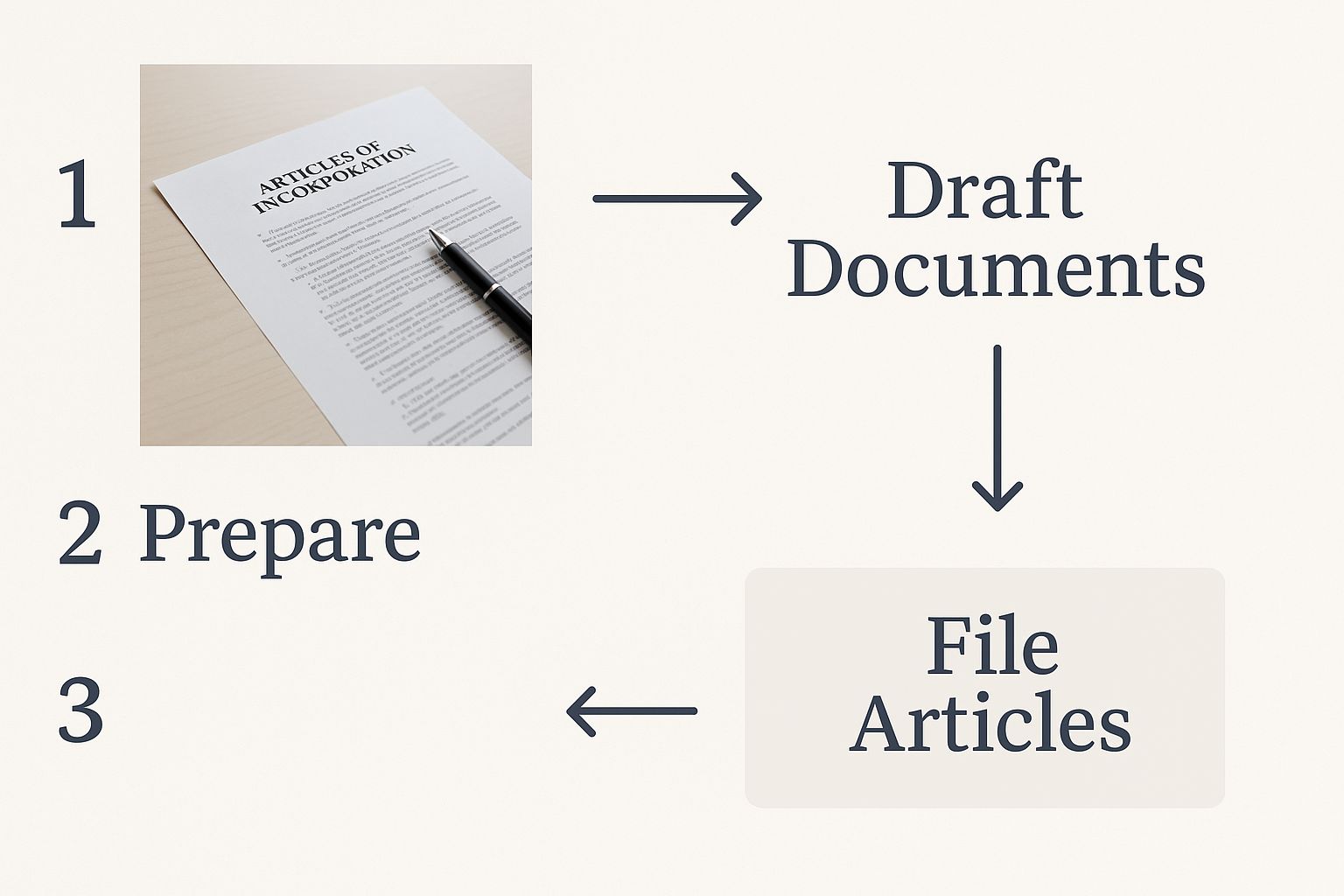
As you can see, filing is the key action that turns all your planning into a real, recognized legal entity.
How to Submit Your Filing
Once you've got your Articles of Organization filled out, you have a few ways to get them to the state. The method you pick will impact both the cost and how quickly you get approved.
Most states now have a simple online portal for submissions. From my experience, this is almost always the fastest and easiest way to do it. You often get instant confirmation that your documents were received, and approval can come in just a few business days.
Of course, you can still go the traditional route and submit your paperwork by mail. This will naturally take longer because of postage and manual processing. If you go this route, be ready to wait anywhere from a couple of weeks to over a month, depending on how swamped your state's office is. Some states also allow in-person filing, which can sometimes get you expedited service if you're willing to pay an extra fee.
Understanding Fees and Timelines
Filing isn't free. Every state charges a one-time filing fee to process your Articles of Organization, and the cost can vary wildly.
Just to give you an idea of the range:
- Lower-Cost States: Some states, like South Dakota, charge around $100.
- Higher-Cost States: Others, like Texas, are closer to $300.
It's absolutely critical to check your specific state's Secretary of State website for the current fee schedule before you file. These fees can change, and sending the wrong amount is a surefire way to get your application rejected.
Processing times also change based on the state's workload and how you submitted your forms. So, plan ahead and don't leave it to the last minute, especially if you have a hard launch date in mind. To file with confidence, you need to have your details double-checked, your payment ready, and a little bit of patience.
Drafting Your LLC Operating Agreement
You've filed your Articles of Organization, and the state has officially recognized your LLC. It's tempting to pop the champagne and call it a day, but hold on. There’s one more crucial internal step that I'd argue is the most important for the long-term health of your business: creating an LLC Operating Agreement.
While only a handful of states actually require you to have one, operating without it is like setting sail without a map or a compass. It's a huge gamble I'd never advise a client to take. This document is the internal rulebook for your company, dictating how it runs, how decisions are made, and how you’ll handle conflicts before they blow up.
It's More Than Just a Formality
Think of it this way: your Articles of Organization gave birth to your LLC, but the Operating Agreement gives it life and rules to live by. This agreement is a private contract between the members that proves your LLC is a legitimate business entity, separate from you personally.
Without it, a court could potentially "pierce the corporate veil." In plain English, that means if your business gets sued, your personal assets—your house, your car, your savings—could be on the line.
Even if you’re a solopreneur running a single-member LLC, this document is still vital. It formalizes your business structure and is often the first thing a bank asks for when you try to open a business account or get a loan.
An LLC Operating Agreement is your first line of defense in a dispute and your best tool for proving the legitimacy of your business. It transforms your LLC from a piece of paper filed with the state into a well-defined, functional organization.
This agreement lays out all the big financial and operational decisions in black and white, preventing massive misunderstandings down the road. It’s where you and your partners get on the same page about the tough questions before they become real problems.
Essential Clauses for Every Agreement
A solid Operating Agreement doesn't need to be a hundred pages long, but it absolutely needs to be thorough. This is your chance to customize the rules for your business instead of being stuck with your state’s default LLC laws, which are often generic and might not fit what you're trying to build.
Make sure your agreement clearly covers these key areas.
- Ownership and Contributions: Detail the percentage of the company each member owns (their "membership interest"). Be specific about what each person contributed—was it cash, property, or maybe sweat equity? Write it all down.
- Profit and Loss Distribution: This one is huge. The agreement needs to spell out how profits (and, just as importantly, losses) will be divided. The beauty of an LLC is that distributions don't have to match ownership percentages. You can create a custom arrangement that works for your team.
- Management Structure: Is your LLC going to be member-managed, where all the owners have a say in daily operations? Or will it be manager-managed, where you appoint one or more people to run the show? This section defines who has the authority to sign contracts and make key decisions.
- Voting Rights and Powers: How will major decisions get made? Does every member get one vote, or is voting power tied to their ownership stake? Define what requires a unanimous vote versus a simple majority.
- Member Changes (The "Buy-Sell" Provision): Honestly, this might be the most critical part of the whole document. It sets the rules for what happens if a member wants to leave, passes away, becomes disabled, or even gets divorced. Without this, a partner's departure can throw the entire business into chaos.
Imagine you're in a two-person LLC and your partner decides to exit. A good Operating Agreement has a pre-agreed process for valuing their share and giving you the first right to buy them out. This kind of foresight is what separates a well-run business from one that’s just a crisis waiting to happen.
Your Post-Formation Checklist

Congratulations, your Articles of Organization have been approved! That's a huge milestone, but the journey isn't quite over. Think of it like this: your LLC is a brand-new car that just rolled off the assembly line. It’s built, but you still need to get it registered, insured, and ready for the road.
This next phase is all about building the operational and financial backbone of your business. These steps are non-negotiable for protecting that liability shield you worked to create, staying compliant, and running your company like the legitimate enterprise it is.
Obtain Your Federal Employer Identification Number
First up, you need to get an Employer Identification Number (EIN) from the IRS. It's basically a Social Security number for your business—a unique nine-digit code that identifies your company to the government. Best of all, it's completely free, and you can apply right on the IRS website.
Why is this so important? Well, you'll need an EIN for just about every core business function:
- Opening a Business Bank Account: Banks won't even talk to you without one.
- Hiring Employees: An EIN is mandatory for handling payroll and payroll taxes.
- Filing Federal Taxes: This is how the IRS knows who you are.
- Building Business Credit: It's the first step to establishing your business as its own financial entity.
Getting this number is a quick but absolutely essential step in legitimizing your operation. It’s the key that unlocks your business's financial independence.
Open a Dedicated Business Bank Account
Once that EIN is in your hands, head straight to the bank. I can't stress this enough: opening a dedicated business checking account is arguably the most critical thing you can do to protect your personal assets. This is where the "limited liability" part of your LLC becomes real.
Crucial Tip: Never, ever mix your personal and business finances. Commingling funds—like paying for groceries with your business debit card or funding payroll from your personal savings—can give a court a reason to "pierce the corporate veil." If that happens, your personal assets are suddenly fair game in a lawsuit.
Keeping your finances separate creates a clear, documented firewall between you and your company. It also makes bookkeeping and tax season infinitely less painful, giving you a clean record of all business income and expenses.
To open the account, you’ll usually need to bring a few key documents:
- Your approved Articles of Organization
- Your LLC Operating Agreement
- Your EIN confirmation letter from the IRS
Secure Necessary Business Licenses and Permits
Your state LLC registration is a general authorization for your business to exist. It doesn't automatically grant you permission to operate. Depending on your industry and where you're located, you will almost certainly need additional licenses and permits to do business legally.
These requirements can come from three different levels of government:
- Federal: Specific industries, like broadcasting, investment advising, or selling alcohol and firearms, require federal licenses.
- State: Many professions, from cosmetology and construction to real estate, demand state-level licenses. You’ll also likely need a state sales tax permit if you sell taxable goods or services.
- Local: Your city or county will often require a general business operating license. You might also need permits for things like zoning, health department clearance, or even the sign you hang outside your door.
A freelance graphic designer, for example, might just need a local business license. But someone opening a restaurant will need a whole stack: a local license, a health department permit, a food handler's license, and a state liquor license. Failing to get the right permits can lead to hefty fines or even the government forcing you to shut down.
Researching these requirements is a vital part of your post-formation due diligence. A great place to start is your local Small Business Administration (SBA) office or your city's official website. They often provide checklists and resources to guide you through what’s needed.
If navigating all of this on your own feels overwhelming, you're not alone. Many entrepreneurs choose to work with a professional service to handle the paperwork and ensure nothing gets missed. It can be a smart investment to get started on the right foot.
LLC Formation Service Provider Comparison
Here’s a helpful comparison of top LLC formation services to help you decide between a DIY approach and professional assistance.
| Provider | Key Feature | Best For | Starting Price |
|---|---|---|---|
| ZenBusiness | Worry-Free Compliance and fast filing speeds | Entrepreneurs seeking ongoing compliance support | $0 + state fee |
| Incfile | Free basic formation package (plus state fees) | Budget-conscious founders who need the basics | $0 + state fee |
| Northwest | Excellent customer service and privacy protection | Business owners who value privacy and support | $39 + state fee |
| LegalZoom | Brand recognition and a wide range of legal services | Those needing comprehensive legal help beyond formation | $79 + state fee |
While hiring an expert costs more than doing it yourself, the peace of mind in knowing that every box has been checked correctly is often worth the investment, especially when you're just getting started.
Keeping Your LLC in Good Standing
Getting your LLC officially formed is a huge milestone, but it's really the starting line, not the finish. Now the real work begins: keeping it healthy. Your focus has to shift to ongoing compliance—the recurring tasks that keep your business legally sound and make sure that liability shield you worked so hard to create stays strong.
Think of it this way: your Articles of Organization brought your LLC to life, but annual compliance is what keeps it breathing. Dropping the ball on these responsibilities can get you into hot water, leading to late fees, losing your "good standing" status, and in a worst-case scenario, the state dissolving your company and undoing all your hard work.
The Annual Report Requirement
The most common compliance task you'll deal with is the annual report. Don't let the name intimidate you; this isn't some complex financial document. It's usually just a simple form where you confirm or update your LLC's basic info on file with the state—things like your main address and your registered agent's details.
Most states require this every one or two years, and you’ll have to pay a fee. Missing the filing deadline is an easy mistake to make, but it can put your LLC's status at risk. For example, if you don't file, the state might just assume your business is defunct and dissolve it, leaving your personal assets exposed all over again.
The day you form your LLC, set a recurring calendar reminder for your annual report deadline. Seriously. Treat it like a tax deadline, because for the health of your business, it is one.
Other Ongoing Obligations
Beyond the annual report, a few other habits are key to staying in good standing. These are the things that prove your LLC is being run as a separate, legitimate entity.
- Maintain Your Registered Agent: You absolutely must have a registered agent on file with the state at all times. If your agent moves or resigns, you have to update your records immediately or you'll fall out of compliance.
- Pay State-Specific Taxes: Some states, like Texas and California, hit LLCs with a franchise tax or an annual tax just for the privilege of existing there. This isn't the same as income tax and is a mandatory part of staying compliant.
- Document Major Decisions: While LLCs are more flexible than corporations, getting into the habit of documenting big decisions is a smart move. Keeping minutes from member meetings (even if you're a single-member LLC just documenting your own choices) or written resolutions creates a paper trail that proves you're treating the business as its own legal entity.
This might sound like a lot to keep straight, but a simple compliance calendar can make it totally manageable. When you run into legal questions about running your company, it's always a good idea to get professional advice. You can learn more about finding the right legal help for your small business to make sure you're always on solid ground. These small, consistent actions are what will truly protect your business and give it a secure foundation to grow.
Your Top LLC Questions, Answered
Even with the best roadmap, forming an LLC can bring up a lot of questions. That’s perfectly normal. This is a huge step, and it's smart to tackle the common sticking points that trip up a lot of new entrepreneurs. Let's dig into some of the most frequent ones I hear.
How Much Does It Cost to Form an LLC?
This is probably the most common question I get, and the answer is: it really depends on your state. The biggest chunk of the cost is the state's one-time filing fee for your Articles of Organization. That fee can be as low as $50 in some places, but jump up to over $300 in others. For example, Texas will run you about $300, while a state like South Dakota is closer to $100.
But that's just the initial filing fee. Don't forget about the other potential costs that will pop up down the road:
- Annual Reports: Most states will require you to file a report each year to keep your company's info up-to-date. These fees are usually pretty reasonable, often between $20 and $200.
- Registered Agent Services: If you decide you don't want to be your own registered agent and hire a professional service instead, you'll need to budget for that. Expect to pay anywhere from $50 to $300 a year.
- Business Licenses: This is a big variable. Depending on your industry and where you're located, you might need specific permits and licenses. These can range from a small local fee to thousands of dollars for highly specialized licenses.
Do I Need a Lawyer to Form an LLC?
Legally speaking, no, you don't have to hire a lawyer to form an LLC. Plenty of entrepreneurs handle it themselves or use one of the many online formation services out there. Those services are built to be user-friendly and can be a pretty cost-effective way to get your business up and running.
That being said, if your business has a more complicated setup—like multiple partners, a significant amount of investor money, or you're in a heavily regulated industry—getting a lawyer involved is a wise investment. It’s all about making sure you’re properly protected from the start.
An attorney can give you advice that's specific to your situation and, just as importantly, help you draft a rock-solid Operating Agreement that will save you headaches later on.
Trying to navigate the legal side of starting a business can feel tricky, but you don't have to figure it all out on your own. At Cordero Law, we specialize in giving clear, strategic guidance to entrepreneurs and creatives. Schedule a consultation with us today and let's make sure your business starts on a solid legal foundation.