
Ever wonder how a brilliant idea actually becomes a legally protected asset? The whole process is called patent prosecution. Think of it less like a courtroom drama and more like a structured, behind-the-scenes negotiation between an inventor, their patent attorney, and a government patent office. The goal? To define and lock down the legal rights to an invention.
Your Invention’s Journey From Idea To Asset
When most people hear the word "prosecution," their minds jump to lawyers in a courtroom. That's a super common mix-up. In the world of intellectual property, prosecution isn't about suing someone; it’s about building something from the ground up. It’s the entire administrative journey, from the moment you file a patent application until that patent is either granted or, sometimes, finally rejected.
Let’s use an analogy to make this clearer: think of it like building a custom house.
- Your Idea is the Blueprint: The detailed write-up of your invention is like the architectural plans for your house. It has to be crystal clear, super specific, and leave no room for guessing.
- Your Patent Attorney is the Architect: They're the ones who take your technical blueprint and translate it into a legally solid patent application. They make sure it follows all the complicated rules and "building codes" set by the United States Patent and Trademark Office (USPTO).
- The Patent Examiner is the City Inspector: This is the government official who meticulously reviews your application (the blueprint). They're checking to make sure your invention is new, useful, and not just an obvious next step. They compare it against all existing structures (what we call "prior art") to confirm it’s truly original.
During this back-and-forth, the patent examiner will almost certainly issue one or more "Office Actions." You can think of these like an inspector's feedback report, pointing out all the areas that don't quite meet the code. It’s your attorney’s job to respond with sharp arguments and careful amendments to fix those issues, strengthen your claims, and clarify what makes your invention so unique.
At its heart, patent prosecution is a strategic dialogue. It’s a negotiation designed to convince the examiner that your invention is worthy of legal protection, ultimately resulting in a strong, enforceable patent that can be a massive asset for your business.
This isn't just a local thing; it's a global hustle. All over the world, inventors are going through this process, leading to roughly 1.85 million patents granted between 2020 and 2024. In that same window, over 2.2 million applications were either issued or abandoned. Those numbers show just how active and competitive the innovation space really is. For a deeper dive, check out the full 2025 patent intelligence report for more on what's changing in patent prosecution on Patexia.com.
Patent Prosecution At A Glance
To help simplify this journey, here’s a quick breakdown of the core stages and what they're all about.
| Stage | What It Is | Main Goal |
|---|---|---|
| Application Filing | The initial submission of your invention's details to the patent office. | To officially start the process and secure a filing date. |
| Examination | A patent examiner reviews your application against prior art. | To determine if the invention meets all legal requirements for a patent. |
| Office Actions | The examiner's written feedback, often including rejections or objections. | To communicate any issues with the application that need to be addressed. |
| Response & Amendment | Your attorney's reply, arguing for patentability and/or changing the claims. | To overcome the examiner's rejections and move closer to approval. |
| Allowance or Rejection | The final decision from the patent office after the back-and-forth. | To either grant the patent or issue a final refusal. |
This table maps out the typical path, but remember, every invention's journey is unique. It’s a process of persistence, strategy, and expert navigation.
The Core Stages Of The Patent Process
Think of getting a patent like following a detailed roadmap. While every invention's journey is a bit different, the main stages are always the same, guiding your idea from the day you file to the final say from the United States Patent and Trademark Office (USPTO). Let's walk through this step-by-step.
The whole thing kicks off the moment you decide to formally protect your invention by filing a patent application. This first step is a big one. Inventors have two main paths to pick from, and each has its own strategic perks. Nailing this choice is key to starting your patent journey on the right foot.
This infographic breaks down the initial steps, showing you the flow from jotting down your idea to your first interactions with the patent office.
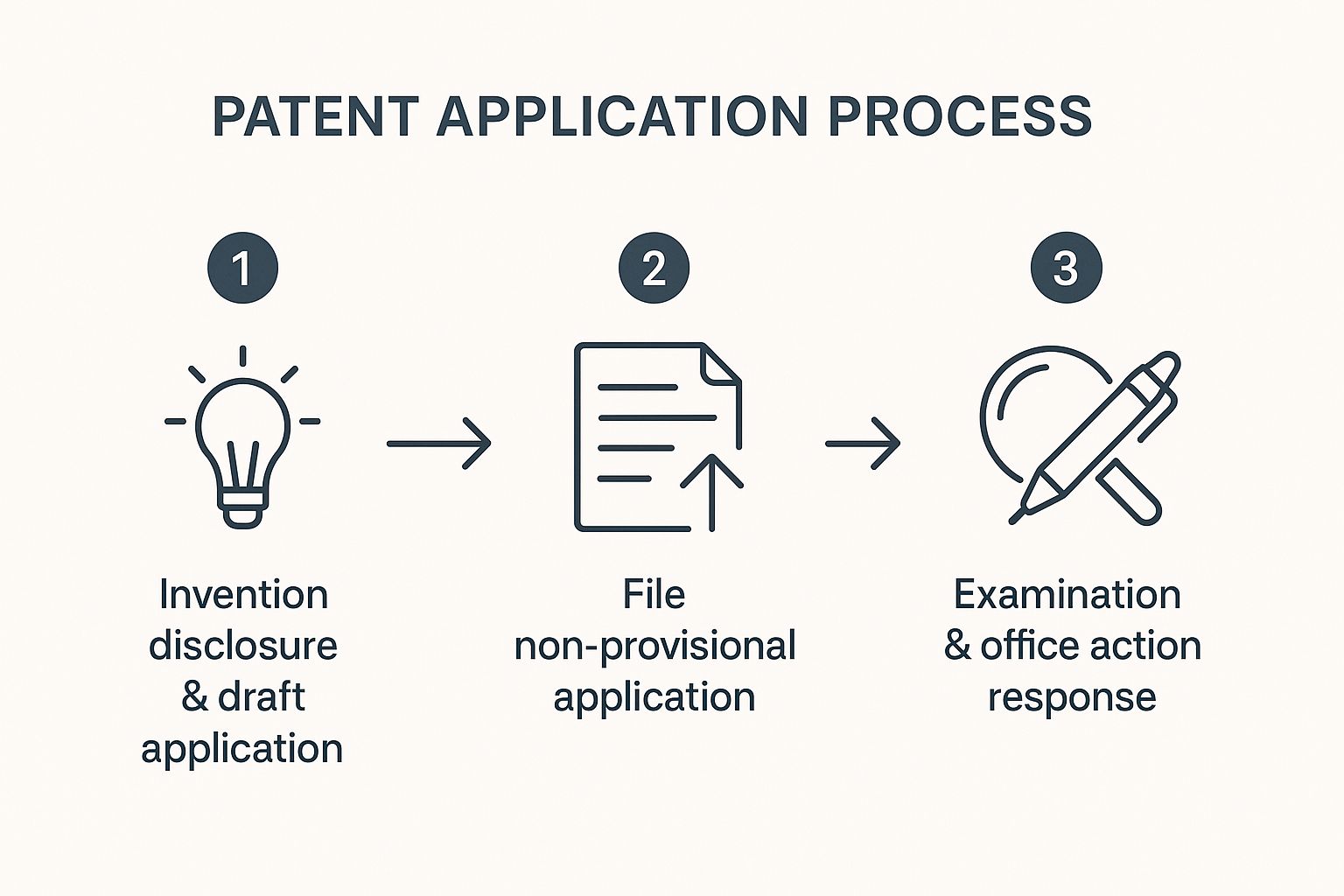
As you can see, it's a linear path where each stage builds on the one before it, all leading up to the all-important examination phase.
Starting Your Journey With The Right Application
Your first major decision is choosing between two kinds of applications:
- Provisional Patent Application: Think of this as a placeholder. It’s a less formal, cheaper option that lets you lock in a filing date and use the term "patent pending" for 12 months. This gives you a year to tweak your invention, see if it has legs in the market, or find funding before going all-in on the full application. It's a great strategic move, but it won't actually get examined on its own.
- Non-Provisional Patent Application: This is the real deal—the formal, complete application that the USPTO will actually review. It has to include a detailed specification, drawings, and a set of "claims" that legally define the edges of your invention. You can file this from the get-go, or file it within a year of your provisional to claim that earlier filing date.
Which one is right for you? It really depends on your specific situation, your timeline, and what you're trying to achieve with your business. For a deeper dive, check out our complete guide to the patent filing process.
The Most Critical Phase: The Office Action
Once you file a non-provisional application, you wait. An examiner, who is an expert in your invention’s field, will do a deep dive into all existing technology (what we call "prior art") to figure out if your invention is new and not just an obvious next step. They'll send you their findings in an Office Action.
An Office Action is the official letter from the patent examiner. It's incredibly rare for an application to get a green light without at least one of these. Usually, they contain rejections or objections to your claims.
An Office Action isn't a final "no." It's better to see it as the start of a negotiation. The examiner is telling you their concerns, and it's your shot to respond, clarify things, and fight for your invention's merits.
Your response is your chance to push back. You and your attorney will put together a reply, which might mean tweaking the claims to narrow them down or presenting solid legal arguments about why the examiner’s take on the prior art is off base. This back-and-forth is the heart of patent prosecution.
Reaching The Finish Line: Allowance Or Final Rejection
After one or more rounds of Office Actions and responses, you’ll get to a final decision. There are two main ways this can go.
- Notice of Allowance: This is the news every inventor wants to hear. It means the examiner agrees that your invention checks all the boxes for patentability. Once you pay the issue fee, your patent will be granted, and you'll get your official patent certificate.
- Final Rejection: If, after a few rounds of discussion, the examiner just isn't convinced, they’ll issue a Final Rejection. But this doesn't have to be the end of the road. You still have options, like filing an appeal with the Patent Trial and Appeal Board (PTAB) or filing a new application to keep the conversation going.
Every stage here demands careful strategy and clear communication. Getting from filing to allowance is a sign of a well-written application and a smart approach to the examination process.
Who Is On Your Patent Prosecution Team

Successfully getting a patent isn't a solo mission; it's a team sport. Securing a strong patent takes a mix of deep technical know-how, sharp legal strategy, and a solid grasp of the rules of the game. Three key players make up the core of every single patent prosecution team.
Each person brings a unique skill set to the table. Understanding their different roles is the key to a smooth process that keeps everyone aiming for the same goal: a strong, enforceable patent.
The Inventor: The Visionary
You, the inventor, are the undisputed MVP of this team. The whole process is built on your creativity, expertise, and your deep understanding of the problem your invention solves. You're the source of all the technical knowledge and the final authority on how your invention works and what makes it special.
Your main jobs include:
- Full Disclosure: You need to provide a complete and honest explanation of your invention. This includes all its different versions, potential uses, and the "best mode" for making it work.
- Technical Clarity: Be ready to answer detailed questions from your attorney. This ensures every little detail is captured perfectly in the patent application.
- Review and Approval: You have to carefully review the application before it's filed to make sure it correctly represents what you've created.
Without you, the whole thing grinds to a halt. Your insight is the fuel that powers the entire journey from idea to asset.
The Patent Attorney: The Strategist and Translator
Your patent attorney or patent agent is your guide, translator, and advocate. Think of them as fluent in two languages: the technical language of your invention and the precise legal language the United States Patent and Trademark Office (USPTO) demands. Their job is to bridge that gap between your brilliant idea and a legally solid document.
But this role is way more than just filling out forms. A good patent attorney is a strategist. They help you define the broadest possible protection for your invention while navigating the complex maze of patent law. They’re the ones who draft the claims—the legal boundaries of your patent—and craft the arguments to convince the examiner your invention deserves protection.
Think of your patent attorney as the architect who turns your conceptual blueprint into a legally sound structure that can stand up to challenges. They make sure every 'i' is dotted and every 't' is crossed to build an asset that has real-world value.
They are your main point of contact with the patent office, handling all the back-and-forth and leading the negotiations during the examination phase.
The Patent Examiner: The Gatekeeper
The Patent Examiner is a highly trained expert in a specific technical field, and they work for the USPTO. It’s easy to see the examiner as an adversary, but that's not a helpful way to look at it. Their real job is to be an impartial gatekeeper, making sure that only inventions meeting the strict legal standards actually get patented.
Examiners are on a critical mission:
- Protecting the Public Domain: They stop overly broad or undeserving patents from being issued, which could block future innovation.
- Enforcing Legal Standards: They check if your invention is truly new (novel), not just an obvious next step (non-obvious), and useful. They do this by conducting a deep dive into all existing technology, known as "prior art."
- Ensuring Clarity: They make sure your application clearly and accurately describes the invention so that others in the field can understand it.
When you understand what motivates the examiner, you and your attorney can frame your arguments much more effectively. Their goal isn't to deny your application; it's to ensure it deserves to be a patent. Working with them, not against them, is the key to getting across the finish line.
Navigating Modern Challenges In Patent Prosecution
Getting a patent today isn’t what it used to be, not even close. It's no longer enough to just have a brilliant idea; you have to shepherd that idea through an increasingly crowded and complicated global system. The game has changed, and the modern hurdles in patent prosecution demand a level of strategy and foresight that was unheard of a decade ago.
One of the biggest challenges is simply the sheer volume of new ideas. Innovation is happening faster than ever, which means a flood of new patent filings. Global patent filings are expected to hit 3.45 million in 2024, a 4% increase from the year before. This explosion is fueled by tech, especially artificial intelligence—AI-related filings shot up 33% since 2018 and have skyrocketed over 300% in the last ten years. You can explore global patent filing insights from WeLocalize for a deeper dive into these numbers.
This surge, particularly in software and AI, is putting a huge strain on patent offices and raising the bar for every inventor trying to get their application approved.
The Rise Of Software And AI Inventions
Let's be honest: inventions involving AI and complex software are a headache to define in a patent application. Unlike a new kind of hammer you can hold in your hand, these ideas are abstract. That creates a massive challenge during the prosecution phase.
Patent examiners now demand an incredible amount of technical detail. You can’t just describe what your software does. You have to explain how it does it, proving it's a real technical innovation and not just a fancy math equation running on a generic computer. This means getting into the weeds with things like:
- Detailed Algorithms: You need to spell out the specific logic and steps your software follows.
- System Architecture: You have to describe how the software bits and hardware pieces work together to create a tangible result.
- Technical Problem-Solving: The key is proving your software provides a specific technical solution to an actual technical problem.
Failing to provide this level of detail is one of the fastest tickets to a rejection. Examiners are gatekeepers, and their job is to make sure patents are granted for concrete inventions. The burden is on you to make a convincing case, especially for something you can't physically touch.
Pushing a software or AI patent through successfully means you need to be fluent in both the technology and the constantly changing legal rules that apply to it.
Navigating The Global Patent Maze
For most businesses, protecting an invention in just one country is not going to cut it. But once you decide to go international, you're stepping into a whole different ballgame. There’s no such thing as a “worldwide patent,” which means you have to file and prosecute your patent in every single country or region where you want protection.
This process is like navigating a strategic maze, with different rules, deadlines, and weird quirks in every jurisdiction. What flies as a patentable idea in the U.S. might get shot down in Europe or China.
Here are some of the key international hurdles you'll face:
- Varying Legal Standards: Every patent office has its own take on what counts as "novel" or "non-obvious."
- Translation Accuracy: This is critical. One small mistake in a technical or legal translation can completely gut your patent claims in another language.
- Local Counsel: You'll need to hire local patent attorneys in each country, which adds layers of complexity and, of course, cost.
To get ahead of these challenges, you have to be proactive. Smart inventors and their attorneys are now using data analytics and specialized tools to track what examiners are doing, dig through prior art more effectively, and map out a global strategy from day one. It’s this kind of forward-thinking that gives innovators a real edge in securing the protection their ideas truly deserve.
Patent Prosecution Versus Patent Litigation
It's a super common point of confusion, but patent prosecution and patent litigation are two completely different worlds. Getting this distinction right is vital for any inventor or business owner. Mixing them up is like confusing an architect with a demolition expert—both deal with buildings, but you call them for opposite reasons.
The easiest way to think about it is this: prosecution is the "building" phase. It’s all about creating the patent. Litigation, on the other hand, is the "defending" phase. It’s all about enforcing it.
The Building Phase: Collaboration, Not Conflict
Patent prosecution is the administrative journey you take before a patent even exists. It's a back-and-forth conversation, a negotiation really, with the United States Patent and Trademark Office (USPTO). The whole vibe is generally cooperative, aimed at getting on the same page with a patent examiner.
Here’s what that looks like:
- The Venue: The whole thing happens at the USPTO, not in a courtroom. Think office, not witness stand.
- The Goal: Your mission is to convince a highly specialized examiner that your invention is new, useful, and not obvious enough to earn a patent.
- The Outcome: At the end of the road, you either get a granted patent—a powerful business asset—or a final rejection.
The entire dialogue centers on hammering out the legal boundaries of your invention through its claims. It’s a constructive process designed to build a solid intellectual property right from the ground up.
The Defending Phase: Adversarial Enforcement
Patent litigation doesn't even enter the picture until after a patent has been granted. This is an adversarial legal fight that plays out in federal court when a patent owner believes someone is stepping on their rights. This isn't a friendly negotiation; it's a conflict that a judge and often a jury will decide.
Here are the key features of litigation:
- The Venue: Litigation happens in a U.S. District Court. It's a completely different and far more formal environment than the USPTO.
- The Goal: To prove that another party is making, using, or selling your patented invention without your permission, and to get paid for the damages or get a court order to make them stop.
- The Outcome: A court judgment that could mean massive financial awards, an injunction, or a ruling that the patent is invalid or wasn't infringed. You can see just how high the stakes are when you look at different patent infringement examples.
Litigation is where the patent you so carefully built during prosecution gets put to the ultimate test.
A strong patent prosecution process builds a sturdy fortress. A weak one builds a house of cards that can easily collapse under the pressure of a courtroom battle.
To really nail down the differences, let's break it down side-by-side.
Prosecution vs. Litigation: What's The Difference?
| Aspect | Patent Prosecution | Patent Litigation |
|---|---|---|
| When It Happens | Before a patent is granted | After a patent is granted |
| Location | U.S. Patent and Trademark Office (USPTO) | U.S. District Court (Federal Court) |
| The Goal | To obtain a patent | To enforce a patent |
| The Parties | Inventor/Applicant vs. USPTO Examiner | Patent Owner (Plaintiff) vs. Alleged Infringer (Defendant) |
| The Vibe | Collaborative, administrative | Adversarial, legal battle |
| The Result | A granted patent or a rejection | A court judgment (e.g., damages, injunction, invalidation) |
Seeing it laid out like this really clarifies that while both are crucial parts of a patent's life, they are fundamentally different processes with different goals and arenas.
The Hybrid Battleground: Post-Grant Proceedings
Just to make things interesting, there's a middle ground where these two worlds meet: post-grant proceedings. These are unique legal challenges that happen back at the USPTO after a patent has already been issued.
The most common one is the Inter Partes Review (IPR), which allows a third party to challenge the validity of an existing patent.
An IPR feels a lot like a mini-trial, but it's held before administrative patent judges at the Patent Trial and Appeal Board (PTAB), not in a district court. It’s a faster, and often cheaper, way for an accused infringer to try and knock out a patent. The stats show just how tough this battleground is. In 2025, final PTAB decisions in IPRs resulted in 67.01% of challenged patent claims being canceled, with only 31.54% making it through unscathed. You can dig into the numbers in the latest PTAB statistics from Finnegan.
At the end of the day, knowing the difference between building your patent (prosecution) and defending it (litigation) is the bedrock of a smart IP strategy.
Actionable Tips For A Stronger Patent Application

You can dramatically improve your odds during patent prosecution by taking a proactive approach. While your attorney is navigating the legal maze, being an engaged and well-prepared inventor makes your entire case stronger right from the start.
Success actually begins long before you even file. A thorough prior art search is an absolute must. This means digging through existing patents, scientific papers, and products to see what’s already out there.
The point isn't just to find a carbon copy of your idea. It's about understanding the landscape so you and your attorney can pinpoint what makes your invention truly new. This homework helps you draft smarter claims that head off potential rejections, saving you a ton of time and money later.
Keep An Open Line of Communication With Your Attorney
Your patent attorney is your most important partner in this process, but they can't read your mind. Clear, constant communication is the foundation of a successful relationship. Don't hold back any details, no matter how small they might seem.
To get the most out of the collaboration, make sure to:
- Explain the "Why": Don't just explain what your invention does; explain the problem it solves and why everything else on the market falls short. This context is gold for your attorney.
- Discuss Every Version: Think about all the different ways your invention could be made or used. Protecting these variations can lead to a much stronger, more valuable patent.
- Stay Responsive: When your attorney has questions or sends a draft, get back to them quickly. Delays on your end can put deadlines at risk and throw a wrench in the whole timeline.
This back-and-forth ensures that nothing gets lost in translation between your technical vision and the legal document that will protect it.
A well-prepared inventor is an empowered inventor. Your deep knowledge of the invention, combined with your attorney's legal expertise, creates a formidable team that can navigate the complexities of patent prosecution more effectively.
Think Like The Patent Examiner
It’s easy to see the patent examiner as an opponent, but it’s far more productive to view them as a gatekeeper. Their job is to make sure only truly novel and non-obvious inventions get the stamp of approval. Understanding their perspective can completely change how you handle Office Actions.
When you get a rejection, step into their shoes. What kind of argument or evidence would convince you? A hugely valuable tool that many people overlook is the examiner interview. This is a direct phone or video call where your attorney can talk to the examiner, clear up any confusion, and negotiate a path forward.
Finally, let's talk budget. Patent prosecution is a marathon, not a sprint, and you need to be financially prepared. Discuss the full scope of potential costs with your attorney from day one. For those just getting started, learning how to file a provisional patent can be a smart, cost-effective way to lock in an early filing date while you finalize your strategy.
Common Questions About Patent Prosecution
Diving into the world of intellectual property can feel like you're learning a new language, and it's totally normal to have a ton of questions. Let's tackle some of the most common ones we hear from inventors just starting their journey.
How Long Does Patent Prosecution Take?
This is the big one, the question on every inventor's mind. The short answer? It varies. But on average, you can expect the process to take about two to three years from the day you file your non-provisional application until you get a final decision from the USPTO.
Now, that timeline isn't set in stone. A few things can speed it up or slow it down:
- Your Tech Field: Some areas, like complex software or biotech, are just busier. There's a bigger backlog of applications, so they naturally take longer than, say, a straightforward mechanical invention.
- The Examiner's Workload: A lot depends on the specific patent examiner assigned to your case and how many applications are already sitting on their desk.
- How Complex Your Invention Is: The more intricate your invention, the more likely you'll have some back-and-forth with the examiner (we call these "Office Actions"). Each round of communication adds to the timeline.
If you're in a real hurry, the USPTO has accelerated examination programs. They can crunch the timeline down to as little as 12 months, but they come with extra fees and stricter requirements.
How Much Does It Cost To Get A Patent?
Budgeting is a huge piece of the puzzle, especially since the costs are spread out over a few years. There’s no single price tag, but for a standard utility patent in the U.S., you should probably plan for a range of $10,000 to $20,000 or more. That number covers everything from government filing fees to legal help.
Think of the cost in stages. You have your initial filing fees, then professional fees for your attorney to draft the application and respond to the examiner. Once your patent is granted, there are issuance fees and ongoing maintenance fees to keep it active.
It's an investment, but it's an investment in protecting your most valuable asset. A good patent attorney will be upfront about their fee structure and help you map out the costs so there are no surprises.
Can I File A Patent Application Myself?
Technically, yes, you can file a patent application on your own—it's called filing "pro se." But I have to be honest with you: it’s incredibly risky. Patent law is a maze of technical rules and legal jargon.
A tiny mistake in how you write your claims or respond to an Office Action can cripple the value of your patent or get it rejected outright. Hiring an experienced patent attorney isn't just a cost; it's an investment in making sure your intellectual property is strong, enforceable, and actually worth something.
At Cordero Law, we live and breathe this stuff. We guide inventors through every single step of patent prosecution, breaking down the complexities to help you build a powerful, valuable asset. Learn how we can help protect your innovation.