
So, what’s the real difference between an LLC and a corporation?
It really comes down to this: an LLC gives you operational simplicity and tax flexibility, while a corporation offers a much more formal structure that’s built for attracting outside investment. The right fit for you depends entirely on whether you value easy, day-to-day management or have ambitious long-term growth plans.
Decoding the Core Differences Between LLCs and Corporations
Choosing your business structure is one of the biggest decisions you'll make as an entrepreneur. It’s not just paperwork; it affects everything from your daily operations and personal liability to how you get taxed and your ability to raise money. Get it right, and you've set a solid foundation. Get it wrong, and you could be creating a world of administrative headaches and financial burdens for yourself down the road.
The decision really boils down to three key areas:
- Liability Protection: How well the structure shields your personal assets from business debts.
- Taxation: How your business profits are taxed—both at the company level and on your personal return.
- Administrative Demands: The formal requirements you'll have to keep up with, like meetings, records, and compliance filings.
This infographic breaks down the major distinctions in ownership, taxation, and liability at a glance.
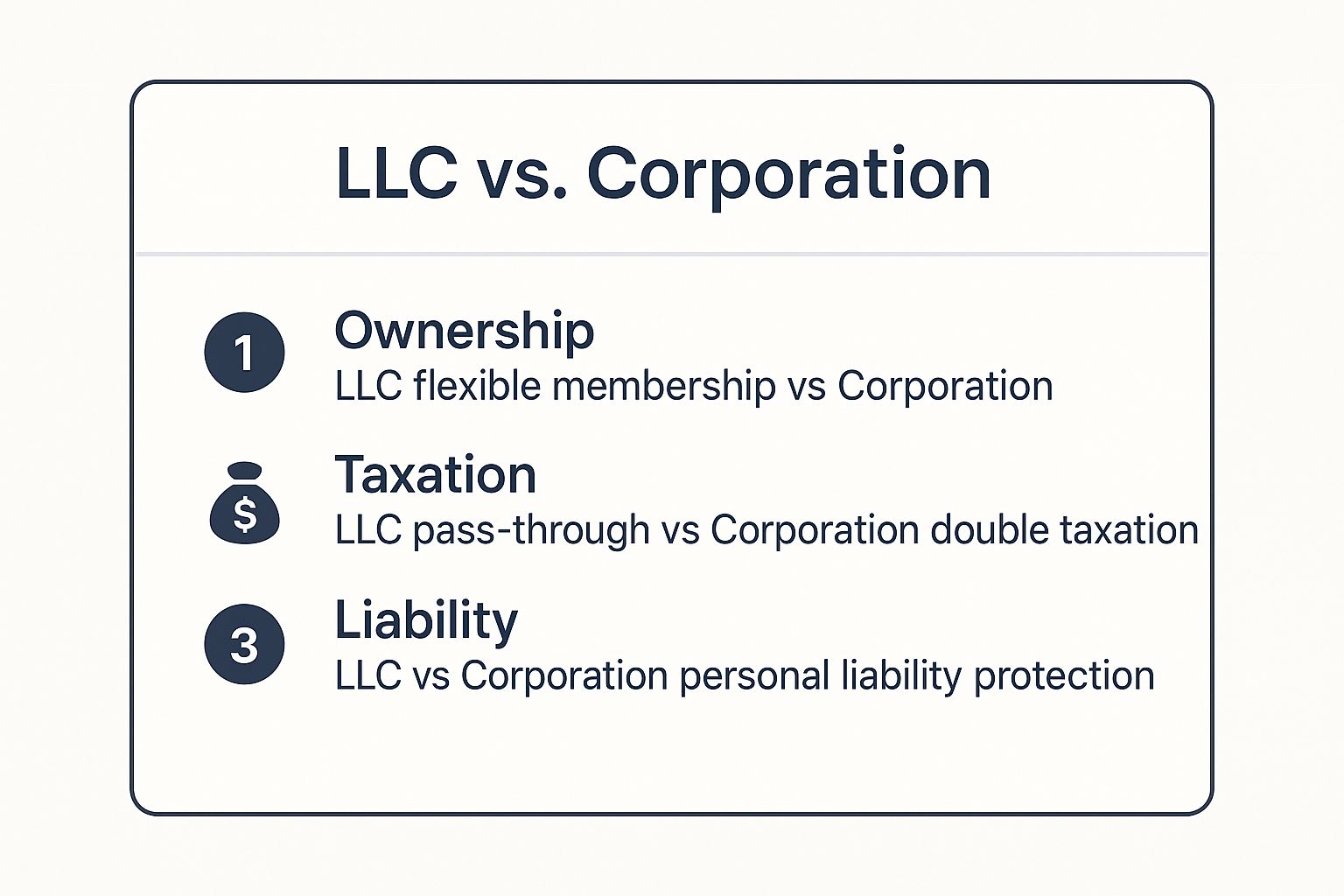
As you can see, while both structures offer that crucial liability protection, their approach to ownership and taxes is fundamentally different. Those differences will have a direct impact on your operational and financial strategy.
Before we dive deeper, here's a quick cheat sheet to keep the main points straight.
LLC vs Corporation At a Glance
| Feature | LLC (Limited Liability Company) | Corporation (C Corp & S Corp) |
|---|---|---|
| Ownership | Owned by "members." Can be one person or many. | Owned by "shareholders." |
| Liability | Provides a strong liability shield for personal assets. | Provides a strong liability shield for personal assets. |
| Taxation | "Pass-through" taxation by default. Can elect to be taxed as an S Corp or C Corp. | C Corps are taxed twice. S Corps have pass-through taxation. |
| Management | Flexible. Can be managed by members or appointed managers. | Rigid structure: shareholders, directors, and officers. |
| Best For | Solo entrepreneurs, small businesses, and partnerships wanting simplicity. | Startups seeking investors, large companies, and businesses planning to go public. |
This table gives you the high-level view, but the real story is in the details and how they apply to your specific situation.
The Modern LLC vs. The Traditional Corporation
Corporations have been around for centuries, giving them a time-tested—and often rigid—framework for doing business. The LLC, on the other hand, is a much newer invention. The very first LLC statute was passed in Wyoming back in 1977, but it took a while to catch on.
Widespread adoption was slow, mostly because of tax uncertainties. It wasn't until a crucial IRS ruling in 1988 clarified their tax status that other states finally jumped on board, embracing this new, more flexible business entity. You can learn more about the history of the LLC and its tax treatment to see just how far it's come.
Key Takeaway: Your decision isn’t just about today; it’s about your future vision. The "best" choice is entirely dependent on your goals, whether you are building a solo freelance business, a family-owned shop, or a high-growth startup aiming to attract investors.
Understanding these foundational differences is the first step. In this guide, we'll walk through each of these areas in much more detail, giving you the insights you need to pick the structure that actually aligns with your ambitions and the way you want to run your business.
Navigating Ownership and Management Structures
So, how will you actually run your business day-to-day? The difference between an LLC and a corporation gets really sharp when you look at how they're managed. One gives you flexible, informal control, while the other demands a more rigid, formal hierarchy.

An LLC is all about flexibility. Its owners are called “members,” and they get to decide how the company is run. This usually leads to two different setups.
The Flexible LLC Management Model
The most straightforward approach is a member-managed LLC. In this structure, all the owners have a direct say in daily operations and big-picture decisions, a lot like a general partnership. It’s a perfect fit for small businesses or solo founders where the owners are the ones doing the work.
The other option is a manager-managed LLC. Here, the members appoint a manager (or a team of managers) to handle the day-to-day stuff. That manager could be one of the members, or you could hire an outside pro for their expertise. This works great for businesses with passive investors who want to put in capital but don't want to be involved in operations.
The real beauty of an LLC’s structure is its adaptability. You can spell out everyone's roles and responsibilities in the operating agreement, customizing the management to fit your exact needs. You aren't locked into some rigid, state-mandated system.
The way ownership and profits are split in an LLC can also be completely customized. If you want to dive deeper, our guide on determining https://www.corderolawgroup.com/blog/2025/llc-percentage-ownership offers some valuable insights into structuring these arrangements.
The Formal Corporate Hierarchy
Corporations, on the other hand, operate with a much more defined and legally required structure. This formality is there for a reason—it’s designed to create accountability, especially in companies with lots of owners or outside investors. The hierarchy has three clear tiers:
- Shareholders: These are the owners. Their main job is to elect the board of directors and vote on major corporate moves, but they aren't involved in the day-to-day grind.
- Board of Directors: Elected by the shareholders, the board is in charge of the big strategic decisions. They oversee the company's direction, appoint the officers, and make sure the business acts in the shareholders' best interests.
- Officers: Appointed by the board, officers (like the CEO, CFO, and Secretary) are the ones who manage the daily operations. They’re the executives on the ground, carrying out the board's strategic vision.
This clear separation of powers is fundamental to how a corporation works. It provides a system of checks and balances but can also make decision-making slower compared to a more nimble LLC. For any startup that plans on seeking venture capital, this formal structure isn't just a "nice-to-have"—it's pretty much required by investors.
How Liability Protection Really Works
One of the biggest reasons to form a business entity in the first place is to protect your personal assets. Both LLCs and corporations do a great job of creating a shield, but the strength of that shield really comes down to how you operate the business day-to-day. This protection comes from a legal concept called the “corporate veil.”

Think of the veil as a legal wall separating your business finances from your personal life. If the business racks up debt or gets hit with a lawsuit, this wall is what stops creditors from coming after your personal savings, your home, or your car. Both structures offer this core benefit, but the real work—and the biggest difference—lies in keeping that wall intact.
Piercing the Corporate Veil
Here’s the catch: that liability shield isn't bulletproof. Courts have the power to "pierce the corporate veil," which means tearing down that protective wall if they find the business isn't truly a separate entity from its owners. This is the single biggest threat to your personal asset protection.
The most common mistake that gets business owners in trouble is commingling funds—using your business bank account for personal stuff or paying business bills from your personal checking account. It blurs the line between you and the company, making it look like the business is just your personal piggy bank. Other actions, like committing fraud or not putting enough money into the business to begin with (undercapitalization), can also lead a court to pierce the veil.
A strong liability shield is built on a foundation of strict separation. Once you start treating the business's money as your own, you give a court a reason to do the same, putting your personal assets directly at risk.
The Critical Role of Corporate Formalities
This is where the operational differences between LLCs and corporations really matter for liability. Corporations are legally required to follow a strict set of rules, known as corporate formalities, just to keep their veil in place.
These aren't suggestions; they are requirements. Corporate formalities include things like:
- Holding annual meetings for the board and shareholders.
- Keeping detailed written minutes of those meetings.
- Adopting and actually following the company's bylaws.
- Issuing stock certificates to all shareholders.
If you fail to keep up with these steps, it can be used as evidence against you in a lawsuit to pierce the corporate veil. LLCs, on the other hand, have far fewer built-in requirements, which gives them a lot more operational flexibility. But this flexibility can be a double-edged sword. Even though you aren't forced to hold annual meetings, you absolutely must maintain that clear financial separation.
To get a deeper sense of what's involved, it's worth learning more about the corporate formalities required for personal liability protection in corporations and why they are so critical.
Decoding Your Tax Options and Obligations
Let’s be honest, taxes are often the biggest deciding factor when you’re weighing an LLC against a corporation. How your business gets taxed hits your bottom line directly, and these two structures go down fundamentally different paths. Your choice here will shape everything from how you file each year to the total tax bite taken out of your profits.

By default, a standard LLC gets what’s called pass-through taxation. It’s a pretty simple concept: the LLC itself doesn’t pay income tax. Instead, all the profits (and losses) are “passed through” to the owners, known as members. They report this income on their personal tax returns and pay taxes at their own individual rates. This setup completely avoids taxing the business at the entity level.
Corporations, on the other hand, play by a different set of rules. A standard C Corporation is hit with double taxation. First, the corporation pays corporate income tax on its profits. Then, when it passes those profits to shareholders as dividends, the shareholders get taxed on that money again on their personal returns. Ouch.
The Power of Tax Flexibility
This is where the LLC really shines. Its biggest superpower is incredible tax flexibility. While it starts as a pass-through entity, it doesn’t have to stay that way. This chameleon-like ability is a game-changer when you’re comparing the two.
The LLC's "check-the-box" regulation is its secret weapon. This IRS rule literally lets an LLC choose how it wants to be taxed—as a sole proprietorship, a partnership, an S Corp, or even a C Corp—without having to change its underlying legal structure.
This means your LLC can evolve its tax strategy right alongside your business. A brand-new startup might love the simplicity of pass-through taxation. But once it becomes highly profitable, electing to be taxed as an S Corp could lead to massive savings.
S Corp Election: A Strategic Move for Savings
Here’s a key point: both an LLC and a traditional corporation can elect to be taxed as an S Corporation. An S Corp is a fantastic hybrid, mixing the pass-through taxation of an LLC with a unique way to potentially slash your self-employment tax bill.
Here’s how it works:
- Reasonable Salary: As the owner-employee, you have to pay yourself a "reasonable salary" for the work you actually do. This salary is subject to the usual payroll taxes (Social Security and Medicare).
- Distributions: Any profit left over can be paid out as distributions. The magic here is that these distributions are not subject to self-employment taxes. For a profitable business, this can translate into thousands of dollars in tax savings every single year.
Taxes are a huge piece of the puzzle, but they’re tied directly to your legal structure. Corporations have a very rigid management hierarchy, whereas LLCs offer much more freedom. From a tax perspective, an LLC’s ability to pick its classification is a clear advantage over a corporation, which is pretty much stuck with C or S Corp status.
Ultimately, figuring out your tax obligations is just as important as protecting your brand's identity. For instance, you might also want to check out our guide on the differences between a trademark vs copyright to make sure your brand assets are secure. Choosing the right tax structure is all about being financially smart and making sure it aligns with where you want to take your business in the long run.
Comparing Formation Costs and Annual Compliance
Okay, let's move from theory to the real world. This is where we break down the actual costs and administrative headaches of launching and maintaining your business. The initial setup and ongoing compliance are where the difference between an LLC and a corporation stops being an abstract idea and starts hitting your calendar and your wallet.
The formation process itself paints a pretty clear picture. To get an LLC off the ground, you file a document with your state called the Articles of Organization. For a corporation, the equivalent is the Articles of Incorporation. The names might sound similar, but believe me, the follow-up work is not.
Initial Setup and Ongoing Tasks
Once your entity gets the green light from the state, the compliance journey truly begins. A corporation is immediately hit with a laundry list of strict rules. You have to hold an initial meeting for the board of directors, formally adopt company bylaws, and issue stock certificates to every shareholder. These aren't just one-and-done tasks; they set the precedent for a future filled with mandatory annual meetings and painfully meticulous record-keeping.
An LLC's path is usually a lot simpler. While most states don't legally require it, drafting a comprehensive Operating Agreement is something I consider absolutely critical. This is your internal rulebook—it spells out how the LLC will be managed, how profits get divided, and what happens if a member wants out. Skipping this step is a huge, and completely avoidable, risk.
While an LLC offers fewer state-mandated formalities, a well-drafted Operating Agreement is non-negotiable. It provides the internal structure that bylaws offer a corporation, preventing future disputes and solidifying your liability protection by proving the LLC is a legitimate, separate entity.
Both business types have to appoint a registered agent to handle official mail and legal notices. You’ll also need to file an annual or biennial report with your state and pay a fee to stay in good standing. But again, the corporate burden is just plain heavier.
Typical Formation and Annual Compliance Tasks
Here’s a practical look at the administrative responsibilities you can expect with each business structure. Think of this as a preview of the long-term commitment you’re signing up for.
| Compliance Task | LLC Requirement | Corporation Requirement |
|---|---|---|
| Formation Document | File Articles of Organization | File Articles of Incorporation |
| Governing Document | Operating Agreement (highly recommended) | Bylaws (legally required) |
| Initial Actions | No formal requirements after filing | Hold board meetings, issue stock |
| Annual Meetings | Not typically required by law | Mandatory for shareholders and directors |
| Meeting Minutes | Recommended but not required | Legally required for all official meetings |
| Annual Report | Required in most states | Required in all states |
As you can see, the corporate framework demands a much higher level of administrative discipline from day one. If you fail to keep up with these formalities—like holding meetings and recording minutes—you could easily jeopardize the very liability shield you formed the corporation to get. This ongoing administrative load is a massive factor when you’re weighing the simplicity of an LLC against the rigid structure of a corporation.
So, What's the Final Call for Your Business?
Choosing between an LLC and a corporation isn't just about filing some paperwork; it's a strategic move that needs to line up with where you see your business going. The right structure really depends on your specific goals, from how you'll run things day-to-day to your biggest, long-term ambitions. Forget those generic pro/con lists you see everywhere. Let's talk about real-world situations to figure out which path makes sense for you.
The buzz around LLCs isn't just a trend; it's a fundamental shift in how people start businesses today. If you look at the data, LLCs have been on a steady climb for the last three decades, outpacing new S corp formations every year since 2004. With an average annual growth rate of 21% compared to the S corp's 6.8%, it's obvious that founders love the LLC's mix of protection and simplicity. You can get the full story on these numbers in this deep dive into 30 years of new business entities.
This massive shift shows just how much the LLC appeals to entrepreneurs. But the real question is, is it the right choice for your business?
When an LLC Is a No-Brainer
For a lot of businesses, the LLC is the clear winner. If you're looking for simplicity, low maintenance, and tax options, this is probably your best bet. It gives you solid liability protection without the corporate red tape.
Here are a few scenarios where I almost always recommend an LLC:
- Solo Entrepreneurs and Consultants: If you're a freelancer, a one-person shop, or a consultant, a single-member LLC is perfect. You get the liability shield you need to protect your personal assets, but you can still file your taxes simply as a sole proprietorship. It's the cleanest way to get protected.
- Real Estate Investors: This is a classic LLC use case. Holding each property in its own separate LLC is a smart strategy to wall off liability. If something goes wrong with one property, a lawsuit can't touch your other assets.
- Small Partnerships and Family Businesses: The LLC is incredibly flexible. Its operating agreement lets you define management roles and profit distributions however you want. This makes it ideal for a few partners who want a straightforward setup without rigid corporate rules.
When a Corporation Is Non-Negotiable
While LLCs have their perks, a corporation's formal structure is built for one thing: serious growth and outside investment. For certain business plans, a corporation isn't just a good idea—it's a requirement.
Key Insight: Let's be clear: Venture capitalists and angel investors almost exclusively fund C Corporations. They need the stock classes, formal governance, and familiar structure that a C Corp provides before they'll even consider writing a check.
A corporation becomes the only real option in these situations:
- You're Chasing Venture Capital: If your business plan involves raising money from VCs, you'll need to be a C Corporation. End of story. The structure is designed to handle multiple funding rounds and the kind of complex stock arrangements investors require.
- You Want to Offer Employee Stock Options: To bring in top-tier talent, offering stock options is a powerful tool. Corporations are set up to issue stock, making it much easier to create and manage an employee stock ownership plan (ESOP).
- An IPO Is Your End Goal: If you dream of taking your company public someday, you have to be a corporation. The entire stock market is built around the corporate model, and only corporations can issue shares to the public.
Even after getting the big picture, you're probably still wrestling with a few specific questions. That's completely normal. Let's tackle some of the most common things entrepreneurs ask when they're stuck between an LLC and a corporation.
Can I Switch From an LLC to a Corporation Later?
Yes, absolutely. This is a very common move for businesses that are scaling up. Many companies start as LLCs and then convert to a corporation down the road.
Usually, this switch happens when a company decides it's time to bring in venture capital. Why? Because investors almost always insist on a C-corporation structure so they can get stock. The process involves filing specific conversion paperwork with the state and creating new corporate documents, like bylaws. It's smart to have legal and tax pros in your corner to make sure the transition goes smoothly and you handle all the financial side effects correctly.
Which Structure Is Better for a Single Owner?
For most solo business owners, the LLC is the way to go. It just makes sense.
A single-member LLC offers the best of both worlds: you get the same personal liability protection you'd get with a corporation, but you're taxed like a sole proprietorship by default. This setup protects your personal assets without burying you in the heavy paperwork and formal meetings required of a corporation. It’s pretty much perfect for freelancers, consultants, and one-person shops.
Do I Need an Attorney to Form My Business?
While you can use an online service to set up your business, I almost always recommend consulting an attorney. Think of it as an investment.
A lawyer can give you advice that's actually specific to your business and your goals, help you draft a solid operating agreement or bylaws, and make sure every single form is filed correctly. That initial cost can save you from a world of expensive legal headaches later on and ensures your liability shield is as strong as it can be from day one.
Choosing the right business structure is one of the first, most critical decisions you'll make. At Cordero Law, we specialize in providing clear, strategic legal advice to help you build your business on a rock-solid foundation. If you're ready to make the right choice for your future, contact us today for a consultation.