The world of New York non compete law is being completely turned on its head. We're watching a seismic shift from a system where these agreements were sometimes enforceable to one that could ban them almost entirely. If you're an employer or employee in the state, your old contracts and assumptions are quickly becoming relics of the past.
Understanding the Shift in New York Non Compete Law
For years, navigating non-compete law in New York felt like driving on a road full of potholes and confusing detours. There was no single, clear statute. Instead, the rules were pieced together from decades of court decisions, creating a patchwork of standards that were often a total crapshoot for both businesses and their workers.
An agreement’s fate often rested on a specific judge's interpretation, which could swing wildly from one courtroom to the next. This uncertainty meant you never really knew if a non-compete would hold up if challenged. It left many employees feeling trapped by a document that might not even be valid, and employers unsure if their protections were worth the paper they were written on.
The Push for a Statewide Ban
That old, rickety system is now facing a dramatic overhaul. In a landmark move, the New York State Assembly passed legislation in June 2023 that aims to prohibit nearly all new non-compete agreements. This bill puts New York in the company of states like California and Minnesota, which are leading the charge to boost worker freedom and mobility.
This isn't just a minor tweak; it’s a direct response to growing concerns that non-competes suppress wages, stifle innovation, and choke economic competition. The proposed law covers both traditional employees and independent contractors, signaling a major philosophical shift. You can find more analysis on this legislative action and what it means for the future of work in New York.
This move is part of a bigger national conversation about empowering workers. The goal is to tear down the legal walls that keep talented people from taking better jobs or even starting their own businesses.
The big idea behind the ban is simple: your ability to earn a living shouldn't be handcuffed by a previous job long after you've moved on. It’s about fostering a more dynamic, competitive, and fair job market for everyone.
The data below shows just how messy the old system was. Even when companies used non-competes, their success in court was never a sure thing.
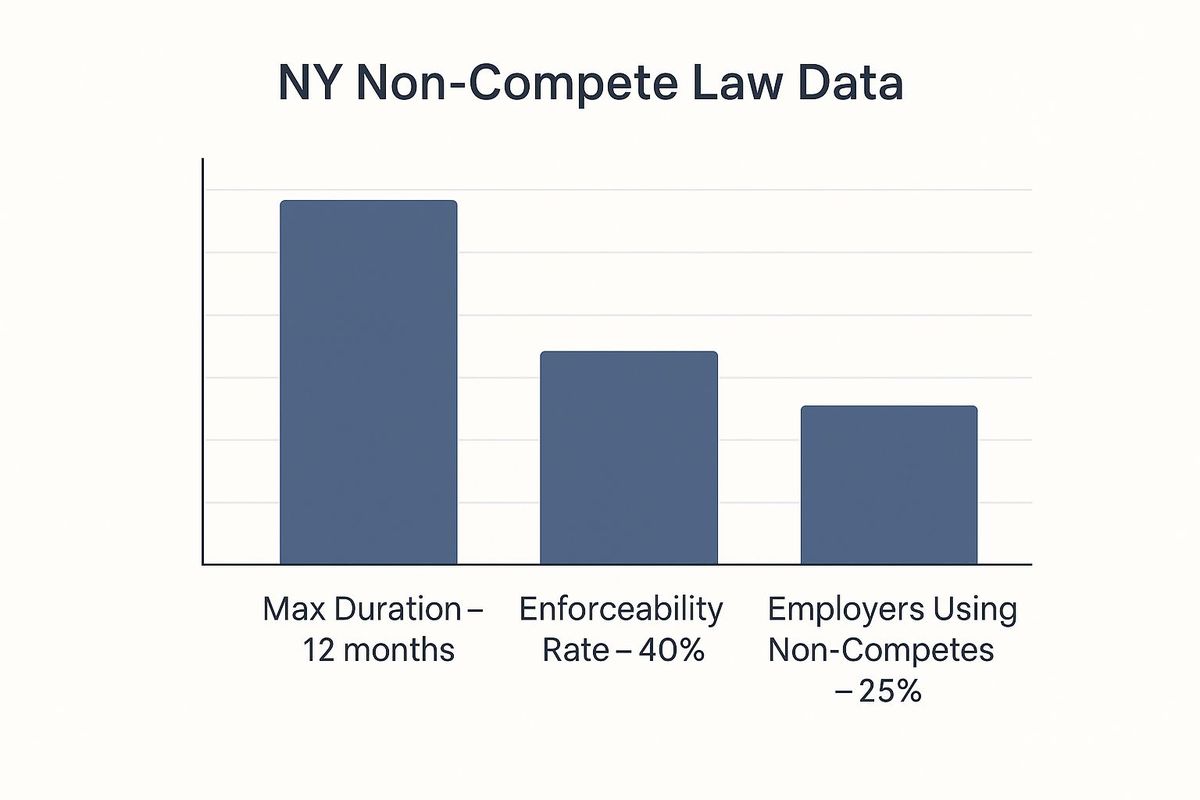
This kind of ambiguity is exactly what the new law is designed to eliminate, replacing a system of "maybes" with a clear "no."
New York Non-Compete Law Key Changes at a Glance
To really get a handle on how big this change is, it helps to see the old rules and the new framework side-by-side. The traditional approach was a delicate balancing act dictated by judges, while the new law draws a much brighter, clearer line in the sand.
Aspect Traditional Common Law Proposed New Law Framework Overall Status Enforceable if deemed "reasonable" by a court. Banned for the vast majority of workers going forward. Scope Judged on a case-by-case, unpredictable basis. Applies broadly to almost all employees and contractors. Key Test A complex "three-prong test" looking at business interest, scope, and employee hardship. A simple, straightforward prohibition. Employee Type Primarily covered salaried and hourly employees. Explicitly covers both employees and independent contractors.
As the table shows, we're moving from a subjective, court-driven system to a clear, statutory ban. For anyone doing business or working in New York, getting your head around these differences isn't just a good idea—it's absolutely essential for staying on the right side of the law.
How Courts Currently Enforce Non-Competes

While new laws might change the game for future agreements, countless existing non-competes are still governed by New York's traditional rules. When a dispute over one of these agreements lands in court, judges don’t just rubber-stamp it. Instead, they act like careful inspectors, examining the contract through a specific lens known as the “three-prong test” of reasonableness.
Think of this test as a three-legged stool. If any one of the legs is weak or broken, the entire stool—and the non-compete agreement—collapses. For an agreement to stand, it has to be fair to the employer, the employee, and the public. This judicial scrutiny is a cornerstone of the current New York non compete law, a system built on decades of case law rather than a single, written statute.
The First Prong: Protecting Legitimate Business Interests
First, a court asks: is this non-compete really necessary to protect the employer’s legitimate business interests? An employer can't simply stop you from working for a competitor out of spite or a desire to shut down the competition. They need a valid, concrete reason.
So, what actually counts as a legitimate interest? Courts generally recognize a few key areas:
- Protecting Trade Secrets: This is the secret sauce—literally, sometimes. It includes things like secret formulas, proprietary software code, or confidential manufacturing processes that give a company its competitive edge.
- Preventing Use of Confidential Information: This covers sensitive material like customer lists, pricing strategies, or internal marketing plans that aren't public knowledge.
- Leveraging Unique Employee Skills: Honestly, this is a high bar to clear. It only applies when an employee's skills are so specialized and extraordinary that their departure to a competitor would cause real, provable harm.
An agreement trying to protect general business knowledge or skills that are common in an industry will likely fail this first test. The interest must be truly special to the business.
The Second Prong: Reasonable Limits in Time and Geography
Next up, the court looks at the agreement's scope. Are the restrictions on time and geography reasonable? This is where many non-competes fall apart. An overly broad restriction looks less like a protection for the business and more like a penalty against the employee.
Imagine a local bakery in Brooklyn. A non-compete preventing a former baker from opening a new shop within a 10-block radius for six months might fly. But a clause stopping that same baker from working anywhere in New York State for five years? That would almost certainly be struck down as excessive.
The core principle is that the restriction should be no wider than necessary to protect the employer’s specific business interests. A global tech company might justify a broader geographic scope than a neighborhood hair salon, but the duration must always be tied to how long the protected information stays valuable.
The Third Prong: Avoiding Undue Hardship
Finally, the court considers the human element: does the non-compete impose an undue hardship on the employee or harm the public? This prong ensures that enforcement won’t prevent someone from earning a living in their chosen field.
If a non-compete is so restrictive that it forces a highly specialized software engineer to either move their family across the country or take a job outside their profession, a court will likely find it imposes an undue hardship. The law recognizes that people need to be able to use their skills to support themselves.
The impact of these agreements is huge, not just in New York but across the country. National data shows that around 14% to 18% of U.S. workers are bound by non-competes. These contracts are part of a long legal story, and their widespread use—which can limit job mobility and suppress wages—has fueled the recent push for reform. You can discover the full history of non-compete regulation to see how we got here. New York’s legal framework is just a modern chapter in this ongoing story.
The Proposed Changes and Who They Protect
The path a bill takes to become law can feel like a long and winding road, full of unexpected twists. The recent push to overhaul the New York non compete law is a perfect example of this. After an initial bill proposing a sweeping, total ban passed in 2023, the effort hit a major snag, forcing everyone back to the drawing board for a more targeted approach.
Understanding this legislative back-and-forth is crucial if you want to see where non-competes are likely headed. The first version was simple: ban them all. It didn't matter if you were an entry-level employee or a C-suite executive. But this "one-size-fits-all" idea immediately sparked concerns about its potential economic fallout.
Governor Kathy Hochul ultimately vetoed that first bill. She argued that while lower and middle-income workers definitely needed protection from these restrictive agreements, a blanket ban could unintentionally hurt New York's ability to attract and keep top-tier talent in hyper-competitive fields. The real challenge was to find a middle ground.
A More Targeted Approach
In response to the veto, lawmakers started over. This led to a new, more nuanced proposal designed to strike that critical balance. Think of it as creating a protective shield for the vast majority of the workforce while leaving different rules in place for the highest earners.
The new bill carves out specific exceptions, recognizing that not all non-compete situations are the same. The core idea is still to free most New York workers from these agreements. However, it also acknowledges that businesses might have a legitimate reason to use non-competes with people who have significant influence and access to high-level company strategy.
Who Is Considered a Highly Compensated Employee?
The new proposal draws a very clear line in the sand with a salary floor. Under this new bill, an employee is considered "highly compensated"—and could still be subject to a non-compete—if they earn $250,000 or more per year.
This salary cutoff is the key compromise. It effectively makes non-competes illegal for the overwhelming majority of New York’s workforce, from baristas and office managers to nurses and marketing specialists. At the same time, it gives businesses a tool they can potentially use to protect their secrets when hiring highly paid executives or elite specialists.
The new proposal essentially creates a two-tiered system. For most workers, non-competes would be off the table. For that small slice of high earners, the old legal tests of reasonableness would likely still apply.
This distinction is everything. It's a legislative attempt to aim the protections where they are needed most without completely disrupting the competitive landscape for businesses trying to recruit elite global talent.
What This Means for Existing Agreements
One of the most important things to know about this proposed law is that it is not retroactive. This is a big deal. It means the new rules, if passed, would only apply to non-compete agreements signed or changed after the law goes into effect.
If you signed a non-compete last year, it will still be evaluated under the old common law rules—that "three-prong test" of reasonableness we talked about earlier. The new ban wouldn't suddenly make your existing contract disappear. This "prospective-only" approach provides stability and avoids tossing millions of existing contracts into legal chaos overnight.
The debate in Albany really reflects a delicate dance between protecting workers and supporting business. As Senator Sean Ryan introduced the updated bill, the focus shifted to this balanced framework. It also clarifies that non-competes tied to the sale of a business are still fair game, ensuring the law targets employment contracts without hurting business acquisitions. You can read more about New York's evolving non-compete legislation to see the finer details of this compromise.
Smart Alternatives for New York Employers
With the legal ground constantly shifting under the traditional New York non compete law, smart employers are looking beyond these old-school agreements to protect their business. This isn't about throwing in the towel on security; it's about building that security on a much stronger, more modern, and legally sound foundation.
Think of it like swapping a single, heavy hammer for a complete, versatile toolkit. Instead of relying on one broad agreement that courts are liking less and less, you can use several specialized tools. These are more focused, more effective, and much more likely to hold up if challenged. It’s a strategy that not only protects your hard-earned assets but also helps build a better, more trusting relationship with your employees.
The Power of Non-Disclosure Agreements (NDAs)
The most direct way to protect your company's crown jewels is with a Non-Disclosure Agreement, which you'll often hear called an NDA or a confidentiality agreement. The difference is simple but crucial: while a non-compete tries to stop someone from working for a competitor, an NDA stops them from spilling your secrets, no matter where they end up working.
A good NDA is laser-focused on protecting specific, sensitive information that gives your business its competitive edge. This can cover a whole range of valuable assets:
- Trade Secrets: This is the real "secret sauce" of your business—things like a proprietary recipe, a unique software algorithm, or a one-of-a-kind manufacturing process.
- Confidential Information: This bucket holds things like your internal financial reports, future business plans, and sensitive market research.
- Client and Customer Lists: That list of clients you've spent years building, complete with their contact info and buying habits? That's a hugely valuable asset an NDA can and should protect.
Unlike a sweeping non-compete, a well-drafted NDA is narrowly tailored to protect information, not to restrict a person's ability to earn a living. That simple distinction makes it a much more powerful and enforceable tool in the eyes of a New York court.
Protecting Your Team and Client Base
Another incredibly useful tool in your kit is a Non-Solicitation Agreement. This contract is more specific than a non-compete and is built to solve two very distinct problems: preventing a former employee from raiding your staff and stopping them from poaching your clients.
A non-solicitation agreement doesn't stop someone from working in your industry. It just puts up a temporary fence around your most valuable relationships—your team and your customers—giving you breathing room to stabilize after an employee moves on.
For instance, you could have a clause that stops a departing sales director from contacting any of the clients they personally managed for one year. You could also prevent that same person from actively trying to recruit your other top salespeople to join them at their new company. These kinds of targeted restrictions are viewed as far more reasonable than a blanket ban on all competition.
Building a Stronger Foundation for Your Business
By shifting your strategy away from a heavy reliance on non-competes, you're not just complying with the law—you're building a more resilient and positive company culture. These alternative agreements aren't just legal paperwork; they're a core part of a bigger strategy for stable, long-term growth. They protect what really matters—your intellectual property and key relationships—without unfairly handcuffing an individual’s career.
For any entrepreneur or business owner, getting these protections in place right from the start is absolutely critical. Knowing how to structure your company legally from day one sets the stage for secure growth down the road. If you're in those early stages, our guide on starting a business in NYC is a great resource for putting these foundational legal safeguards in place. This kind of forward-thinking approach is what ensures your new venture is built to last.
Your Guide to Facing a Non-Compete Agreement

Getting handed a non-compete agreement can feel like a pop quiz you didn't study for. It's usually tucked inside a thick stack of new-hire paperwork and presented like it's just another standard form. But this is one document you should never sign on autopilot. Your future career flexibility could be on the line.
Instead of feeling intimidated, look at this as your first real chance to advocate for yourself. The trick is to slow down, actually understand what you're being asked to agree to, and remember that you have more power than you might think. A request to sign is the beginning of a conversation, not the end of it.
Think of it as giving the agreement a "contract health check." Just like a doctor checks your vitals, you're about to examine this document for clauses that are fair and reasonable versus those that are overly restrictive and could seriously sideline your career. Taking a calm, step-by-step approach will turn that anxiety into action.
Your First Steps After Receiving the Agreement
Before you do anything else, just pause and breathe. Don’t let anyone rush you into signing right then and there. It is completely reasonable and professional to ask for some time to look it over. A simple, "Thank you, I'd like to take a day or two to review this carefully," is a perfectly normal and acceptable response.
Once you have the document, your first read-through is just to get the lay of the land. Don't get hung up on the dense legal jargon yet. For now, just focus on understanding the core restrictions the company wants to place on you after you leave.
The most important thing to remember is that a signature turns a piece of paper into a potentially binding legal obligation. Taking the time to review it isn’t just smart—it’s your fundamental right as a prospective employee.
After that first pass, it's time to dig into the details. Grab a highlighter and start marking up the key terms. This is where you put on your detective hat, searching for the critical details that define the agreement's real-world impact on your future.
The Contract Health Check
Now, let's perform that health check we talked about. You're looking for the three most important "vital signs" of any non-compete. A problem with any one of these is a major red flag.
- Time (The Duration): How long does this thing last after you leave the company? In New York, courts tend to look sideways at anything over 12-24 months. A healthy duration is short and directly tied to how long the company’s confidential information actually stays relevant.
- Geography (The Location): Where does the agreement stop you from working? Is it a specific borough, all of New York City, or the entire country? The geographic area has to be narrowly tailored to where the company actually operates and has a real business interest to protect.
- Scope (The Prohibited Activities): What specific jobs or industries are off-limits? Does it stop you from working for any "competitor" in any role whatsoever, or is it specific to a position that could directly harm your former employer? Vague or overly broad definitions of "competition" are classic signs of an unhealthy, and likely unenforceable, clause.
How to Negotiate for a Fairer Deal
If your health check turns up some red flags, it's time to prepare for a negotiation. This isn't about being difficult or confrontational; it's about finding a reasonable middle ground. Start by figuring out your ideal changes. Do you want to shorten the duration from two years to one? Or maybe narrow the geographic limits from the entire East Coast to just the New York metro area?
When you approach your employer, frame your requests as collaborative problem-solving. Explain that you're excited about the job and committed to protecting their business, but you also need to make sure you aren't unfairly boxed in down the road. Proposing specific, reasonable changes shows you're being thoughtful, not just pushing back. By taking control of the process, you can confidently work toward an agreement that protects your new employer and your own professional future.
What Happens When a Non-Compete Is Breached
When someone breaks the terms of a non-compete agreement, it kicks off a series of legal moves and strategic choices for both the old employer and the employee. Getting a handle on this process is vital, because the fallout can be pretty serious. The first move almost always comes from the employer, who feels their business is on the line.
Let's imagine Alex, a sharp developer, leaves a small tech startup in Manhattan for a new gig at a direct competitor. The startup’s founder, convinced Alex’s new job violates the non-compete he signed, decides it's time to act. This doesn’t mean a lawsuit gets filed overnight. It’s usually a more gradual process, starting with a formal warning.
The Employer's First Move
The most common first step is for the employer’s lawyer to fire off a cease-and-desist letter. Think of this formal document as a shot across the bow. It demands that the employee immediately stop the alleged violation—in Alex’s case, to quit his new job—and warns that a lawsuit is next if they don't comply. It’s a serious warning shot intended to fix the problem without ever seeing the inside of a courtroom.
If the letter gets ignored, the employer might take it up a notch by seeking a preliminary injunction. This is a court order that temporarily stops the employee from working for the competitor while the main lawsuit moves forward. For an employer, getting an injunction is a huge victory, as it can stop the perceived damage in its tracks.
An injunction is like a referee hitting the pause button on the game. The court is essentially saying, "Hold on, nobody moves until we figure out if the rules were actually broken." For the employee, this means being forced to sit on the sidelines, out of their new job, until the case is decided.
The Employee's Defense Strategy
For the employee, getting that cease-and-desist letter is a make-or-break moment. It's not a time to panic, but it is a time to get strategic. This is where someone like Alex would start digging into his legal defenses against the enforcement of the New York non compete law. If you're in this boat, knowing how to respond to a cease-and-desist letter is the first, and most critical, step in protecting your career.
An employee can push back on a few different grounds. A very common defense is to argue that the agreement itself is flat-out unenforceable because it fails that three-prong test—meaning it’s unreasonable in its time limit, its geographic reach, or is just way too broad.
Another powerful defense is the "first material breach" doctrine. This legal strategy involves arguing that the employer actually broke the employment contract first. For instance, if Alex’s startup never paid him a bonus they promised, he could argue that they breached the contract first, which frees him from his obligation to honor the non-compete. This move cleverly flips the script, putting the employer's own actions under the microscope and potentially wiping out the entire agreement.
Frequently Asked Questions About NY Non-Competes

Even with a solid overview, it's the nitty-gritty details of New York non compete law that often trip people up. It's totally normal to have questions. Here are some quick, straightforward answers to the practical concerns I hear most often from both employees and employers.
I Work Remotely in New York for an Out-of-State Company. Does New York Law Apply to Me?
More than likely, yes. If you physically live and do your work in New York, our state’s courts are almost certainly going to apply New York law to your employment agreement. It doesn’t matter if your company’s headquarters is in Delaware, Texas, or anywhere else.
Now, your contract might have what's called a "choice of law" clause that points to another state's rules. But New York courts can—and will—ignore that clause if enforcing it would go against a strong public policy here. A potential new law banning non-competes is a perfect example of such a policy.
What Is the "Blue Pencil" Doctrine and Does New York Use It?
The "blue pencil" doctrine is a legal concept where a court can essentially edit a non-compete that goes too far, making it reasonable enough to enforce. Picture a judge taking out a blue pen and just crossing out the unfair parts of the agreement.
New York courts do have a version of this, but it’s not a blank check for employers to write sloppy contracts. A judge won’t completely rewrite a poorly drafted agreement from scratch. They might, however, chop an unreasonable time limit—say, from five years down to one—if they believe the original agreement was made in good faith.
But be warned: if a court thinks an employer was deliberately trying to lock an employee down with ridiculously unfair terms, it might just throw out the entire non-compete clause, declaring it totally invalid.
Can I Be Fired for Refusing to Sign a Non-Compete Agreement?
This is a tough spot for any employee. Under New York's current "at-will" employment laws, the answer is generally yes. An employer can fire you for refusing to sign a non-compete, as long as you don't have an employment contract that states otherwise.
This situation could change in a big way, though. If the proposed statewide ban on non-competes is signed into law, forcing an employee to sign one would become illegal. That would give you solid legal ground to refuse without the fear of being fired for that specific reason. For small businesses trying to keep up with these changes, our article on legal help for small businesses offers some valuable insights.
At Cordero Law, we specialize in demystifying complex legal issues to empower our clients. If you're facing a non-compete or need strategic counsel for your business, we're here to provide the personalized support and clear guidance you deserve. Visit us at corderolawgroup.com to learn how we can help.