Thinking about how to register a trademark name in the USA can feel like diving into a deep legal rabbit hole. But let's reframe that. Securing your trademark isn't just a legal task; it's one of the most fundamental business moves you can make to protect your brand's identity, its value, and its entire future.
It really boils down to the difference between just using a name and truly owning it.
Without federal registration, your brand is left exposed. I've seen it happen too many times: an entrepreneur pours years of hard work and marketing dollars into building a name, only to get a cease-and-desist letter from a company in another state that's been using a similar one. That's a nightmare scenario that can lead to expensive legal fights or, even worse, a full-blown, soul-crushing rebrand from square one.
Why Registering Your Trademark Is a Core Business Strategy
The fight for a unique brand name is more intense than ever. You’re not just competing for customers; you’re competing for the name itself. The sheer volume of applications hitting the United States Patent and Trademark Office (USPTO) tells the story.
In a recent fiscal year, the office was flooded with nearly 765,000 applications—a huge jump from the year before. You can dig into the latest trademark application data yourself to see how competitive it is. This isn't just a random spike; it’s a clear signal that smart entrepreneurs know they need to lock down their intellectual property early.
This is about more than just avoiding lawsuits. It's about building a real, tangible asset for your company. A federally registered trademark:
- Gives you nationwide legal ownership of your brand name.
- Puts the public on notice that the name is yours, which deters others from even trying to use it.
- Lets you use the powerful ® symbol, which instantly signals credibility and legal protection.
- Becomes a valuable company asset that you can one day sell or license to others.
My Two Cents: Stop thinking of trademark registration as an expense. It's a core investment in your brand's long-term health. It’s the legal armor you need to grow your business with confidence, knowing your most valuable asset—your brand identity—is secure.
Now, let's walk through the whole process. From the initial homework you need to do, to handling the inevitable post-registration paperwork, I'll give you the clarity you need to get this done. With the right approach, it's a process you can absolutely handle.
Before we dive deep, it helps to have a bird's-eye view of the road ahead. The trademark journey has several distinct phases, each with its own timeline and goals.
Here's a high-level summary of the key phases involved in registering a trademark in the USA.
Quick Guide to the Trademark Registration Journey
Phase Key Objective Estimated Timeline Preparation Conduct a thorough search to ensure your name is available and prepare all required application materials. 1-4 weeks Application Filing Submit your application to the USPTO through the TEAS (Trademark Electronic Application System). 1 day USPTO Examination An examining attorney at the USPTO reviews your application for legal compliance and potential conflicts. 6-10 months Publication & Opposition If approved, your mark is published for 30 days, allowing others to oppose its registration. 30 days Registration & Maintenance Your trademark is officially registered. You must file maintenance documents to keep it active. Ongoing (First filing at 5 years)
This table gives you a rough idea of what to expect. While the timelines can vary, understanding these stages will help you plan your strategy and manage your expectations from start to finish.
Completing Your Pre-Filing Homework

Your success with the United States Patent and Trademark Office (USPTO) often comes down to the work you do before you even think about filling out an application. I’ve seen it happen time and time again: an entrepreneur gets excited, rushes the process, and ends up with a swift rejection. That’s a surefire way to lose your non-refundable filing fee and a whole lot of time.
Let’s treat this like a pre-flight checklist. The single most important step is a deep, thorough trademark search. You have to be confident your name isn’t already in use or so similar to another brand that it would cause confusion. Your primary weapon here is the USPTO's own Trademark Electronic Search System (TESS). It's an incredibly powerful database, but it can be a bit clunky, so you'll need some patience.
A real search goes way beyond looking for an exact match. You have to think like the USPTO examiner. Look for names that sound alike, have similar meanings, or just create the same overall vibe. Let's say you want to trademark "Kwik Clean" for a cleaning service. You absolutely have to search for "Quick Klean," "Qwik Klyn," and any other phonetic variation you can dream up. A few Google searches and a check of state business registries are also smart to find any unregistered "common law" uses of the name.
Defining What You Are Protecting
Before you file, you need to be crystal clear on what you're actually protecting. This isn’t just about the name itself; it’s about the form it takes. You've got two main choices, and this decision has major consequences for your brand's future.
- Standard Character Mark (Word Mark): This is the big one. It protects the name itself, no matter how it’s styled. If you register "AURA COFFEE," you own that name whether you write it in a basic font like Times New Roman or a custom, elaborate script. This gives you the broadest possible protection for the words.
- Special Form Mark (Design/Logo Mark): This protects a specific design, which usually includes the name. If you have a cool logo with a sun graphic next to the words "Aura Coffee," this registration protects that exact visual combo. Crucially, it does not protect the words "Aura Coffee" on their own.
Most businesses I work with register the standard character mark first to lock down the name. Then, once the brand's visual look is more settled, they might file a second application for the logo. You can read a more detailed breakdown in our guide to trademarking a business name.
Key Insight: Filing for a standard character mark first is often the most strategic move. It gives you the flexibility to change your logo and branding over time without losing the core legal protection for your name.
Choosing Your Goods and Services Class
Last but not least, you have to tell the USPTO what goods or services your trademark actually represents. The government uses a system of 45 different "classes"—34 for goods and 11 for services—to categorize everything. You must file in the right class, and here's the kicker: each class you file for requires a separate fee.
Getting this wrong is a classic, costly mistake. For example, if you sell bags of coffee beans, that falls under Class 30 (for staple foods). But if you run a café that serves coffee, you'd file in Class 43 (for services providing food and drink). Same product, "coffee," but two totally different business activities and two different classes.
The USPTO has a helpful Trademark ID Manual to help you pinpoint the correct descriptions and classes for your business. Don't skim this part. Getting your class right is non-negotiable if you want a smooth application process.
A Practical Walkthrough of the USPTO Application
Okay, you've done the pre-filing homework. Now it's time for the main event: tackling the online application itself. This all happens on the USPTO's website through a system called the Trademark Electronic Application System, or TEAS. It can feel a little intimidating and formal, but trust me, with the right prep work, it’s completely manageable.
The first big decision you'll have to make right out of the gate is your filing basis. This is just a fancy way of telling the USPTO if you're already using your name out in the wild or if you're planning to soon.
Use In Commerce vs. Intent To Use
This choice is critical because it dictates what you need to submit with your application.
- Use in Commerce: You’ll pick this one if you're already selling products or services under your trademark. If this is you, you have to provide a "specimen" (more on that in a sec) and tell the USPTO the date you first used the mark anywhere and the date you first used it across state lines.
- Intent to Use (ITU): This is your option if you have a real, good-faith plan to use the mark but haven't launched yet. You won't need a specimen upfront, but you'll have to file one later on to get fully registered. This involves a separate form and another fee.
For a lot of startups and new brands, filing under ITU is a smart strategic play. It gets your foot in the door at the USPTO and locks in your priority date while you're still working on things like packaging, website design, or marketing campaigns.
Key Takeaway: An "Intent to Use" filing basically acts as a placeholder for your brand's rights. It establishes your spot in line, which can stop others who file after you from swooping in and claiming a similar mark while you're getting ready to launch.
Preparing An Acceptable Specimen
If you're filing based on "Use in Commerce," the specimen is your proof. And the USPTO is very particular about what counts. This isn't just a random picture of your logo; it has to show the trademark exactly as a customer would see it when they're about to make a purchase.
An internal company memo or a mockup on your computer? That won’t cut it. You need real-world evidence.
- For Goods (like t-shirts or coffee): Think photos of a tag sewn into a shirt, a label right on a coffee bag, or the actual product packaging. The mark has to be clearly visible on the item itself or its container.
- For Services (like business consulting or a hair salon): A screenshot of your website where the mark is shown near a description of your services is perfect. A digital ad or even a picture of your physical storefront sign works great, too.
Having all your information gathered and organized is half the battle, as this image really drives home.
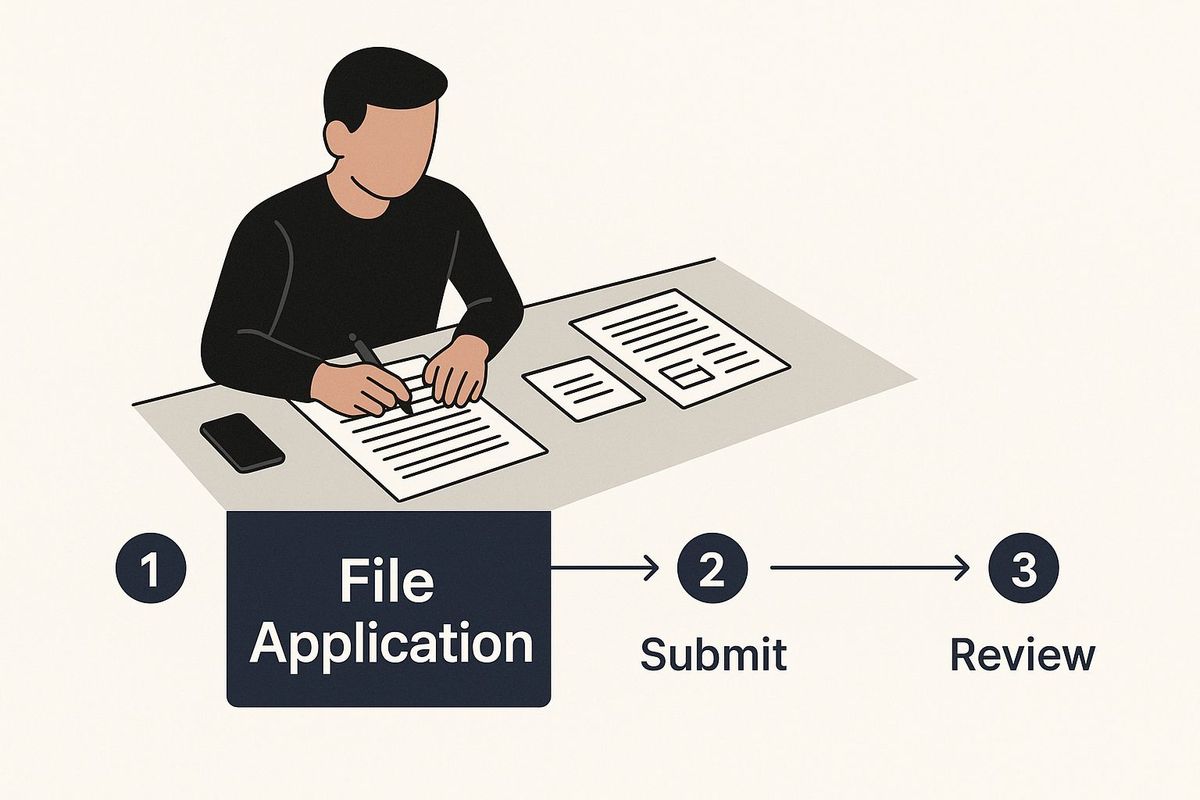
Getting your ducks in a row before you even log into TEAS makes the whole submission process smoother and less stressful.
Budgeting for Application Fees
Let's talk money. Figuring out the costs is a huge part of learning how to register a trademark name in the USA. The USPTO has a few different fee options, but it's the potential extra charges you really need to watch out for.
Understanding USPTO Application Fees
Below is a quick breakdown of the main costs and some common surcharges you might run into when filing.
Fee Type Cost Per Class When It Applies TEAS Standard $350 This is the most common filing fee. Processing Surcharge $100 Applied if you provide incomplete information and the USPTO has to issue a notice. Custom ID Surcharge $200 Applied if you write your own description of goods/services instead of using the pre-approved list.
These fees can stack up fast, especially if you're filing in multiple classes. The $200 surcharge for a custom description, for example, can be a painful surprise if you're not expecting it.
The best way to control your budget is to be prepared. When you do your homework upfront—having your classes figured out and your specimens ready—you can sidestep these kinds of penalties. A clean, complete application isn't just about avoiding headaches; it's your most direct and cost-effective route to getting registered. Remember, the quality of your initial search is crucial, a topic we dive into in our guide on how to do a trademark search.
What to Expect After You Submit Your Application

You’ve done the hard work, triple-checked everything, and finally hit “submit” on your TEAS application. It’s a great feeling, but now the real waiting game begins. I find this is often the most stressful part of the process for entrepreneurs, but knowing what’s happening behind the scenes can make it a lot more manageable.
Once you file, your application doesn't just sit in some digital purgatory. It gets put into a queue to be assigned to a USPTO examining attorney. This is a real person whose job is to meticulously review your application to make sure it complies with federal trademark law.
The Examination and Potential Office Actions
After a few months, the examining attorney will conduct their review. They’ll run their own search for conflicting marks and scrutinize every detail, like whether you chose the right class or if your specimen is acceptable. If you've nailed everything, you’ll get an approval notice. Fantastic. But in many cases—and I want to stress this is normal—you'll receive what's called an Office Action.
Don't panic. An Office Action is just a formal letter from the USPTO detailing legal problems with your application. It’s not a final rejection; it's an opportunity to fix issues or argue your case. Some of the most common reasons I see for an Office Action include:
- Likelihood of Confusion: The examiner thinks your mark is too similar to an existing registered trademark.
- Merely Descriptive: Your mark is viewed as simply describing a feature of your products (e.g., "Tasty Tacos" for a taco stand).
- Specimen Refusal: The proof you sent in doesn't correctly show your mark being used in commerce.
You’ll typically have six months to respond. If you don't, your application will be considered abandoned. This is where a clear, well-reasoned legal argument is absolutely critical.
Navigating the Timeline and Backlogs
Patience isn't just a virtue here; it's a requirement. The USPTO often has a massive backlog, sometimes with over half a million pending trademark applications. This logjam directly impacts your wait time. These delays underscore why it's so important to get your application right the first time, as any amendments will only prolong the process. You can even read about the challenges facing patent and trademark applicants on Lathrop GPM.
From the day you file to the day you hear from an examiner can take anywhere from 6 to 10 months, and sometimes even longer. It’s a long haul.
Key Takeaway: Receiving an Office Action is not game over. Think of it as the start of a dialogue with the USPTO. A thoughtful, legally sound response can often overcome the examiner's concerns and get your application back on the path to approval.
If your application gets the green light, it moves to the next phase: the publication period. For 30 days, your mark is published in the Official Gazette, a weekly USPTO publication. This gives the public a chance to formally object if they believe your registration would harm them.
If no one opposes your mark during that month, you're in the home stretch. Shortly after, you'll receive your official registration certificate.
What To Do After Your Trademark Is Officially Registered
Popping the champagne? Go for it. Getting that official trademark registration certificate is a huge milestone. It feels like the finish line, but in reality, it's the start of a whole new race: the lifelong job of protecting your brand.
It's a common mistake to think the work is over. I've seen it happen more times than I can count. Your focus has to shift from getting the trademark to keeping it alive and defending it. If you drop the ball here, you can lose everything you worked so hard for.
Don't Miss These Critical USPTO Deadlines
The United States Patent and Trademark Office (USPTO) needs you to prove you're still actually using your trademark. Think of it as a periodic check-in. These aren't just friendly reminders; they are hard deadlines you absolutely cannot miss.
Here’s the first one to put on your calendar right now:
- The Declaration of Use (Section 8 affidavit): You must file this between the fifth and sixth years after your registration date. You’re essentially submitting a sworn statement, plus a new "specimen" (proof of use), showing the mark is still in action for the goods or services you listed.
Once you clear that hurdle, the timeline gets a bit longer. You'll then need to file a combined Declaration of Use and Application for Renewal (known as a Section 8 and Section 9 filing) every ten years from your registration date.
My Two Cents: Seriously, put these dates in your calendar with about a dozen reminders. Missing a maintenance deadline is probably the single easiest way to have your federal trademark canceled. If that happens, you're back at square one, ready to spend all that time and money all over again.
Using and Defending Your Mark in the Real World
Now that you're federally registered, you've earned the right to use the coveted ® symbol. Don't underestimate this little guy. It packs a serious legal punch, putting the whole world on notice that this brand is yours and you will defend it.
You should start using the ® symbol wherever you can—on your products, packaging, website, and marketing materials. It’s a powerful signal that tells potential copycats to back off. Remember, before registration, you could only use TM (for goods) or SM (for services). The ® is exclusively for the big leagues of federally registered marks.
But it doesn't stop with a symbol. You have to be the guardian of your brand. This means actively keeping an eye on the marketplace for anyone trying to use a name or logo that's confusingly similar to yours. I recommend setting up alerts and doing regular searches to see what’s out there.
If you spot a potential infringer, the first move is usually to talk to an attorney about sending a formal cease-and-desist letter. Trust me, acting fast is crucial to shutting down a problem before it gets out of hand and damages your brand's reputation.
Common Questions About Trademark Registration
Even with a clear game plan, the road to registering a trademark can have some confusing twists and turns. Let's dig into some of the most common questions I hear from entrepreneurs and creators all the time.
How Long Does Trademark Registration Take?
This is usually the first question on everyone's mind. For a perfect, no-hiccup application, you might see an approval in 12 to 18 months.
But let's be realistic. The USPTO is dealing with serious backlogs, and getting at least one Office Action is pretty common. A more practical timeline for most people is somewhere between 18 to 24 months. The best shot you have at staying on the shorter end of that spectrum is to nail the application perfectly right from the start.
Can I Register a Trademark Myself?
Technically, yes. You're allowed to file a trademark application on your own—this is called filing "pro se." The USPTO's online portal is built for public use.
However, and this is a big however, this isn't just about filling out a form. It's a legal proceeding. A simple slip-up, like picking the wrong filing basis or submitting a website screenshot that doesn't qualify as a proper specimen, can get your application delayed or even rejected for good. If that happens, you don't get your application fee back.
Key Takeaway: Plenty of people file on their own. But if your brand is the most important asset your business has, getting professional help is a smart investment to make sure it's protected correctly.
What Is the Difference Between TM, SM, and ®?
You’ve definitely seen these symbols around. Knowing the difference is crucial because it tells the world about your legal rights.
- TM and SM: The TM (Trademark) symbol is for goods (like a t-shirt or software), while the SM (Servicemark) symbol is for services (like consulting or a cleaning service). Anyone can use these symbols to put the public on notice that you're claiming a mark as your own, even without a federal registration.
- ® (Registered): This is the one with real legal teeth. You can only use the ® symbol after the USPTO officially issues a federal registration certificate. Using it before you're officially registered is against the law.
Getting a handle on these symbols is just one piece of the intellectual property puzzle. For a deeper dive, you can learn about the crucial differences between a trademark and a copyright in our other guide.
What Happens If My Trademark Is Rejected?
First off, don't panic. Getting an Office Action from the examining attorney that raises an issue or rejects your mark isn't the end of the road. Think of it as the start of a negotiation.
You'll typically have six months to file a response. This is your chance to argue why your mark is eligible for registration or to make amendments to your application to solve the problem the examiner pointed out. It's a very normal part of the process.
At Cordero Law, we turn confusing legal jargon into clear, actionable advice. If you're ready to protect your brand but aren't sure where to start, we're here to guide you through every step. Schedule a consultation with us today and let's get your brand's future secured.