
Your domain name is so much more than a web address. It’s a foundational business asset. When you trademark that domain, you transform it from a simple URL into a legally protected piece of your brand identity. This gives you the exclusive right to use it for your goods or services nationwide.
Think of it as the legal shield that guards your online presence from competitors and copycats.
Why Trademarking Your Domain Is a Smart Move

Here's something a lot of people miss: simply registering a domain name with a service like GoDaddy or Namecheap doesn't give you any legal ownership of the brand itself. All it does is grant you the right to use that specific web address. The distinction is crucial.
Without a trademark, your business is left wide open.
Imagine a competitor launches a website with a slightly misspelled version of your domain—think "KidKrafts.com" instead of your "KidCrafts.com." They could easily siphon off your hard-earned traffic, confuse your customers, and tarnish the reputation you've worked so hard to build. A registered trademark gives you the legal power to shut them down.
From URL to Protected Asset
A trademark elevates your domain from a functional address to a valuable piece of intellectual property. This protection goes beyond just the .com version. If you own the trademark for "BrandName," you can stop others from using "BrandName.net" or "BrandName.org" in a way that creates consumer confusion.
This legal standing brings a few huge advantages:
- Nationwide Protection: Common law rights are limited to your geographic area. A federal trademark protects your brand across the entire country.
- Legal Recourse: It provides a much stronger foundation for legal action against anyone infringing on your name, making disputes easier and less expensive to resolve.
- Brand Credibility: Using the ® symbol signals to everyone that you are serious about protecting your brand. Trademarking your domain helps secure your identity, much like how using an email with a custom domain to boost business credibility reinforces your professional image.
To really understand the difference, let's break it down.
Domain Registration vs Trademark Protection
| Feature | Domain Registration Only | Trademarked Domain Name |
|---|---|---|
| Scope of Rights | Right to use a specific URL (e.g., yourbrand.com). | Exclusive right to use the brand name nationwide in connection with your goods/services. |
| Protection Against | No one else can register the exact same URL. | Competitors using confusingly similar names, logos, or domains. |
| Legal Power | Very limited. Disputes often fall under UDRP policy, which can be complex. | Strong legal basis for lawsuits, cease and desist letters, and stopping infringers. |
| Symbol Usage | None. | Allows use of the ® symbol, signaling legal ownership and deterring copycats. |
| Asset Value | The URL has resale value. | Becomes a valuable piece of intellectual property that can be licensed or sold. |
As you can see, simply owning the dot-com isn't enough to truly own your brand online.
Defending Against Online Threats
The internet is filled with brand impersonation and cybersquatting. These bad actors register domains similar to established brands just to profit from their reputation. The problem is massive. In a recent period, trademark owners from 133 countries filed a staggering 6,168 cases to combat domain name abuse—one of the busiest years on record.
By trademarking your domain, you create a legal fortress. It becomes your primary tool in fighting cybersquatters, preventing phishing schemes, and shutting down anyone trying to trade on your good name.
To qualify, your domain has to be used as a source identifier. This just means customers associate it directly with your products or services. Generic terms like "BestCarDeals.com" are much harder to protect than a distinctive, unique name.
For a deeper look into the relationship between these two critical assets, you might be interested in our guide on the interplay between https://www.corderolawgroup.com/blog/2025/trademark-and-domain-names.
Doing Your Homework Before You File

Jumping into a trademark application without doing your homework first is one of the fastest ways to get a rejection from the U.S. Patent and Trademark Office (USPTO). Trust me, a little prep work now will save you a ton of money and frustration down the road.
The first, most critical task is to run a thorough trademark search. This isn't just a quick Google search for your domain. You need to dig deep to make sure your name isn't "confusingly similar" to an existing trademark, especially one used for related products or services.
Performing a Knockout Search
Your first pass is what we call a "knockout search." The goal here is simple: find any direct conflicts that would immediately kill your application. The best place to start is the USPTO’s own database.
This free system, officially called TESS (Trademark Electronic Search System), lets you look for similar names, spellings, and even things that sound alike. It's powerful, but it can feel a bit clunky at first, which is why a lot of business owners get professional help. For a step-by-step tutorial, check out our guide on how to do a trademark search.
A solid search needs to cover:
- Direct Hits: Searching for your exact domain name.
- Variations: Looking for different spellings, plurals, and similar-sounding words.
- Industry Classes: Checking for similar marks within your specific category of goods or services.
Gauging the Strength of Your Domain
Not all domain names are created equal in the eyes of trademark law. How distinctive your name is has a direct impact on how easy it will be to protect. Marks generally fall into a few categories, from strongest to weakest.
- Fanciful Marks: These are completely made-up words. Think "Verizon.com" or "Kodak.com." They have no other meaning, which makes them the strongest and easiest to trademark.
- Arbitrary Marks: These are real words that have no connection to the product or service. A perfect example is "Apple.com" for computers.
- Suggestive Marks: These hint at what you do without explicitly describing it. "Netflix.com" (suggesting movies over the internet) is a classic case.
- Descriptive Marks: These directly describe a product, like "BestCarDeals.com." These are very tough to trademark unless you can prove they’ve gained "secondary meaning" over time—meaning customers associate that descriptive name specifically with your brand.
The key takeaway is that the more unique and less descriptive your domain is, the stronger your trademark rights will be. Generic terms are almost impossible to protect.
With global domain name registrations soaring past 368 million, the online space is more crowded than ever. This saturation makes picking a truly distinctive, trademarkable name a critical first step. This homework is foundational to the success of trademarking your domain and securing your brand’s future.
A Friendly Walkthrough of the USPTO Filing Process
Staring at the official application on the U.S. Patent and Trademark Office (USPTO) website can feel a bit intimidating. I get it. But filing for a trademark doesn't have to be a bureaucratic nightmare. If you have the right information ready to go, it's a surprisingly straightforward process.
Your entire journey will take place through the Trademark Electronic Application System, or as the cool kids call it, TEAS. This online portal is where you'll make your case to the USPTO. Try to think of it less as a dreaded government form and more as your brand's official introduction to the world.
This graphic really simplifies the whole journey, from that first bit of research all the way to keeping your mark protected for years to come.
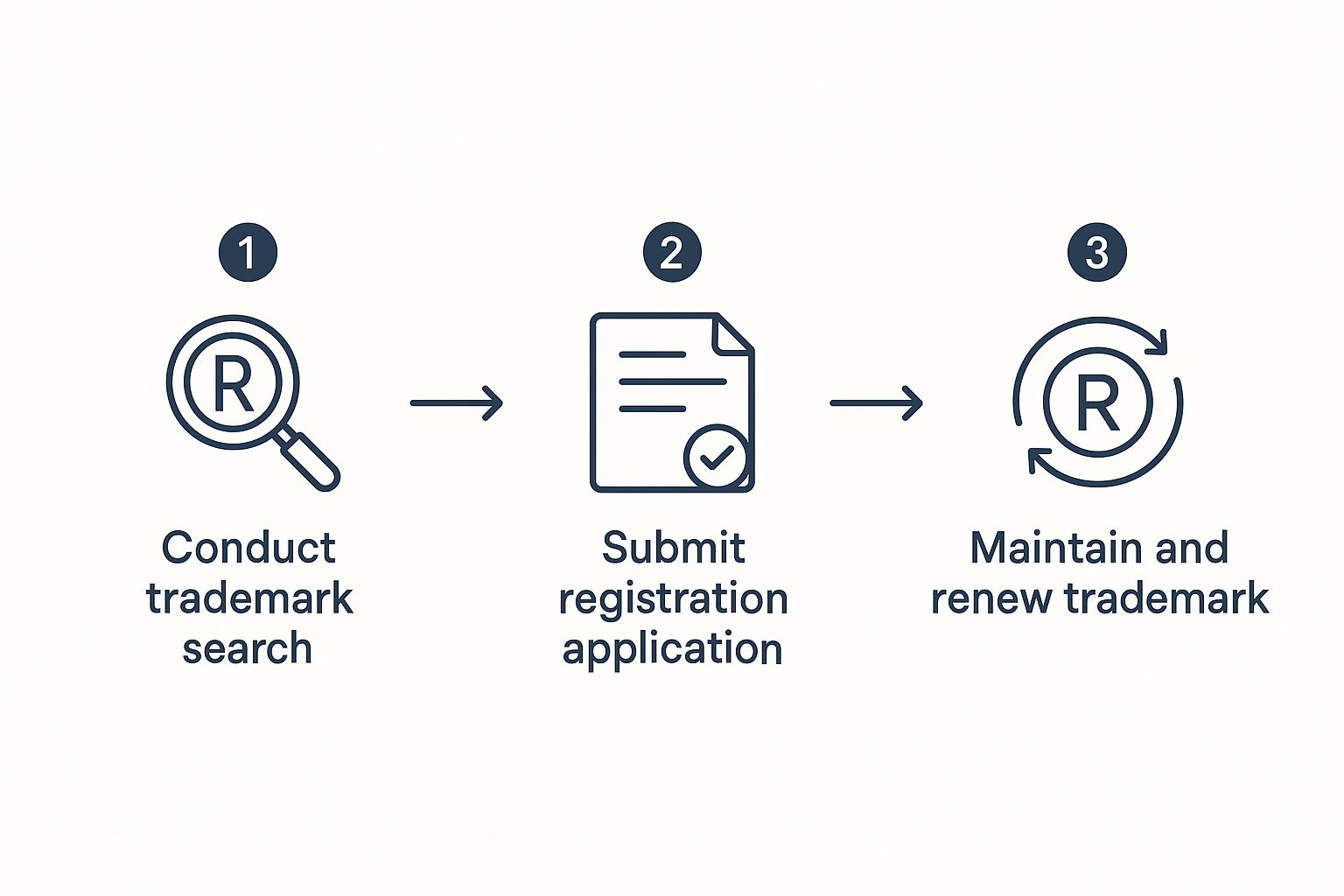
As you can see, the application is the pivotal step that connects your initial homework to the long-term security of your brand.
Getting Your Ducks in a Row First
Before you even click over to the TEAS portal, let’s get a few key items squared away. This will make the whole experience much, much smoother. One of your first big decisions is picking the right "class" of goods or services. The USPTO has everything imaginable sorted into 45 different classes, and you’ve got to pick the one that truly fits what you offer.
For instance, if you sell custom t-shirts on your website, you're likely looking at Class 025 for clothing. But if your domain is for a marketing consultancy, you'd be filing under Class 035 for advertising and business services. Nailing this is critical because it defines the entire scope of your trademark's protection.
The other non-negotiable piece you need is your specimen. This is your proof of use.
A specimen is just real-world evidence showing how you're using your domain name in commerce to actually sell your products or services. It's not just a logo—it has to show the mark in action.
For a domain name, the go-to specimen is a screenshot of your website. But it can't be just any old screenshot. It needs to clearly display your domain name being used as a brand, directly connected to the goods or services you're selling. A product page showing your branded domain with an "Add to Cart" button is the gold standard here.
Crafting a Winning Application
With your info gathered, it’s time to file. Inside the TEAS system, you'll see two main options: TEAS Plus and TEAS Standard. TEAS Plus is the cheaper route (around $250 per class) but it's more restrictive. You have to pick a pre-approved description of your goods from the USPTO's official list.
TEAS Standard costs a bit more (around $350 per class) but gives you the freedom to write your own custom description. Honestly, for most straightforward domain name filings, TEAS Plus is the best and most cost-effective path.
Mistakes here can be costly and cause major delays. It's easy to get tripped up, especially with the specimen. I've seen it happen more times than I can count.
Here’s a quick rundown of some of the most common filing errors people make and how you can sidestep them.
Common Filing Mistakes and How to Avoid Them
| Common Mistake | Why It Happens | How to Avoid It |
|---|---|---|
| Picking the wrong "class" | Rushing the process or misunderstanding the nuanced descriptions. | Use the USPTO's Trademark ID Manual to search keywords related to your business and find the perfect fit. |
| Submitting a weak specimen | Using mockups, internal documents, or screenshots that don't show a clear connection to a sale. | Take a screenshot of a live product or service page with your domain name clearly visible next to a "Buy Now" or "Add to Cart" button. |
| Filing as an individual vs. a business | Confusion over who the legal "owner" of the trademark should be. | If you operate as an LLC or corporation, the business entity must be listed as the owner, not you personally. Check your business formation documents. |
| Incorrectly formatting the mark | Submitting a standard character mark when you have a stylized logo, or vice versa. | Decide upfront: are you protecting the words (standard character) or the specific design (special form)? They are different filings. |
Taking a little extra time to get these elements right from the start will dramatically increase your chances of a smooth approval. You'll avoid frustrating back-and-forth with the USPTO and get that much closer to securing your digital brand.
The Waiting Game: What Happens After You Apply

You’ve done the hard work. Your application is in, your specimen is perfect, and you’ve officially hit “submit.” So… now what? This is the part of the process where you’ll need a healthy dose of patience. Your application doesn’t just vanish into a government black hole; it enters a very structured review pipeline at the U.S. Patent and Trademark Office (USPTO).
The first thing that happens is your application gets assigned a serial number and you'll receive a filing receipt. This is your official confirmation that you're in the system. From there, it lands in a queue to be reviewed by a USPTO examining attorney. This initial wait can easily take several months, so don't panic if you hear radio silence for a while. It's totally normal. The examiner's job is to make sure your application ticks all the legal boxes.
Navigating the Office Action
It’s extremely common to get a formal letter from the examiner known as an "Office Action." I tell my clients this all the time: this is not a rejection! Think of it more like a request for more information or a heads-up about a potential issue that needs sorting out before your mark can be approved.
An Office Action can pop up for all sorts of reasons:
- Specimen Issues: Maybe the screenshot you sent doesn't clearly show your domain being used to actually sell something.
- Likelihood of Confusion: The examiner might have found a pre-existing trademark they think is a little too close to yours for comfort.
- Descriptiveness: Your domain name might be seen as just describing the services you offer, rather than acting as a unique brand name.
Getting one can feel like a setback, but it’s a standard part of the game, especially when trademarking domain names. You'll typically have six months to put together a detailed response. Your goal is to lay out solid legal arguments or provide new evidence to overcome whatever objections the examiner raised. Honestly, this is a crucial step where having professional guidance can be the difference between approval and denial.
The Publication and Opposition Period
So, let's say the examining attorney is happy with your application (or your response to an Office Action). What's next? Your mark gets "published for opposition." This just means it appears in the USPTO’s weekly publication, the Official Gazette.
This kicks off a 30-day window where anyone who thinks your trademark would harm their own brand can legally object to your registration.
This opposition period is essentially a public notice. It gives other business owners one last chance to formally challenge your registration before it’s set in stone.
If no one files an opposition within that 30-day period, congratulations! You've cleared the final hurdle. The USPTO will move forward with registering your trademark, and your official registration certificate will be on its way.
From start to finish, the entire process can take anywhere from nine months to well over a year. My best advice? Check your status periodically through the USPTO's online system. It's a great way to stay informed without driving yourself crazy with the wait.
Putting Your New Trademark to Work
Securing a registered trademark for your domain name is a huge deal, but don't pop the champagne just yet—it’s not the finish line. A trademark is only as powerful as your willingness to defend it. Now, your focus needs to shift from registration to enforcement. It’s all about actively protecting the brand you've worked so hard to build.
This means you need to be vigilant. The responsibility for policing your mark falls squarely on you, not the USPTO. Consistently keeping an eye on the market is the only way to stop infringers before they can do real damage to your reputation or start confusing your customers.
Actively Monitoring for Infringers
So, how do you actually keep an eye out for potential copycats? It’s a mix of simple, regular searches and more structured monitoring. You should make it a habit to search for your brand name and any domain variations on search engines and social media.
Setting up alerts is a fantastic and low-effort way to get started:
- Google Alerts: This is a no-brainer. Create alerts for your brand name, your exact domain, and even common misspellings. You'll get an email whenever new content matching those terms pops up online.
- Social Media Monitoring: Don't forget social platforms. Periodically search hashtags and usernames on Instagram, X (formerly Twitter), and Facebook to see how people are using your name.
The digital marketplace is exploding, a trend you can see in the surge of global trademark filings. China, for instance, has submitted over 7 million applications in a single year, while the European Union has processed more than 500,000. These numbers show a massive global commitment to brand protection, and they highlight just how important your own monitoring efforts are. You can discover more insights about these global trademark trends to get the bigger picture.
Taking Action Against Infringement
Okay, so what happens when you find someone using a domain that's way too close to yours for comfort? Your first move is almost always to send a cease and desist letter. This is a formal document, ideally drafted by an attorney, that notifies the other party of your trademark rights and demands they stop using the conflicting domain. It’s a professional, direct way to handle the issue without immediately jumping into a lawsuit.
A well-crafted cease and desist letter resolves a surprising number of these disputes. It signals that you're serious about protecting your brand and are prepared to take further steps if needed.
If the infringer is a cybersquatter—someone who grabbed the domain in bad faith just to profit from your brand—you have a powerful tool: a Uniform Domain Name Dispute Resolution Policy (UDRP) complaint. This is a streamlined, cost-effective process designed specifically to resolve clear-cut cases of domain name abuse without a long, drawn-out court battle.
By actively monitoring your mark and enforcing your rights, you ensure that trademarking your domain name gives you the powerful, real-world protection your business deserves. For more details on the entire process, check out our comprehensive guide on trademarking a domain name.
Your Trademark Questions Answered
After digging into the process, you probably have a few specific questions still swirling around. Let's tackle some of the most common ones we hear about trademarking domain names to give you that extra bit of clarity.
The details can feel a little tricky, but the answers are usually more straightforward than you might think. We've gathered the most frequent "what-ifs" to help you feel confident moving forward.
Can I Trademark a Domain That Is Just My Name?
Yes, but it's a bit more involved. To trademark your own name, you have to prove it has achieved "secondary meaning." This is a legal way of saying the public directly connects your name with your specific products or services, not just you as an individual.
Think of someone like Tim Ferriss. "TimFerriss.com" is so strongly linked to his brand of books, podcasts, and business advice that it clearly functions as a trademark. He's crossed that threshold from just being a person to being a brand.
What Is the Difference Between the ® and ™ Symbols?
This one's a big deal. You can use the ™ (trademark) symbol anytime to show you're claiming a brand name as your own, even before it's officially registered. It's essentially like calling dibs and putting others on notice that you see this name as your property.
The ® (registered) symbol, on the other hand, is the real deal. It’s legally protected and can only be used after the USPTO has officially approved your trademark registration. Using it before you get that certificate is illegal.
So for your domain, you'd use ™ while you wait for approval and switch to ® after you get the green light.
Key Takeaway: Use ™ to claim your rights from day one, but only use ® after you have an official registration certificate in hand from the USPTO.
How Long Does a Domain Name Trademark Last?
A U.S. trademark can potentially last forever, as long as you keep up with it. It’s not a one-and-done deal. You must file a Declaration of Use with the USPTO between the 5th and 6th years after registration to prove you're still using the mark in business.
After that initial check-in, you have to renew it every 10 years. As long as you keep up with these filings and fees and continue to actually use the domain for your business, your protection remains active indefinitely.
Does My .com Trademark Protect Me from Someone Using .net or .org?
Generally, yes. Trademark law is all about preventing consumer confusion. If another business uses your exact brand name with a different top-level domain (TLD) like .net or .org to sell similar stuff, it would almost certainly be considered infringement.
Your trademark rights protect the brand itself—the name, the logo—not just the specific web address. This gives you the power to enforce your rights across different TLDs to shut down copycats trying to benefit from your hard work.
For specific situations, it’s always smart to get advice tailored to you. When it's time for deeper legal strategy, consider consulting legal marketing experts who can connect you with specialized attorneys.
At Cordero Law, we specialize in turning your brand's potential into protected assets. If you're ready to secure your online identity with confidence, reach out to us for a consultation at https://www.corderolawgroup.com.